We'll Know If It Works Once We've Done It: The Gambling Commission's Guide to Evidence-Based Policy
Tim Miller has explained that evaluation must follow implementation. This is, apparently, how regulation works now.
GAMBLINGPOLITICS
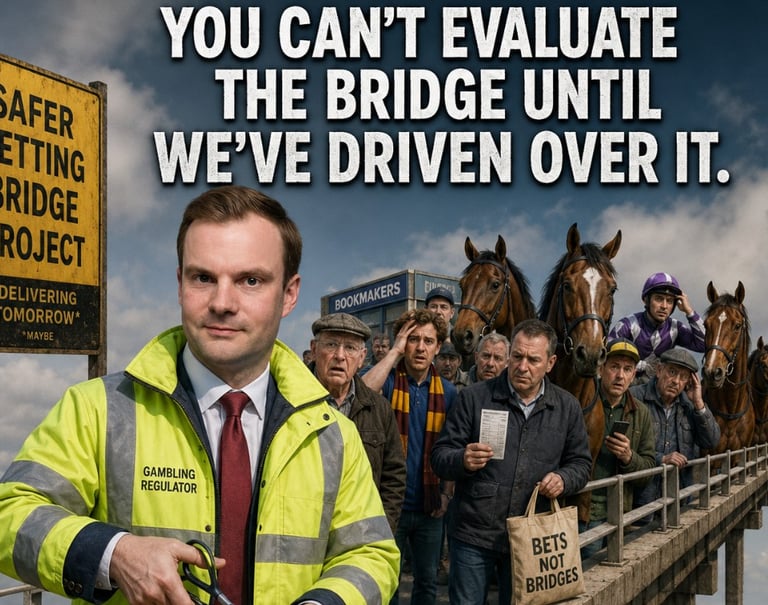
There are sentences that should come with a small brass plaque, so future generations can gather around them in museums and ask, in hushed tones, how a functioning state ever survived people saying such things in public. Tim Miller, the Gambling Commission’s Executive Director of Research and Policy, produced one of these at the CMS gambling conference in London. Asked about the resignation of James Noyes — who had spent a considerable chunk of his professional life trying to make affordability checks intellectually respectable, before concluding that the Commission was about to implement them without proper independent evaluation — Miller replied: “You can’t evaluate something until you have implemented it.” Well then. That’s science sorted.
For centuries, mankind has been labouring under the absurd delusion that one might test an idea before unleashing it on the public. Trials, pilots, modelling, counterfactuals, control groups, impact assessments — all that fussy Enlightenment clutter can now be pushed into the skip alongside phrenology and the Betamax. The new doctrine is much simpler. First you do the thing. Then, once the thing has happened to everyone, you find out what the thing did.
It has a refreshing simplicity, like solving a house fire by waiting to see which rooms are still standing.
Imagine this principle being applied elsewhere. A bridge inspector explains that structural integrity cannot truly be assessed until the bridge has collapsed into the estuary. A medicines regulator says it would be premature to evaluate a drug before a meaningful number of people have swallowed it and begun glowing in the dark. An aviation authority insists that crash data is, by its very nature, only available after the crash. In each case the logic is exactly the same. In each case, the official responsible would be introduced to a cardboard box, security pass removal, and a very quiet meeting with HR.
But in gambling regulation, apparently, this is now a methodology.
Miller was also asked about the Commission’s own past enforcement material, in which operators were shown demanding financial documents from customers to prove they could afford their betting. Payslips. Bank statements. The whole municipal apparatus of means-testing, applied not to a mortgage, a care home place, or a Treasury bailout, but to the ancient British pastime of sticking £20 on a horse that has already decided, spiritually, to finish seventh. His answer was that the compliance report in question was “published a long time ago.”
This is true in the same sense that a dented lamppost is “historical street furniture”. The report was published around 2019 to 2020, which is indeed not this morning. But it was also the Commission’s own document, produced under its own authority, and cited by operators trying to work out what the regulator actually wanted from them. If the Commission’s position is now that its own enforcement output has exceeded its sell-by date, that is interesting. Will operators be permitted to say the same thing when they are next hauled up for failing to interpret yesterday’s regulatory mood music correctly? One suspects not. “I think we’re in a place now,” Miller said, “where we shouldn’t need to have to rely upon things like payslips and things like that in 2026.”
Splendid. A breakthrough. Somewhere, a recreational punter who has recently been asked to upload proof of income to a gambling operator’s compliance portal will be thrilled to learn that the institution whose shadow sits behind this process has now reached the view that perhaps it is all a bit much.
The timing is the funny part. Not funny-ha-ha, obviously. Funny in the way it is funny when the council digs up the same road three times in a month because the water people, fibre people, and gas people have discovered the concept of calendars only in theory. First the Commission creates the incentives. Then operators respond to those incentives. Then customers are annoyed by the resulting document chase. Then the Commission announces that, actually, perhaps payslips are not the future after all. This is not regulation. It is a man assembling a parachute while reading the instructions aloud on the way down.
What Miller seemed to be suggesting, through the usual fog machine of conference language, is that the Commission knows the current position is not coherent, knows the old thresholds may no longer make sense, knows the documentation burden has become politically and commercially toxic, and would very much like everyone to join hands and “jointly create” some guidance.
Jointly create. There it is: the modern bureaucratic hymn. Nobody decides anything any more. They co-produce, co-design, collaborate, engage, consult, workshop, reflect, iterate and emerge six months later with a 47-page PDF explaining that all stakeholders are on a journey.
The operators, meanwhile, have some fairly basic questions. What are they supposed to do? At what threshold? Using what data? With what safeguards? For what purpose? To achieve what measurable outcome? These are not hostile questions. They are not the deranged mutterings of men in tweed who believe the nanny state is coming for their accumulator. They are the questions any regulated business asks before a regulator tells it to interfere with customer accounts.
Normally, these matters are settled before the policy arrives. That is, traditionally, the charm of having a policy. It is a thing with edges. It has a beginning, an end, a test, a rationale. The Gambling Commission’s version appears to have the consistency of warm porridge and the constitutional certainty of a parish council séance.
Then came the May 21 board meeting, which Miller said had been turned into something “akin to giving royal assent to a piece of legislation when it’s nothing of the sort.”
This may be right. Perhaps critics have over-interpreted the significance of the meeting. Perhaps the industry, the BHA, and a recently resigned adviser have all misunderstood the Commission’s intentions. But if every informed observer has misread the situation, the problem may not be that everyone else is hysterical. It may be that the Commission’s communications strategy is being run through a kaleidoscope.
Because what has emerged is not reassuring. It is a portrait of an institution wedged between political instruction and operational reality, moving with all the grace of a shopping trolley trapped in a revolving door. The Commission has been told to pursue affordability checks. It knows the policy is controversial. It knows the practical thresholds are disputed. It knows intrusive document requests are unpopular. It knows the sector believes it is being asked to enforce a half-formed doctrine. It knows one of its advisers has resigned noisily enough to make the curtains twitch.And its answer is: we shall evaluate it once it exists.
The Gambling Commission exists to make gambling safer and fairer. It has a statutory mandate, a sizeable staff, and one of the world’s most sophisticated online gambling markets to supervise. Yet on its flagship consumer-protection policy, it seems to have arrived at a position only marginally more advanced than throwing a chair into a lake and measuring the splash. British racing estimates the experiment could cost it £250 million over five years. The Commission, presumably, will have a clearer view of that figure after the money has vanished. This is the great advantage of post-event evaluation. It is always highly accurate about the wreckage.
And so we arrive at the central genius of the thing. You cannot evaluate affordability checks until they have been implemented. You cannot know whether they work until punters, operators, racing, compliance departments, and the black market have all had a chance to respond. You cannot measure unintended consequences until they have stopped being unintended and started being consequences. In the old days, this was called guessing. Now it is called regulation.
The Commission awaits your cooperation with the evidence base.