Vouchers for the Velvet Rope
The BHA’s new Training Fees Credit Scheme is not stupid, which in racing administration now qualifies as genius. But a sport with a thinning base will not save itself by offering a rebate to the people already standing in the best enclosure.
HORSE RACINGSPORT
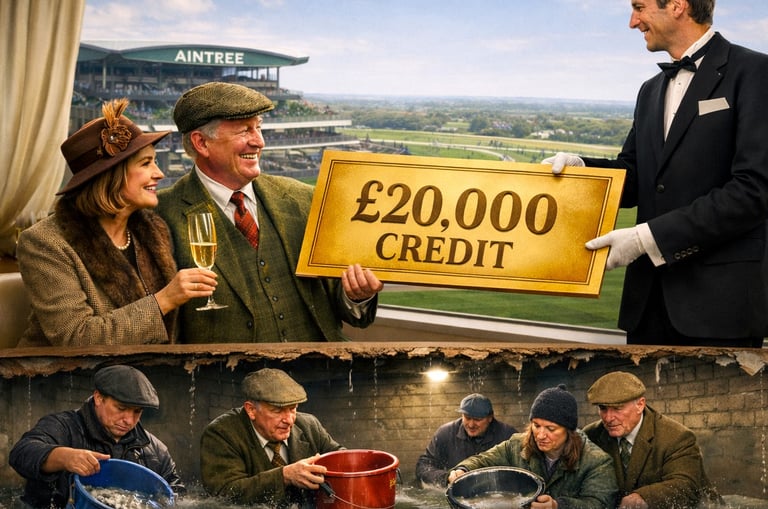
There are few sights in British public life more touching than an official body unveiling a modest incentive and behaving as though it has redrawn the map of Europe. The British Horseracing Authority has announced its new Training Fees Credit Scheme: winners of Grade 1 hurdle and chase races in Britain during March and April receive £20,000 in training-fee credits, with £10,000 for runners-up, to be used on a new British-trained jumps horse. The language around it is the usual state-sponsored porridge of support, confidence, innovation and ecosystem — the sort of words produced when nobody wants to say, plainly, that the sport is losing depth and is trying to stop the bleeding with a branded handkerchief.
To be fair — and fairness is always more lethal than hysteria — this is not an idiotic idea. Racing has produced enough truly idiotic ideas over the years to make basic coherence look like statesmanship. At least this scheme is aimed at behaviour. It tries to influence a decision point: where an owner places the next horse. That is more intelligent than the old industry custom of issuing a statement, convening a panel, and then watching another useful young horse disappear across the Irish Sea while everyone adopts the expression of a butler who has dropped the soup.
The people least in need of persuasion
But the central absurdity lumbers into view almost at once. This is a scheme aimed at owners of Grade 1 horses. In other words, people already operating at the summit of the game. These are not, generally speaking, citizens on the brink of flogging the heirlooms to keep the dream alive. They are not examining the weekly feed bill as though it were the terms of surrender at Versailles. British jumps racing has a grassroots problem, a pipeline problem and, above all, a confidence problem among ordinary owners. And the BHA’s answer is to send a coupon to the owners’ box.
There is something magnificently racing about that. The roots are weakening, so naturally the authorities have chosen to polish the chandelier. The basement is flooding, so out comes a tasteful penthouse discount. One can almost picture the committee. “The broad ownership base is nervous and shrinking.” “Yes, but have we considered making a wealthy Grade 1 owner feel slightly more warmly encouraged?” It is the logic of a stately home collapsing into the moat while the trust announces a new subsidy for silver polish.
The defence, of course, is that this is about keeping better horses in Britain. Quite right. If a major owner wins a top race and then decides the next expensive recruit should be trained here rather than elsewhere, that is a positive. If it encourages a few new relationships between elite owners and British trainers, good. If it keeps several better prospects in the domestic system, also good. Nobody sensible should sneer at a measure simply because it may do some good.
But one must call it what it is. This is a top-end incentive for people already deeply embedded in the sport, not a genuine programme of renewal. It may affect where quality horses are placed. It does not seriously address why the wider ownership ladder feels increasingly steep, slippery and faintly deranged to those lower down it.
The real problem is lower down the ladder
And that distinction matters because the health of a jumps code is not created in the winner’s enclosure. It is created in the mud, in the middle market, in the vague madness of people who still believe owning a horse might be an adventure rather than a form of outpatient financial treatment. Quality at the top is the final expression of confidence lower down. First-time owners, small partnerships, syndicates, patient trainers, store-horse buyers, breeders, point-to-point people — these are not decorative extras in the story. They are the story. They are the layer from which future stars eventually emerge.
That is the real structural insight racing keeps ducking. It does not have merely an elite-horse retention problem. It has a replenishment problem. A top horse only becomes a top horse because there is a functioning ecosystem beneath him producing risk, optimism, churn and opportunity. If fewer people enter that ecosystem, or stay in it, or progress through it, then the upper tier eventually thins, no matter how many boutique incentives are draped over the top like bunting over a sinkhole.
Sports and industries alike make this mistake when they become too obsessed with visible prestige. They start tending the showroom and ignoring the factory. They confuse the preservation of excellence with the cultivation of conditions that produce excellence. British jumps racing is in danger of becoming a heritage display of itself: marvellous winners, famous meetings, great silverware — but with a narrowing social and economic base underneath, like a cathedral balanced on matchsticks.
The scheme’s value reflects that problem. £20,000 is real money. Only an idiot, or a racing administrator, would pretend otherwise. But in the economics of elite ownership it is an inducement, not a transformation. It may influence location. It is much less likely to determine purchase. These owners were not one bad month away from abandoning the sport and taking up bowls. So while the sum is useful, it should not be inflated into an act of strategic brilliance. It is a nudge, not a rescue.
A rebate is not a rebuilding plan
This is where racing’s official imagination keeps betraying itself. It loves an initiative that looks neat on paper, because neatness is the natural religion of bureaucracy. A scheme can be announced, measured, branded and praised. It creates movement without necessarily creating change. And that is the danger here: the presentation flatters the sport into believing it has taken a strategic step when it has really just subsidised behaviour at the margins.
A serious repair programme would begin somewhere less glamorous and more useful. It would ask why small and medium owners feel less secure. It would look at training-fee pressure, ownership retention, syndicate viability, the route from store sales into training, and whether the economics for developmental operations still make sense. It would ask how Britain produces more future Grade 1 horses, not merely how it rewards the people fortunate enough already to own one. That is harder, less photogenic work. It does not lend itself to triumphant press releases and flattering launch copy. But it is the work that matters.
Instead, the sport keeps trying to solve structural decline with boutique incentives. It is like a man attempting to repair a collapsed roof by aggressively polishing the chimney pot. Or like a government confronting a falling birth rate by offering free champagne to dukes. There is always a scheme, always a targeted intervention, always some jargon-rich assurance that confidence is being restored. Yet the deeper truth is that confidence is rarely restored by being told it exists. It is restored when people lower down the chain can do the arithmetic without laughing in a haunted way. So yes, let us be fair: this scheme is better than nothing. It is sharper than the usual slurry of official waffle. It may keep some useful horses in Britain and some useful owners engaged. Fine. Give it that.
But British jumps racing will not be rebuilt by offering vouchers to people who already own Grade 1 horses and calling it renewal. That is not rebuilding the pyramid. That is offering concierge service while the scaffolding gives way. The sport does not need more applause for tidy top-end gestures. It needs confidence, viability and ambition lower down, where tomorrow’s quality actually comes from.
Until then, this remains what it is: a respectable little rebate for the best-seated people in the room, presented as though it were a philosophy of national recovery. Which is to say, racing in perfect miniature.