Through a Glass, Darkly: The Systematic Sabotage of British Horseracing.
The Systematic Opacity of British Horseracing — and Why It Serves Everyone Except the Sport
HORSE RACINGPOLITICSBUSINESS
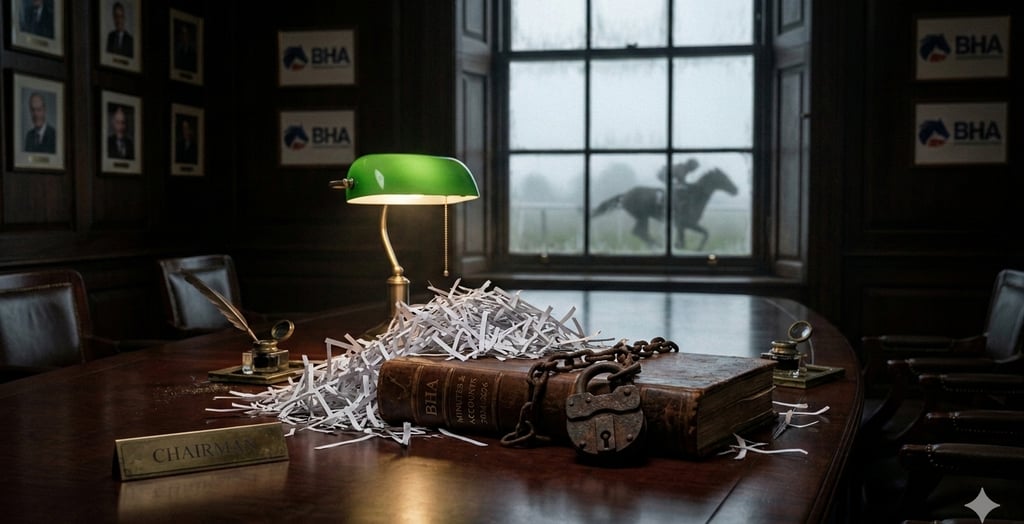

Prologue: The Man Who Came to Dinner and Left Before the Starter
Yesterday, Lord Charles Allen resigned as Chairman of the British Horseracing Authority after six months. The man delivered the Manchester Commonwealth Games and helped land London 2012, but British racing defeated him in less time than it takes a Flat horse to go from breeze-up to the July Sales. His crime was arriving with a torch in a building whose occupants have spent decades ensuring the fuse box stays disconnected.
Lord Allen took the role on the explicit condition that member organisations — the Racecourse Association, Racehorse Owners Association, Thoroughbred Breeders’ Association and Licensed Personnel — would support an independent board. They agreed unanimously. Then unanimity evaporated. The turkeys voted for Christmas, thought about it over the weekend, and decided they preferred the traditional arrangement of not being eaten. The question nobody asks is whether Lord Allen was recruited to succeed or to absorb the blame for a failure structurally guaranteed before he accepted the role. Within minutes, the Jockey Club and Ascot, Goodwood, Newbury and York demanded urgent RCA governance reform. Nick Luck called it ‘one of the sorriest episodes in the governance of the sport.’ The speed of this reaction — immediate, coordinated, pre-drafted — tells its own story. If they saw it coming, why didn’t they prevent it? Because under the RCA’s one-member-one-vote constitution, the courses with most to gain from reform are outnumbered by those with most to lose.
Lord Allen’s departure should not obscure the deeper pathology. British racing suffers from a systematic, structurally embedded refusal to allow those who fund it, work in it, bet on it and love it to see how it operates and whose interests it serves. What follows catalogues that opacity, maps the corporate structures sustaining it, and asks: cui bono?
1. The Cast List: A Corporate Taxonomy of Unaccountability
The British Horseracing Authority is a private company limited by guarantee (Companies House No. 02813358), not subject to FOI, receiving no government funding, outside the National Audit Office’s purview. Despite wielding regulatory powers over a £1.5 billion industry, it operates with less statutory accountability than a parish council. It is a textbook case of regulatory capture: a regulator whose board is appointed by the organisations it is supposed to govern. In financial services, utilities or telecommunications, this would be a scandal. In racing, it is called governance.
The BHA’s governance requires unanimity among member organisations to amend the Articles. Each member retains a veto. Any reform threatening any stakeholder can be killed by one dissenting voice. This is not accidental. It is a governance structure whose primary function is preservation of the status quo, dressed in the language of consensus. And it is worth being precise about responsibility: DCMS, as the sponsoring department for the HBLB and the body that could refer racing’s governance to Parliament, has watched this dysfunction for two decades and done nothing. The department’s passivity is not neutrality. It is complicity by omission.
The Horserace Betting Levy Board is a statutory body whose seven members are appointed by the Secretary of State (three), the Jockey Club (three) and the Betting and Gaming Council (one). No seat for punters, owners, trainers or breeders. The chair since July 2025 is Roger Devlin, former chairman of William Hill. The BGC directly appoints Simon Clare. Between the bookmakers and the Jockey Club’s racecourse-aligned nominations, the intermediaries hold effective control of the body that decides what the rest of the sport may know.
The Jockey Club operates fifteen racecourses under Royal Charter, answerable principally to itself, appointing 43% of the Levy Board. Arena Racing Company (Companies House No. 07997040), owned by the Reuben Brothers through the British Virgin Islands, operates sixteen racecourses and 39% of all fixtures, runs three of five all-weather tracks, holds a stake in Sky Sports Racing, and does not file consolidated accounts. Combined turnover exceeds £264 million. The RCA operates one-member-one-vote: ARC’s sixteen courses carry sixteen votes against Ascot’s one. RMG distributes £113 million with no per-course breakdown. This is not a governance structure. It is an ecosystem evolved to resist scrutiny.
2. The Levy Board’s Most Expensive Secret — and the Bookmakers’ Veto
The HBLB collects £109 million per year from a statutory 10% levy. This is public money collected under compulsion of law. Now ask the simplest question: how much levy does each race generate? The HBLB collects precisely this data. Its Data Collection Partner tender specified collection of race-by-race turnover and gross win data — roughly one million items per annum. Alan Delmonte described it as ‘invaluable in enabling HBLB to assess the performance of races.’ Invaluable. His word, not mine.
But the data is provided on a ‘voluntary and confidential basis.’ Those five words are the lock on the door. The bookmakers do not wish it released. Pause on this, because it is one of the most remarkable exercises in logical inversion in the governance of any British industry.
The HBLB has accepted this as a law of nature rather than a choice. It is not. The levy is collected under statutory compulsion regardless. The HBLB could require this data or commission its own collection. Instead it accepted the bookmakers’ terms. This is a policy choice serving the bookmakers’ interests at the expense of every other actor in the sport. And it reveals something important: the bookmakers benefit from racing’s ignorance. A sport that cannot measure the economic value of its own fixtures cannot negotiate effectively on levy distribution, media rights or fixture planning. The information asymmetry is not a side effect of the current arrangements. It is their purpose.
The bookmakers are intermediaries. They do not breed, train, ride or own the horses. They take bets on a product created entirely by others and pay 10% back under compulsion. Their role is that of the tollbooth operator, not the road builder. Yet it is the tollbooth operators who have a veto over whether the road builders may see how much traffic uses each stretch of road — and the body that granted this veto is chaired by a man who ran the largest tollbooth in the country.
Without race-by-race data, nobody can determine whether Monday evening at Wolverhampton generates a net return for the sport or simply dilutes the product whilst enriching ARC and the media rights distributors. Nobody can assess whether the fixture split between Premier and Core is calibrated to betting demand, or whether the Levy Board’s allocation of tens of millions represents optimal distribution or the path of least institutional resistance. The structural disenfranchisement of the betting public from the governance of betting-funded institutions is one of the most under-examined democratic deficits in British sport. The millions of punters whose wagers generate the £109 million have no seat on the HBLB and no access to the data. If the levy is functionally a tax on punters — collected by statute, spent by a public body — then its governance should meet the standards of any other compulsory levy: representation, transparency, accountability. It meets none of them. The people who sell access to the river have been given authority over whether anyone else may measure its depth. If racing wished to serve its participants rather than its intermediaries, this data would have been published years ago.
3. BHA Board Minutes: A Masterclass in Performative Openness
In January 2020, the BHA agreed to publish summary minutes. This was heralded as a transparency initiative. It was institutional comedy: one suspects Sir Humphrey had a hand in the proposal.
The ‘summary minutes’ are summaries in the sense that a photograph of an envelope is a summary of the letter inside. No dissent recorded, no evidence base disclosed, no financial analysis underlying budget choices, no strategic options considered and rejected. They are communiqués dressed in the borrowed clothing of accountability. The UK Statistics Authority publishes full minutes with supporting papers within weeks. The FCA publishes policy discussion and dissent. Even the FA, whose governance record might charitably be described as ‘mixed,’ publishes minutes of greater substance. Racing Victoria publishes wagering revenue by product type. The BHA publishes less than any comparable body in any comparable jurisdiction, then proclaims on LinkedIn its values of ‘Integrity,’ ‘Accountable,’ and ‘Credible — we are open and honest about what we do.’ These words sit on the page with the poignant dignity of a New Year’s resolution made by someone who has already ordered the takeaway.
A private company wielding regulatory power over a £1.5 billion industry, levying fees up 3.9% in consecutive years, setting the fixture list that determines every training yard’s viability — yet accountable to no external body and publishing ‘minutes’ that would embarrass a village hall committee. The opacity protects the power structure. The power structure protects the opacity. A closed loop, with only the sport’s participants outside it.
4. Follow the Money: Racing’s Financial Labyrinth
Money flows between the BHA, Levy Board, Jockey Club, ARC, RMG, Great British Racing, Racing Digital and Weatherbys. At no point does it pass through a consolidated, publicly visible accounting structure. This is not oversight. It is architecture designed by those it serves.
Prize money reached £194.7 million in 2025 — cited by the BHA as a record with the quiet pride of a man whose house is on fire but whose garden looks lovely. This comprised £63.3 million from the Levy Board, £103.3 million from racecourse executive contributions, £26.8 million from owners’ entry fees, and £1.3 million from the BHA Development Fund. Where does the racecourse contribution come from? Largely media rights. RMG distributed £113 million in 2024, down from £113.9 million in 2023 and £117.6 million in 2022 — a declining asset presented as stable income. Per-course breakdown: not disclosed. Proportion retained as profit versus passed on as prize money: not disclosed. Whether courses receiving most media rights income generate proportionate levy returns: unknowable, because the levy data is locked at the bookmakers’ request. The financial trail goes cold precisely where it would become useful.
ARC warrants particular scrutiny. Combined turnover exceeding £264 million across its Arena Racing Corporation and NR Acquisitions Topco holding companies; ultimate ownership through Racing Holdings Limited and Omaha Business Holdings in the British Virgin Islands — a jurisdiction not celebrated for its commitment to transparency; no consolidated accounts; 39% of all fixtures; three of five all-weather tracks dominating the winter programme; a significant stake in Sky Sports Racing. When Martin Cruddace called the ‘fixation on media rights’ ‘economically illiterate,’ he was making a claim nobody outside ARC has the data to test. That is not a coincidence. It is the point. Any industry where the dominant player’s financial relationship to the product is opaque is one where that player’s interests prevail unchallenged.
The £5.9 million Racing Digital overrun saw its chair Chris Batterham forced out in February 2026. The PJA called it ‘fundamentally wrong.’ No independent audit published. In any comparable organisation — a charity, a housing association — a £5.9 million overrun would trigger a published independent review as a matter of course. In racing, the money vanishes and the industry is invited to trust. Those same 2024 accounts revealed former CEO Julie Harrington received a £180,000 ex gratia payment, bringing her final-year pay to £598,000. The BHA board — appointed by the member organisations the CEO was supposed to regulate — awarded this discretionary gift without shareholder vote, public oversight, or parliamentary scrutiny, disclosing it months later. Consider what that signals to stable staff on £22,000 whose entry fees help fund the BHA’s operations. A system where the people who make decisions and the people who benefit from them are the same people is not governance. It is a cartel with a constitution.
The participants — owners who contributed £26.8 million in entry fees, trainers whose businesses depend on the fixture list, stable staff whose wages come from prize money, jockeys who risk their lives every afternoon — are asked to fund a system whose financial architecture they cannot see. They are, in the most literal sense, paying for their own exclusion from the information that would empower them to demand better.
5. The Betting Collapse: Measuring the Fever but Hiding the Thermometer
The BHA’s own 2025 Racing Report documents a sport in accelerating financial trouble. Total betting turnover fell 4.3% in 2025. Since 2023, 10.3% wiped off the balance sheet. Average turnover per race has declined 5.6% since 2024 and 11.6% since 2023. At Core fixtures — the day-to-day bread and butter of the fixture list — turnover collapsed 8.1%. Over three years, the cumulative decline in the everyday product’s betting appeal is heading towards a quarter. These numbers would trigger a full strategic review in any commercially rational organisation. In the BHA, they trigger a blog post attributing the decline primarily to affordability checks.
The affordability argument contains some truth. But the BHA’s near-exclusive emphasis on external regulation is a category error dressed as root cause analysis. If the decline is entirely government’s fault, the sport’s own decisions about fixture volume, race quality and product presentation bear no responsibility. This is blaming the weather for a leaking roof. The weather may be real. The roof is still your problem. And you cannot credibly diagnose the roof if you refuse to let anyone inspect the building.
A genuine assessment would start with race-by-race levy data to identify which races generate meaningful turnover and which do not. It would quantify value destruction from thin fields at Core (average Jumps field size: 7.63, down from 8.52). It would model whether the relentless expansion of all-weather evening cards produces diminishing or negative returns. It would ask whether the £113 million in media rights is optimally allocated or merely distributed according to fixture volume — a model that rewards quantity regardless of demand. None of this is possible because the people who benefit from an oversupplied fixture list — racecourse groups collecting media rights per fixture and bookmakers filling schedules with content — have no incentive to publish data proving the sport is cannibalising itself for their benefit. The bookmakers want content regardless of quality. The racecourse groups want fixtures regardless of demand. Between them, they have constructed an information environment in which those who lose out cannot marshal the evidence to resist. This is not a market failure. It is an information failure, deliberately maintained by those it enriches.
6. The CEO’s Delusion: Optimism as Institutional Pathology
Brant Dunshea has been acting Chief Executive since January 2025. ‘Acting’ is doing considerable work in that sentence. In fourteen months: governance collapse, chairman’s resignation, Racing Digital chair departure, his predecessor departing with £598,000 including £180,000 nobody outside the board was consulted about. In any normal organisation, the acting CEO would by now have been confirmed or replaced. But the permanent vacancy is itself a design feature — and this point deserves emphasis, because it illuminates the entire governance model. An acting CEO cannot challenge the structure that appointed him. He cannot demand the data the bookmakers have withheld. He cannot threaten resignation over reform, because his position is already contingent. He is the placeholder the system requires: present enough to manage, powerless enough to be managed. In the BHA, ‘acting’ is not a temporary designation. It is institutional paralysis — designed by its own stakeholders — rendered grammatically respectable.
Dunshea’s response to Lord Allen’s resignation: ‘I think the important thing is that we must do the right thing. That includes ensuring we do the right thing in relation to governance, the right thing in relation to continuing to seek growth in our sport, and the right thing regarding the promotion of our sport and its participants, whether they be horses or people.’ Five invocations of ‘the right thing’ and zero specifics. This is not a statement. It is a liturgy — the cadence of meaning without the burden of content. It commits to nothing, acknowledges nothing, and reveals nothing — the most perfectly BHA utterance imaginable.
Dunshea described himself as ‘quite optimistic’ and cited 250,000 additional racegoers and a £20 million rise in prize money since 2019/20. He will also, with some justification, point to the ‘Axe The Racing Tax’ campaign. Credit where due: the campaign was impressive theatre. On 10 September 2025, racing staged an unprecedented strike, cancelling meetings at Carlisle, Lingfield, Kempton and Uttoxeter whilst its leaders descended on Westminster with placards, economic impact studies and the quiet desperation of an industry convinced the Chancellor was about to double its tax bill. Lord Allen — still labouring under the impression that his members wanted reform — called the proposed duty harmonisation ‘nothing short of an existential threat.’ BHA analysis suggested a rise from 15% to 21% would cost £66 million and 2,752 jobs in year one. Racing rallied. Racing lobbied. Racing cancelled actual races to make the point that there might be no races left to cancel.
And it worked — sort of. Chancellor Reeves exempted horserace betting. Duty stayed at 15%. But simultaneously, Remote Gaming Duty rose from 21% to 40% — a near-doubling — effective April 2026, and online sports betting duty from 15% to 25% from April 2027. These measures are projected to raise over £1 billion per year by 2031. The bookmakers who fund racing had their operating costs dramatically increased on every other product. Racing obtained its exemption. The industry that finances it was carpet-bombed.
Some bookmakers believe racing actively lobbied for higher taxes on other gambling products to secure its own exemption — the strategic equivalent of throwing your dinner companions overboard to lighten the lifeboat, then wondering why nobody wants to split the restaurant bill. One industry source told the Racing Post it was ‘staggering’ that the BHA should consider the Budget a good result, noting that ‘their key funding source has been drastically hit.’ Bookmakers facing 40% gaming duty are cutting sponsorship, promotional budgets, enhanced odds — the discretionary spending that flows to racing. As Alex Frost, CEO of the UK Tote Group, observed, racing is already the most expensive product for operators: gambling duty, responsible gambling levy and horserace betting levy on top of media rights costs. When operators look for lines to cut, the most expensive product with the thinnest margins goes first. Racing’s 15% exemption is a tax rate on a revenue line declining at 10.3% over two years. Preserving a percentage of a shrinking base is the arithmetic of managed decline, described in the language of triumph.
The deeper irony: the ‘Axe The Racing Tax’ campaign demonstrated everything the BHA claims to be unable to achieve elsewhere — unity, mobilisation, effective political communication, coordinated action towards a shared objective. Every stakeholder marched in step. The RCA, whose members couldn’t agree on governance reform for Lord Allen, agreed overnight to cancel fixtures. The sport that cannot reform its own Articles turned out to be perfectly capable of organising a parliamentary lobby at three months’ notice. The obvious question is: if racing can unite against external threat, why not against the internal dysfunction that poses the greater existential risk? Because a tax rise threatens everyone equally, whereas governance reform threatens those who benefit from current arrangements. The tax campaign united racing against the Chancellor. Governance reform would unite most of racing against ARC and the RCA’s smaller members. Self-interest is a remarkably effective organising principle — but only when the threat comes from outside the building.
Against the full inventory — betting turnover collapsing; horses in training declining 2.3% per annum; the BHA’s own modelling forecasting a 6–7% drop in runners by 2027; Core field sizes collapsing; the foal crop in structural decline; the Chairman driven out by a governance structure designed to prevent reform; Racing Digital £5.9 million over budget with no independent audit; the departing CEO collecting £180,000; no permanent CEO; no independent board; governance reform dead; bookmakers hit with near-doubled gaming duty that will inevitably reduce their capacity to invest in racing — Dunshea is ‘quite optimistic.’ The attendance increase to 5.031 million is real but follows the post-Covid recovery arc; it is normality returning, not strategic brilliance. Prize money of £194.7 million is a nominal record flattering a sport where real-terms value is stagnant and substantially funded by a levy whose base is eroding. The philosopher Harry Frankfurt distinguished between the liar, who knows the truth and conceals it, and the purveyor of a looser relationship with factual precision. Dunshea’s optimism is not dishonesty. It is something more corrosive: an institutional environment where nobody has the data to prove him wrong, because the bookmakers vetoed its publication and the Levy Board complied. Opacity does not merely enable poor governance. It enables sincere delusion. When you cannot see the dashboard, every road feels smooth.
7. Cui Bono? The Architecture of Information Asymmetry
Step back from individual failures and a systemic architecture emerges. Each information deficit serves a specific interest. The Levy Board holds race-by-race data but shares it only with bookmakers: information monopoly in every negotiation over levy distribution, fixture planning and data rights. RMG distributes £113 million with no per-course breakdown: no scrutiny of retention versus prize money. ARC files fragmented accounts through the BVI: the largest commercial actor in the sport operates with near-zero visibility. The BHA publishes vacuous minutes: factional organisations shielded from accountability for the positions taken in their name. The RCA’s opaque voting records mean governance reform can be blocked by a minority nobody can identify. Each opacity is individually defensible. Collectively, they constitute a system.
The business model, stripped of heritage rhetoric, is extractive: value flows upward to intermediaries; risk flows downward to participants. Owners bear the cost of training and compete for prize money whose distribution they cannot influence. Stable staff work for wages funded by economics they cannot see. The betting public generates the levy and has no voice in how it is spent. The people who assume the least risk and create the least value — the tollbooth operators and the fixture factories — capture the most information and exercise the most control.
This is not conspiracy but something more durable: a system evolved to reward opacity and punish disclosure. The much-cited ‘industry strategy’ which Julie Harrington and Joe Saumarez Smith spent years developing was never more than a slogan pinned to a structure designed to prevent the collaboration it claimed to promote. You cannot build shared strategy on concealed data. You can only build the appearance of one — which is precisely what Lord Allen discovered when he tried to convert appearance into reality. Knowledge, as Bacon observed, is power. In British racing, the systematic withholding of knowledge is the operating system.
8. What Real Transparency Would Look Like — and Who Would Scream
Race-by-race levy data published by the HBLB under statutory authority, with independent data collection if bookmakers object. Every race carrying a visible price tag. Owners, trainers and the BHA would finally distinguish commercially viable fixtures from value-destroying ones. This measure alone would transform the quality of industry decision-making. HBLB board reform including at least one member representing the betting public and one representing participants. Substantive BHA board minutes within 28 days, redacting only genuinely sensitive material with reasons given. Disaggregated media rights disclosure as a condition of fixture allocation: the £113 million made visible. ARC consolidated reporting as a condition of operating 39% of fixtures from the BVI — the minimum price of that privilege should be transparency proportionate to influence. Racing Digital independent audit. RCA voting records published so those blocking reform can be identified by name.
None of this is radical. Every item is standard practice in comparable organisations. Racing Australia publishes more. The FA publishes more. The British Olympic Association publishes more. The question is not whether it is feasible but whether the intermediaries who currently benefit from opacity will permit it. Every item transfers power from intermediaries to participants and reduces the information advantage bookmakers and racecourse groups hold over owners, trainers, breeders and punters. Each would make the governing body accountable to the sport rather than to the factional interests that nominate its directors. The screaming would come from precisely those whose advantage depends on things staying as they are. That screaming would be the sound of the sport beginning to heal.
Conclusion: The Question Racing Cannot Afford Not to Answer
Lord Allen’s resignation is the latest governance failure stretching back to the BHA’s formation in 2007. The structural conditions — factional vetoes, information asymmetry, a unanimity requirement designed to prevent reform, a culture where a departing CEO collects £180,000 without public challenge — remain wholly intact. It will not be the last such failure.
British racing generates £1.5 billion in revenue, employs 85,000 people, contributes £4.1 billion to the UK economy, and is responsible for the welfare of 21,728 horses in training. It is too important — economically, culturally and in terms of animal welfare — to be governed in the dark by a constellation of private companies, statutory bodies and Royal Charter organisations that cannot reform themselves and will not permit others to reform them.
The sport faces a choice its leaders have spent decades avoiding. Continue managing decline in the language of optimism, concealing data upon which rational planning depends, allowing bookmakers to veto the transparency the industry needs. Or demand, from its own institutions or from Parliament, the right of those who fund the sport, breed the horses, train them, ride them, bet on them and love them to see how it is run. Transparency is not sufficient for good governance. But without it, every reform is negotiated in the dark between parties with asymmetric information, and the CEO can describe himself as ‘quite optimistic’ whilst nobody can marshal the evidence to prove him wrong.
Trust without transparency is not trust. It is credulity. And credulity is what racing’s institutions — and the intermediaries they protect — have traded on for far too long.
Yesterday, a man who could reform the Olympics but could not reform British racing walked out of the door. Tomorrow, an acting CEO will issue another statement about doing the right thing. And the day after that, the Levy Board will collect another day’s worth of race-by-race data and lock it in a drawer that most of the sport is not allowed to open — because the bookmakers said no, and the Levy Board, chaired by a former bookmaker, said yes.
Meet the new opacity. Same as the old opacity.