The Reubens Back Reform. The Money, As Always, Is Elsewhere.
Britain's second-richest family has donated £100,000 to Nigel Farage's party. Somewhere in the British Virgin Islands, a holding company is having a very quiet chuckle.
HORSE RACINGPOLITICS
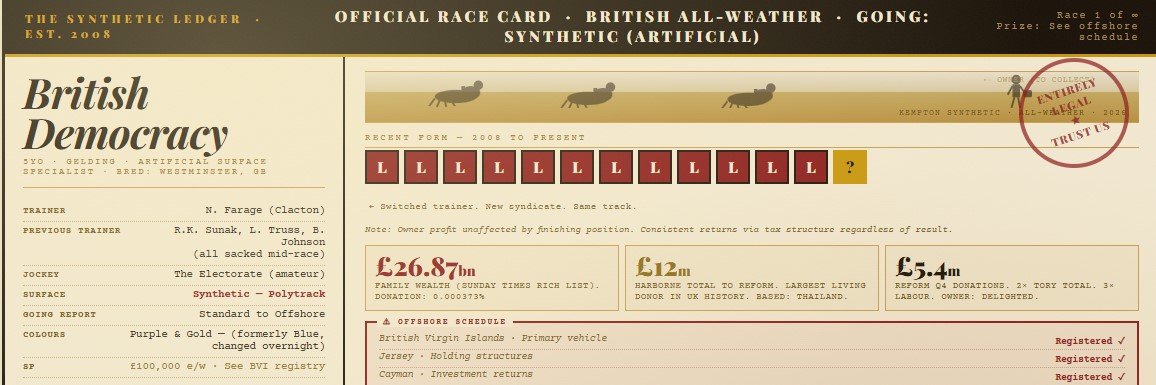
There is a type of racehorse owner — and I have met several, usually at the kind of wet Wednesday afternoon meeting at Wolverhampton that God himself seems to have given up on — who has absolutely no interest in whether the horse wins. They are there for what racing people call "the experience," which is a polite way of saying they are there to write off the training fees, the transport costs, the farrier, the physio, the equine nutritionist, and the frankly implausible invoice for something called "supplementary electrolyte consultation," against their tax liability. The horse could finish stone last, could indeed stop halfway round and eat the running rail, and these men would leave perfectly satisfied, because the whole enterprise was never really about the horse at all.
I thought of these men when I read that David and Simon Reuben — Britain's second-richest family, proprietors of Admiralty Arch, Millbank Tower, and approximately half of everything else you can see from a London taxi — have donated £100,000 to Reform UK. Their first ever gift to a party other than the Conservatives. A landmark moment. A political earthquake. Front page material, if Peter Mandelson hadn't been busy absorbing all available front pages for the foreseeable future.
The brothers are worth £26.87 billion. This £100,000 donation therefore represents roughly 0.000373 per cent of their wealth. To put that in terms a normal person can understand: if you earn the UK median salary and maintain that same proportional generosity, your equivalent political donation would come to approximately £1.46. You'd need to check down the back of the sofa, but you'd probably manage it.
The Form CardReuben Brothers have donated nearly £1 million to the Conservative Party since 2008, plus £85,000 in office space to Boris Johnson post-office. Reform received £5.4 million in donations in Q4 2025 — more than double the Tories' £2.4 million. Christopher Harborne's cumulative £12 million to Reform is the largest single donation to any UK party by a living donor. The Reubens' £100,000, in context, is a sighter. A horse sent to post to test the ground.
Now, what the political commentariat has somewhat overlooked in its breathless coverage is that the Reuben family's financial affairs are structured, in the time-honoured tradition of people with more money than several small nations, through an architecture of offshore holding companies, property vehicles, and investment structures that would require a dedicated team of forensic accountants roughly eighteen months and three filing cabinets to fully diagram. Their primary vehicle, Reuben Brothers Limited, operates through entities registered in jurisdictions that tend to appear on lists, usually in a font size that suggests the author found the whole thing slightly embarrassing. The British Virgin Islands feature. Jersey features. Various other places that are technically British but have somehow arranged not to be British in the ways that cost money also feature.
I am not suggesting anything improper. Everything, one is assured, is entirely legal. It is always entirely legal. That is rather the point. When you have enough money and enough lawyers, legality is less a constraint than a design specification. You brief the lawyers, the lawyers brief the accountants, the accountants consult the relevant offshore registry, and somewhere at the end of this process a structure emerges which is, technically, a British company donating to a British political party, but whose underlying ownership sits in a place where the tax man cannot quite reach without falling off the edge of the map.
"The really brilliant thing about all-weather racing — and about offshore tax structuring — is that the surface looks entirely normal until you actually try to get a grip on it."
Which brings me back, as everything eventually does, to horseracing. The Reubens have been involved in all-weather racing in Britain for years, which means they already have extensive experience of a product that is marketed as the genuine article but is, structurally, quite different from what it superficially resembles. All-weather racing takes place on artificial surfaces — Tapeta, Polytrack, Fibresand, each with its own curious properties that bear no relationship to any naturally occurring ground in these islands. Horses that win on turf often flounder on it. Horses that were entirely useless on turf sometimes discover, on the synthetic, a previously hidden aptitude. The form book becomes unreliable. The breeding credentials count for less. And the whole enterprise is run, to a significant degree, by a small number of very wealthy people who own both the horses and the facilities, and who have arranged things so that whether the punter wins or loses, they do not.
It is, in this respect, a not entirely imperfect model for British political funding. The surface looks like democracy. The participants genuinely believe they are engaged in something meaningful. And somewhere in the ownership structure, sitting quietly in a jurisdiction that rhymes with "Blersey," the actual returns are being collected by people who will be entirely fine regardless of the result.
Reform UK, of course, presents itself as the party of the ordinary British man, furious at elites, suspicious of globalism, deeply sceptical of the kind of international financial arrangements that allow the very rich to exist in a state of permanent tax efficiency unavailable to anyone who earns their money by actually doing something. Nigel Farage has made quite a career out of positioning himself as the enemy of precisely the sort of people who are now funding him. Christopher Harborne, his single largest donor at £12 million and counting, is based in Thailand. The Reubens operate through offshore structures. One imagines the Reform membership, should they ever look into this too carefully, might feel rather as I do when I discover that the "locally sourced" beef in a Cotswolds gastropub has been sourced locally from a distribution centre in Swindon.
But they won't look into it too carefully, because — and this is the genius of modern politics, just as it is the genius of all-weather racing — people do not come to be informed. They come because the alternatives are worse. The Conservatives have spent fifteen years producing the political equivalent of a horse that finishes seventh in a field of eight, consistently, in all conditions, regardless of the jockey, the trainer, or the number of supplementary electrolyte consultations it has received. At some point, even the most loyal owner looks at their training fees and thinks about diversification.
"Reform is the synthetic surface on which the old Tory money is now discovering, with some surprise, that it can actually move."
There is also, I suspect, a specific racing calculation at work here that the financial press has missed entirely. When very wealthy people shift money into a new racing operation — buying into a yard, backing a new trainer, acquiring a horse with unexplored potential — they do not do it because they have fallen in love with the animal's eyes. They do it because they have looked at the each-way market, assessed the going, noted that the favourite is dramatically overpriced given its recent form, and concluded that the returns on a modest speculative position are worth the exposure. A hundred thousand pounds to the Reubens is not a conviction bet. It is a hedging instrument. It keeps them in the paddock. It gets their name on the racecard. And if Reform does, against some people's better judgement, end up forming a government or extracting meaningful concessions from one, the Reubens will find that their £100,000 has bought them rather more access than the same sum spent on Tory fundraising dinners, where the food was always indifferent and Rishi Sunak would spend the evening explaining cryptocurrency.
Meanwhile, the actual money — the £26.87 billion, the Admiralty Arch rental income, the Millbank Tower office leases, the dividends quietly accumulating in structures registered in places with no capital gains tax and a suspiciously good climate — continues its unhurried journey through the international financial system, entirely untroubled by whatever is happening on the synthetic surface of British politics. The horses go round. The politicians give speeches. The punters get wet. And somewhere, in a well-appointed office in a low-tax jurisdiction, the form book is being updated with the cool precision of men who have always understood that the real money is never in picking the winner.
It's in owning the track.