The Racing Post: Beaten a Length by the Modern World
While Proform, HorseRaceBase, ATR and Racing TV keep improving, the Racing Post is still trying to sell punters an old monopoly at luxury rates.
HORSE RACINGSPORTBUSINESS
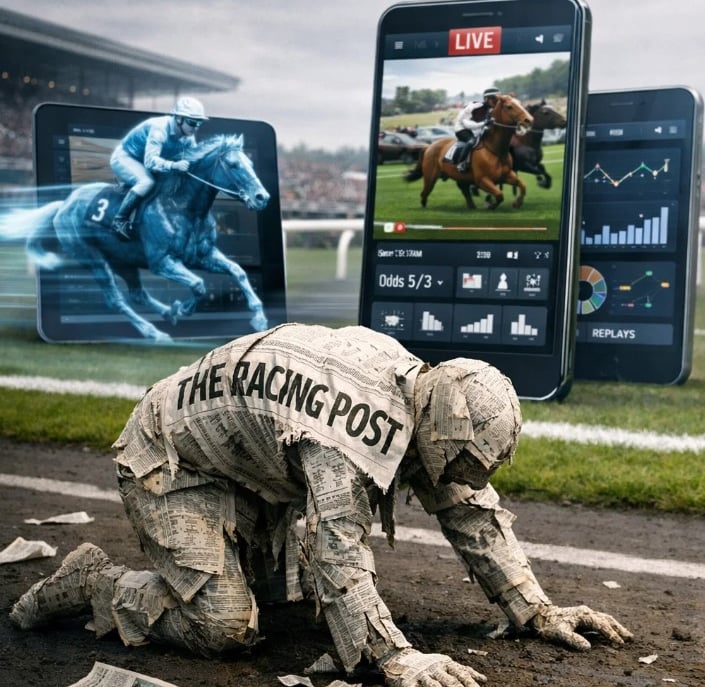
Thirty Quid a Month to Watch Yourself Become Irrelevant
Let us begin with the digital price, because when a business has lost touch with reality the first symptom is usually visible on the invoice. The Racing Post wants £29.99 a month for digital access. Thirty pounds. Every month. That is £360 a year for a racing publication in an age when punters can get news, cards, replays, markets, whispers, stats and half a dozen contradictory opinions for free before breakfast. The print version, meanwhile, now waddles in at about £6 a copy, which is less a cover price than a cry for help. Six quid for a newspaper suggests either exquisite craftsmanship or a hostage situation. At that money I don’t want a racecard. I want embossed pages, a complimentary hip flask and a former handicapper materialising in the kitchen to murmur that the favourite has badly gone at the game.
The whole thing has the air of an institution that has mistaken surviving for thriving. The Racing Post still prices itself as though it occupies the commanding heights of racing information, when in fact it increasingly resembles one of those stately old department stores that kept charging Mayfair prices long after the roof was leaking and everyone had gone online.
A Betting-Shop Relic with Wi-Fi
The great unspoken truth is that the Racing Post was never simply a newspaper in the romantic Fleet Street sense. It was a utility. A betting-shop tool. A form guide wrapped in journalism and supported by a commercial ecosystem of bookmaker advertising, shop distribution and captive punters with time to kill between races. It flourished not because the nation was aflame with passion for racing prose, but because thousands of people in betting shops needed something to read, circle, fold, swear at and blame. It was infrastructure wearing a masthead. It was a leaflet with ambitions.
Now that world has evaporated. Betting shops have thinned out, punters have migrated online, and the paper survives in this odd half-life of bookmaker ads, affiliate links and inherited authority, like some crumbling aristocrat renting out the ballroom for vape conventions. One can admire the persistence. One cannot confuse it with a strategy.
The News Has Left the Building
The most comic part of the proposition is “news”. Racing news now travels at the speed of X, WhatsApp, Telegram, bookmaker apps and stable gossip. By the time a legacy racing site has written, edited, formatted and paywalled a story about a jockey booking or a stable confidence move, the market has already reacted, three tipsters have claimed they knew yesterday, and a man called GaryNAPS has posted seventeen rocket emojis under a screenshot. Trying to monetise basic racing news in this environment is like setting up a premium telegram service because you’ve heard people enjoy updates. Yes, information matters. But it no longer belongs to the people who print it neatly.
Replays Everywhere, Exclusivity Nowhere
This is where the trouble becomes structural rather than merely embarrassing. The Racing Post used to benefit from information bottlenecks. Replays mattered. Access mattered. Form mattered because it was relatively hard to assemble in one place. Not anymore.
With shared replays now available across At The Races and Racing TV, one of the old pillars of racing media exclusivity has been kicked away. What was once gated and valuable is now increasingly visible and shared. The punter no longer has to treat the Racing Post as the sole keeper of the sacred scrolls. He can watch, compare, clip, review and cross-reference elsewhere.
And that matters because replays are not some decorative extra. They are one of the load-bearing walls of serious punting. Once those become widely available, the Racing Post loses another chunk of its old gravitational pull. It is not the centre of the conversation anymore. It is increasingly just one stop on a road full of better-lit alternatives.
Meanwhile, the Specialists Are Building Like Mad
This is the bit the Racing Post should find genuinely alarming. While it is still charging heritage prices for broad, slightly creaky coverage, specialist platforms like Proform and HorseRaceBase are adding features at a pace that makes the Post look like it is being run by a monastery.
These products are not sitting around polishing their brand identity and reminiscing about the glory days of print circulation. They are building. Every week there seems to be a new angle, a new filter, a new report, a new way to interrogate trainer habits, pace biases, sectional nuance, track patterns or market behaviour. They are behaving like modern software products in a competitive market, which is to say they are moving.
That is the really dangerous thing. Not merely that competitors exist, but that they are improving all the time while the Racing Post too often gives the impression of an organisation that still thinks being the Racing Post is, in itself, a feature. It isn’t. Not anymore.
The Bundle from 2004 Meets the User from 2026
The Post’s broader problem is that it is trying to serve too many audiences with one expensive, increasingly muddled proposition. Casual racing fans, medium-grade punters, hardcore form students, database obsessives and professional bettors do not want the same thing. One wants convenience. Another wants speed. Another wants tools. Another wants evidence. Another wants a workflow so efficient it would frighten an air traffic controller.
The Racing Post attempts to be all things to all men and ends up in that peculiarly British middle ground of being respected, useful-ish, and increasingly bypassed. It is the media equivalent of a hotel that offers a spa, a business centre, a wedding suite and a children’s menu, but somehow does none of them well enough to justify the room rate.
Marginalised, and Not by Accident
This is the word the Racing Post ought to fear: marginalised. Not destroyed. Not disappeared. Marginalised.
Because that is how decline happens in modern media. Not with a dramatic bang, but with a thousand small substitutions. Someone uses Sporting Life for headlines. ATR or Racing TV for replays. A bookmaker app for cards. Proform for filtering. HorseRaceBase for angles. Timeform for ratings. X for chatter. A private WhatsApp group for tips. The Racing Post remains present, of course, but no longer central. No longer indispensable. Just another tab in a crowded browser, and an expensive one at that.
That is a much more dangerous position than outright collapse, because institutions can ignore it for years. They mistake familiarity for necessity. They see traffic and think loyalty. They see subscriptions and think strength. All the while the serious user is assembling a better ecosystem elsewhere and the casual user is discovering he can live perfectly well without the old titan entirely.
The Brutal Choice: Improve or Die
And this is where satire has to give way briefly to plain English. The Racing Post needs to up its game or die. Not metaphorically. Commercially.
It cannot go on charging top-end prices while others innovate faster, distribute smarter and offer more practical value. It cannot rely on being the old name in the sport while newer or more agile services add features week by week and steadily absorb the serious end of the market. It cannot watch replays, tools, cards and analysis become more widely available elsewhere and pretend this is a minor inconvenience rather than a strategic emergency.
It has real assets: archive, brand, contacts, authority, history. Fine. Lovely. Put them to work. Build something forensic. Build something indispensable. Build databases and analysis tools that make serious punters stop what they are doing. Integrate replay intelligence properly. Offer pattern recognition, sectional depth, trainer profiling, jockey behaviour analysis, investigations, genuinely premium insight. Stop pretending broad familiarity is enough.
Because the race being run now is not against the Racing Post of twenty years ago. It is against nimble specialists who ship features constantly, platforms with replay access, free products subsidised by betting turnover, and a user base that has become ruthlessly unsentimental.
And ruthlessly unsentimental is what the market becomes when you ask it for £29.99 a month and £6 a paper while giving off the unmistakable aroma of a product from the last century living on bookmaker advertising, affiliate links and old prestige.
That game ends one of two ways. Either the Racing Post becomes sharper, faster, deeper and more essential, or it becomes a heritage brand people remember fondly while using something better. In other words: up your game, or die in the stalls.