The Racing Breakaway Blueprint
Nevin Truesdale's Vision for Racing's 'Premier League Moment'
HORSE RACINGSPORT
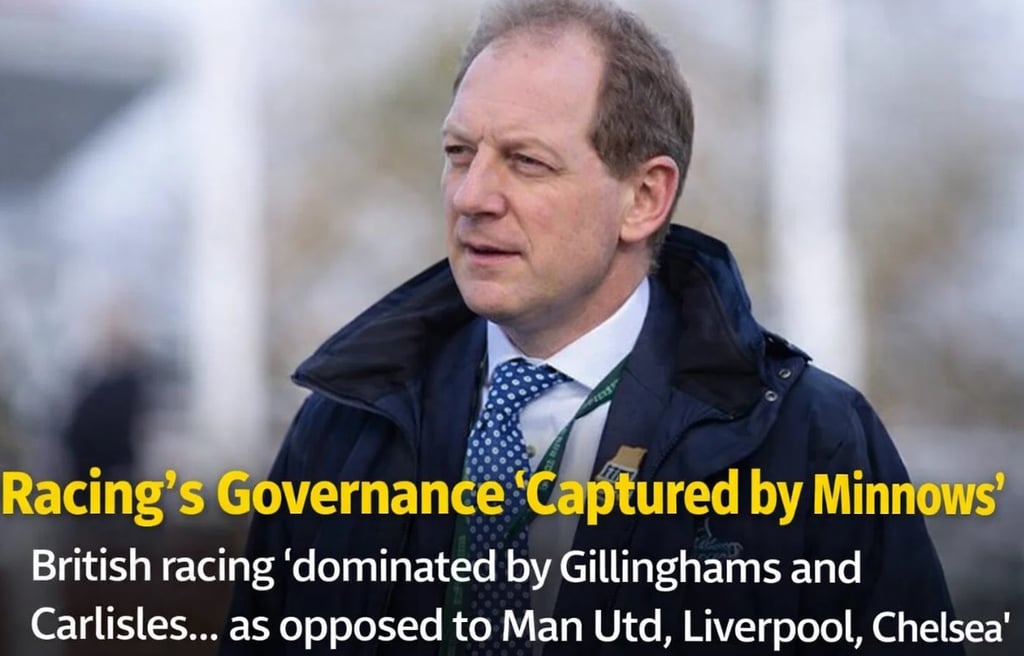
In a remarkable series of posts on X over 19–20 December 2025, Nevin Truesdale—the former Chief Executive of The Jockey Club—has outlined what amounts to a manifesto for revolutionary change in British racing governance. These are not the musings of a casual observer; they represent the considered views of someone who spent over a decade at the heart of racing's largest commercial operation and who led the industry's fight against affordability checks.
What makes his intervention particularly striking is its explicit invocation of football's 1992 Premier League breakaway as a template for action. This is a former industry leader effectively calling for a coup against the status quo—and citing the man who made the Premier League the most valuable football competition on earth as his model.
The Diagnosis
Truesdale's central thesis is brutally direct: British racing's governance has been captured by entities whose interests are fundamentally misaligned with the sport's long-term health. He suggests that racing finds itself in 'a situation where governance is dominated in football terms by the Gillinghams and Carlisles of this world... as opposed to Man Utd, Liverpool and Chelsea.'
The target is unmistakable. Arena Racing Company (ARC) and smaller independent racecourses, operating through the RCA's one-racecourse-one-vote structure, can effectively outnumber The Jockey Club and the Leading Independents. This arithmetic, Truesdale argues, has allowed short-term commercial interests to dominate strategic decision-making, with ARC and smaller independents 'able to exert control over the BHA board through informal alliance with others.'
On ARC specifically, Truesdale is diplomatically devastating: 'they are behaving perfectly rationally given their business objectives. It's just that I happen to believe these are not the right ones for the long term health of the industry and the breed.' This is the language of irreconcilable difference—an acknowledgement that no amount of negotiation will align ARC's private equity–driven model with what Truesdale sees as the sport's existential needs. When he adds that 'at some stage' sidelining ARC 'may be necessary,' the implication is clear: that stage may already have arrived.
The Prescription
Truesdale's proposed grouping comprises The Jockey Club, the Leading Independents (courses like Ascot, Goodwood, and Chester), the National Trainers' Federation, the Thoroughbred Breeders' Association, the Professional Jockeys Association, and 'a reconstituted ROA' representing larger owners under both codes. The governance structure would feature a 'fully independent BHA Board' populated by experts 'from within the industry and well beyond to encompass expertise from other sports and consumer businesses in digital content, data, commercial rights.' Crucially, membership would be conditional—those unwilling to commit to the reform agenda would be excluded.
The substantive agenda represents a comprehensive rejection of volume-first racing: radical fixture rationalisation addressing 'failing races and areas of small field sizes'; Levy defunding of Class 6 races (which could still run if racecourses funded them entirely); steeper prize money curves favouring quality; breeding incentives 'especially at the top end, to reverse the foal crop decline'; and transformation of the sport's media approach including behind-the-scenes content, jockey cams, microphones on participants, and cameras in stewards' enquiries.
Perhaps most significantly, he calls for reversal of recent decisions that 'encouraged more volume at the expense of quality'—including race divisions and nine-race cards—and 'a commitment to invest and co-operate on a consistent world class owner experience.' This dual focus on elite quality and grassroots access recognises that racing's future depends on both maintaining aspirational appeal and broadening participation through syndicates and new entrants.
The Scudamore Model
Truesdale's invocation of football's 1992 revolution is not casual rhetoric. He reveals that 'Richard Scudamore briefed Project Pace team: in 1992 they made it clear to all that the Prem Lge was happening come what may.' Scudamore—Premier League Chief Executive and Executive Chairman from 1999 to 2018, who grew media rights from £1.2 billion to over £5 billion—is perhaps Britain's most successful sports administrator. That he has apparently been advising those seeking to transform racing is a telling detail.
The implication is clear: this is not idle speculation but a model being actively studied by serious people with a track record of delivery. The 1992 football breakaway succeeded because the top clubs were prepared to proceed regardless of whether others joined them. Arsenal, Everton, Liverpool, Manchester United, and Tottenham had been plotting since the late 1980s. When they finally moved, they did so with the backing of the FA and the promise of transformative television revenue.
The key lesson Truesdale draws: breakaways require absolute commitment. 'You could get on board with the principles or not. But if not you didn't have a ticket.' This is not an invitation to negotiate; it is a declaration that those who wish to build something better must be prepared to proceed without those who don't.
Context and Obstacles
Truesdale's intervention lands at a moment of acute crisis and tentative reform. Lord Allen took up the BHA chairmanship in September 2025 after a protracted delay caused by his insistence on governance changes. At the Gimcrack dinner earlier this month, Allen acknowledged that 'change needs to happen at the top' and confirmed his commitment to a fully independent board. The BHA has engaged consultants to recruit independent board members.
But Truesdale suggests this may not be enough: an independent BHA board is 'a good step but a small one.' The fundamental problem—that racecourse ownership structures allow those with misaligned incentives to block necessary reforms—remains unaddressed by changes to the BHA alone. The question he poses is whether The Jockey Club and Leading Independents are 'brave enough to sideline those who act for short term gain or to keep the status quo'—including, if necessary, leaving the RCA altogether.
Racing is not football, and the parallel has limitations. Football's breakaway was enabled by a single transformative asset: the right to negotiate independent television contracts worth hundreds of millions of pounds. Racing's commercial rights are fragmented across RMG, the Tote, and various racecourse groupings. There is no single pot of gold waiting to be unlocked by better governance.
Moreover, the Premier League succeeded partly because the FA—the sport's regulator—actively supported it, seeing an opportunity to wrest control from the Football League. It is far from clear the BHA, even under Allen's leadership, would be willing to take sides in a civil war between racecourse factions. And there is the matter of fixture allocation: racecourses own their fixtures, and any breakaway group would need to control sufficient racing to maintain a viable product.
Conclusion
Whatever one thinks of Truesdale's proposals, his intervention serves a vital function: it names the problem explicitly and proposes a solution matching the scale of the crisis. For too long, British racing's discourse has been dominated by incremental adjustments and calls for collaboration among parties whose interests are fundamentally opposed.
Truesdale is saying what many in the sport privately believe: that the current governance structure is not capable of making the decisions necessary to secure racing's future, and that waiting for consensus among all stakeholders is a recipe for managed decline. The reference to Scudamore's involvement suggests this is not a lone voice crying in the wilderness but part of a broader conversation among those who understand what successful sports governance looks like.
When he writes that it 'depends on whether those stakeholders whom I have named... are prepared to lead a significant breakaway change,' he appears to be testing the waters—or perhaps signalling that conversations are already underway. Racing, as Truesdale makes clear, is running out of road. 'At some stage that may be necessary,' he writes of a breakaway. The only question is whether that stage has already arrived.