The £200 Million Question: When Winning Feels an Awful Lot Like Losing
British Racing's Crisis Timeline and Why the Champagne May Be Premature An objective assessment of an industry celebrating survival while the building burns
GAMBLINGHORSE RACINGPOLITICS

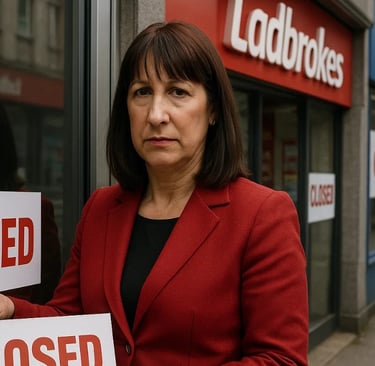
There is a peculiar sort of victory that involves dodging a punch to the face only to walk directly into a glass door. British horseracing finds itself in precisely that position following last week's Autumn Budget, clutching its untouched 15% tax rate like a participation trophy while the entire betting ecosystem that funds it quietly haemorrhages to death in the corner.
The celebratory press releases from the British Horseracing Authority were understandable, if somewhat premature. Racing's lobbying campaign—including an unprecedented one-day strike in September and the admittedly catchy #AxeTheRacingTax hashtag—had apparently worked. Remote bets on horseracing would remain taxed at 15%, while online casino products faced a near-doubling to 40%, and other sports betting would rise to 25% by 2027. Racing had secured its "carve-out." Champagne corks were duly popped. Trainers praised the Chancellor. Everyone went home feeling rather pleased with themselves.
Unfortunately, celebrating this outcome requires a fundamental misunderstanding of how the industry actually works—a misunderstanding that a deep-dive crisis assessment currently circulating among executives suggests could cost the sport more than £200 million annually within five years.
The Ecosystem Nobody Noticed
Here is the uncomfortable truth that racing's leadership apparently failed to grasp during their successful lobbying campaign: the sport has spent the last decade being quietly subsidised by online casino profits.
Those high-margin casino products—the ones now being taxed into near-oblivion—were the golden geese that allowed bookmakers to treat racing as a premium offering despite its being, in commercial terms, a thoroughly expensive product to support. The media rights, the sponsorship deals, the promotional offers, the price boosts, the competitive odds: all of this was funded by money that came not from the betting ring at Cheltenham but from punters spinning virtual roulette wheels at two in the morning.
With the new 40% tax applied to Gross Gaming Revenue—not profit, but revenue before costs—the casino vertical now operates on what analysts describe as single-digit margins before corporation tax. The subsidy is gone. And racing, having successfully protected its own tax rate while its benefactors were eviscerated, now finds itself in the position of a remora fish that has just watched its shark host being harpooned.
The bookmakers are not amused. Words like "unhelpful" and "betrayed" have been deployed with the sort of quiet fury that suggests future media rights negotiations will be conducted with all the warmth of a divorce settlement.
The Timeline of Decline
The crisis assessment makes for sobering reading, primarily because it is not a prediction of what might happen but a description of what is already underway. The timeline breaks down into three phases, each more alarming than the last.
Phase One (0–12 months): Early Compression
The signs are not subtle. Online betting turnover on racing has already declined by more than £2 billion since 2022, with a further 6% drop recorded in the year to March 2025. Betting turnover per race at the major festivals fell by 12.4% last year. Cheltenham attendance dropped by 51,000 compared to 2022 figures. Average turnover per race at everyday "Core" fixtures has collapsed by 14.4%, while Premier fixtures remained flat—suggesting that recreational punters are still engaged with the big days but that the larger-staking regular customers have either stopped betting or migrated elsewhere.
That "elsewhere" deserves attention. Black market gambling activity has exploded by a staggering 522% since 2021, with research suggesting the unregulated offshore market has grown from 0.43% of UK gambling to nearly 9% by 2025. These operators pay no tax, contribute nothing to the levy, offer no consumer protections, and are now positioned to hoover up any punters driven away by worsening odds and increased restrictions in the regulated market. The Office for Budget Responsibility estimates that £600 million could be lost to offshore substitution as the new tax regime bites.
Meanwhile, sponsorship is softening, with several commercial partners quietly exiting. Prize money at Class 4–6 level—the backbone of day-to-day racing—is compressing. Field sizes have shrunk to near-record lows, with almost 28% of races between April and May 2025 contested by six or fewer runners. The BHA's attempt to delete small-field races was scrapped after trainer backlash, but the underlying problem—too many races chasing too few horses—remains unresolved.
Phase Two (12–36 months): Structural Weakness Exposed
The levy—racing's primary funding mechanism—is already under strain. While contributions hit a nominal record of £108 million last year, this masks a fundamental problem: betting turnover, the engine that drives levy income, is in sustained decline. If turnover continues falling at current rates while bookmaker margins revert to historical norms, levy receipts could drop by more than 20%.
Media rights represent the next battleground. Bookmakers currently contribute approximately £350 million annually to racing through a combination of levy, media rights, and sponsorship. With casino profits gutted and overall margins squeezed, operators will view racing's cost base with the sort of cold commercial eye usually reserved for underperforming business units. Projections suggest media rights payments could fall by £50–£120 million.
Lower-tier trainers, already operating on margins that would embarrass a budget airline, face existential decisions. Some will exit. Owners will reduce string sizes or move horses abroad, attracted by superior prize money in Ireland, France, Australia, and the Gulf. The foal crop—already projected to fall 25% from 2022 levels by 2026—will decline further as breeders confront the grim arithmetic of median yearling sales losses of around £33,000 per horse.
Phase Three (36–60 months): Systemic Crisis
The endgame is not a sudden collapse but a gradual hollowing-out. Field sizes could fall to levels that compromise the betting product itself, creating a feedback loop of declining turnover, reduced funding, fewer horses, smaller fields, and worse betting value. Racecourse closures or forced mergers become probable rather than possible. Revenue loss accelerates as each closure reduces fixtures, coverage, and national visibility.
Britain, long a global centre of excellence for breeding and racing, risks losing international relevance. The comparison with greyhound racing—once a thriving sector that entered a period of slow structural decline and never recovered—is drawn explicitly. The warning is clear: decline does not arrive as a collapse but in stages, each one small enough to ignore until the cumulative effect becomes irreversible.
What the Punter Actually Faces
For all the talk of levy mechanisms and media rights negotiations, the person who will feel this first—and feel it most acutely—is the ordinary punter trying to have a bet. The degradation is already visible for anyone paying attention. Odds are tightening across the board as bookmakers increase overrounds to compensate for squeezed margins. Price boosts and promotional offers, which were once scattered across the racing calendar like confetti, are becoming rarer and less generous. Each-way terms are being quietly adjusted in ways that advantage the layer rather than the player.
Account restrictions, already the bane of any punter who demonstrates the slightest hint of winning consistently, will intensify. The notion of a "price-sensitive customer"—someone who shops around for value, who backs winners more often than random chance would suggest—has become synonymous with "problem to be eliminated." Expect faster stake reductions, lower betting limits, and more aggressive account closures as operators decide they can no longer afford to deal with anyone who isn't essentially donating money.
The market will consolidate. Smaller independents, lacking the economies of scale to absorb the new tax burden, will either exit or be swallowed by larger competitors. Several have already indicated they will be forced to pull all racing-related sponsorship simply to survive. One small bookmaker told industry media that it would no longer be able to offer football bets at all once the new duty rates take effect—a remarkable admission given that football overtook racing as the most bet-on sport in 2019.
Consumer choice will narrow. Innovation will stall. The competitive pressure that once drove bookmakers to offer better odds and more creative markets will fade as the surviving operators focus on survival rather than growth.
And for punters who find the legal market increasingly unappealing? The offshore alternatives will be waiting, offering better prices, no restrictions, and none of the responsible gambling measures that have become the regulated industry's defining characteristic. That 522% increase in black market activity did not happen in a vacuum. It happened because punters were pushed.
The Industry's Response: Too Little, Too Late?
The mitigation recommendations are neither new nor radical. Diversify revenue beyond bookmaker dependency. Develop racing-owned digital and data products. Modernise commercial rights. Reform funding streams. Protect the grassroots. Engage government with a coherent economic argument. Strengthen international competitiveness. The problem is not identifying what needs to be done. The problem is doing it quickly enough, with sufficient unity, in an industry that has historically struggled to agree on the colour of the sky.
The BHA has announced initiatives aimed at strengthening developmental pathways for young horses, with new eligibility requirements for Grade 1 novice races and extended support for the Jump Breeder Bonus Scheme. These are sensible measures, but they operate on timescales measured in breeding cycles—years, not months. The crisis assessment suggests the window for meaningful intervention may be considerably shorter.
Meanwhile, the relationship between racing and its betting partners—the foundation upon which the entire economic model rests—has been fractured by the lobbying strategy that secured racing's tax exemption. Rebuilding that trust while simultaneously negotiating reduced media rights payments will require diplomatic skills that have not been conspicuously on display.
The Greyhound Warning
The crisis assessment draws a pointed comparison with greyhound racing, and it deserves attention. Greyhound racing was once a thriving sector, drawing millions of spectators and supporting a substantial betting economy. Its decline did not arrive as a catastrophic event but as a slow structural erosion—falling attendances, shrinking betting interest, track closures, reduced investment, diminishing relevance. Each individual step seemed manageable at the time. The cumulative effect was terminal.
The warning is clear: decline does not announce itself with a crash. It arrives in stages, each one small enough to explain away, to attribute to temporary factors, to assume will be reversed by the next innovation or the next sponsorship deal or the next government intervention. By the time the cumulative pattern becomes undeniable, the opportunity for meaningful reversal has often passed.
What Must Happen—And Who Must Make It Happen
The strategic imperatives are obvious. Racing must reduce its dependency on bookmaker-linked revenues by developing products and partnerships it controls directly. It must protect the grassroots—the Class 4–6 racing that sustains field sizes, employment, and trainer viability—even when the temptation is to concentrate resources on glamour fixtures. It must engage government with a joined-up argument that links gambling policy reform to the economic role racing plays in rural communities. It must benchmark its prize money, owner experience, regulation, and presentation against global racing powers rather than nostalgic memories of past glories.
The fundamental question is whether an industry that has consistently struggled to align its competing interests can summon the collective will to make these changes before the window closes.
Racing's fragmented governance—with racecourses, trainers, owners, jockeys, breeders, and the BHA often pulling in different directions—has been a persistent weakness. The prolonged delay in appointing Lord Allen as BHA chair was symptomatic of these fractures. The successful tax lobbying campaign, whatever its other effects, demonstrated that the industry can unite when facing a common threat. Whether that unity can be sustained for the longer, harder work of structural reform remains to be seen.
The £200 Million Question
This is not yet a crisis narrative. It is a warning. Field sizes can be rebuilt. Revenues can be diversified. Sponsorship can return when confidence does. Racecourses can modernise. The sport still retains global prestige, exceptional talent, unmatched heritage, and a loyal audience.
But inertia is not an option.
The next five years will determine whether British racing bends upward toward renewal or downward toward sustained contraction. The deep-dive assessment suggests an annual contraction of more than £200 million is possible if the current trajectory continues unchecked. That is not hyperbole. It is arithmetic.
The £200 million question is not whether the danger is real. The evidence is overwhelming that it is. The question is whether racing has the will—and the unity—to answer it.
Because the clock, as the assessment makes unmistakably clear, has started. And for an industry that just spent six months celebrating its escape from a tax increase, the realisation that the real crisis was always somewhere else entirely may be arriving just a little too late.
The Budget did not kill British racing. It simply pulled back the curtain on a business model that was already failing, an ecosystem that was already fragmenting, and a sport that may have won its battle while losing something considerably more important.
Racing dodged a bullet. Unfortunately, it remains very much in a war zone—and the next salvos are already incoming.
The data in this article draws on analysis from the British Horseracing Authority, Racing Post, the Betting and Gaming Council, the International Horse Federation, and independent industry assessments. The £200 million contraction figure represents a five-year cumulative scenario based on projected declines in levy income, media rights, and sponsorship.