“Satire so sharp, it cuts deeper than the truth.”
The owls of Darlington have been cancelled, and somewhere a mouse is booking a holiday
How refusing a bacon sandwich qualifies you to decide what a seven-year-old in Darlington is allowed to look at on a Thursday.
PHILOSOPHYCULTURE
Ed Grimshaw
7/14/20265 min read
There is a peregrine falcon that lives, on and off, near a bridge I sometimes cross, and last spring I watched it fold its wings and drop out of the sky like a house that had been pushed off a cliff. Two hundred miles an hour, they say. Faster than a Bugatti, faster than anything Lewis Hamilton has ever sat in, and it did this not for a sponsorship deal or a podium or a magnum of warm champagne but because it had spotted a pigeon and fancied lunch. The pigeon did not, I should stress, fill in a consent form. Nobody had asked it whether it wished to participate. It simply ceased to exist in a puff of grey feathers, and the falcon carried on being the single most magnificent thing I have ever seen that wasn't a Fabulous Baker Boys running on soft ground at Cheltenham.
I mention this because a falcon, being a falcon, has no idea that its entire way of life is now considered problematic in Darlington.
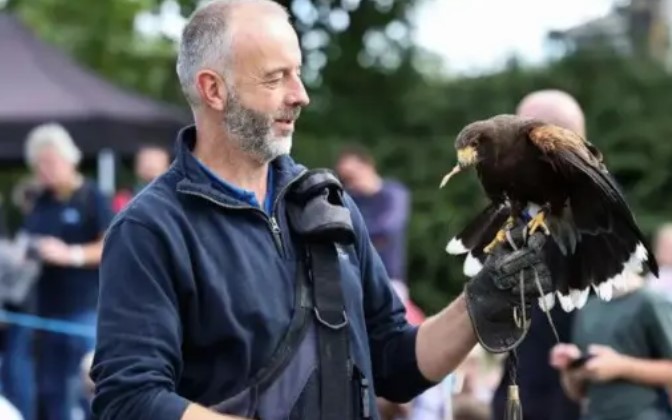
And naturally, this brings me on to Hopetown, the railway museum in that fine town, which had arranged for a company called Walworth Birds of Prey to bring some owls and eagles and hawks along on the 31st of July so that families — actual human families, with children who own iPads and have never seen anything more predatory than a Border Terrier — might come face to face with a real live hunter. Free of charge, mind. A talk on food chains, life cycles and conservation, a photograph with a hawk, a genuinely educational morning. And then it was cancelled. Not because of avian flu, not because the eagle had pulled a hamstring, but because two groups called Darlington Vegans and North East Animal Rights wrote a letter.
I know precisely what the letter said, because one of the leaders, a Kathy Barley, was kind enough to explain it to the world. The event, she said, forces "wild animals to perform unnatural behaviour such as flying to human cues." Flying. That's the unnatural behaviour they've identified. A bird. Flying. This is a bit like objecting to a sheepdog trial on the grounds that the collies are being made to do the deeply unnatural thing of running about in a field, or complaining that a fish has been coerced into the frankly degrading act of swimming. I have read the sentence eleven times now and each time a small part of me leaves my body and goes to sit quietly in the garden.
Obviously, the birds themselves are distraught about all this. You can tell, because falconry birds are famous for their rich inner emotional lives and their strongly held views on the ethics of crowd spectacle. The Harris hawk in particular is known to lie awake at night, tormented, staring at the ceiling of its aviary, thinking: is it really me they've come to see, or merely the idea of me? Whereas in the wild, where these campaigners would prefer it to be, the very same hawk would be living a life of pure dignity, by which I mean starving to death in a hedge near the A1 having eaten a rat that had itself eaten some rat poison. That's the good ending. That's the one they're fighting for.
What fascinates me most, though, is the machinery of the thing. Because this was not one aggrieved individual firing off an email at half past eleven at night. This was Darlington Vegans, in formal alliance with North East Animal Rights, and, for good measure, a national outfit called Freedom for Animals, all three names appearing in the same triumphant press statement like the signatories of a peace treaty. They have, in other words, unionised. Somewhere there is a committee. There are, I would bet actual money, minutes. And the founding principle of this coalition, the great cause around which grown adults have organised themselves into a bloc, is the avoidance of events involving live animals — which does rather raise the question of what happens next to Crufts, or the Grand National, or the bloke at the county show with the ferret he lets run up your trouser leg for a pound. Consider the trade union so principled it must, to be consistent, come for the sheepdogs.
But the deeper thing, the thing I genuinely cannot get my head round, is this. At what precise moment does declining to eat a bacon sandwich confer upon a person the authority to write the ethical rulebook for the rest of humanity? I have nothing whatever against what anybody puts on their plate. Eat lentils, eat air, eat a single organic broad bean at dawn facing east, it is no business of mine. But it is a curious leap, is it not, from "I would rather not have the sausage" to "I shall now determine what your children are permitted to look at on a Thursday morning in Darlington." A dietary preference has somehow been promoted, without an election, without a single qualification in zoology or ethics or indeed anything, into a licensing authority. Pythagoras didn't eat beans either. Nobody let him run the museum.
I want to be fair here, because fairness matters, and because I have met the sort of people who devote their weekends to the welfare of animals and a great many of them are heroes — the woman who rescues hedgehogs, the chap who sits up all night with a lambing ewe, the bird sanctuaries that actually house the injured owls that idiots buy on a whim and then can't cope with. Those people have got up, got dressed, and put in a shift. Kathy may well be one of them. And on the narrow question of whether a wild animal should be kept purely to be gawped at, there is a real conversation to be had, one that serious falconers and zoologists have been having, carefully and with actual expertise, for about a hundred years.
But that conversation was already happening at Hopetown. That was the whole point of the morning. Expert handlers, talks about habitats and conservation, the exact opposite of a Victorian freak show. The museum even said, with the weary patience of a headmaster, that "all appropriate welfare, accreditation and safety standards were in place." They had ticked every box. There was no cruelty to stop. There was only a photograph of a child looking up at an owl, which is, I'd have thought, precisely how you create the next generation of people who care whether owls exist at all. You do not learn to love the natural world through the medium of a laminated poster. You learn it because once, when you were seven, a man in a glove let a barn owl land next to your head and your heart stopped.
And here is the part that truly gets me. Barley congratulated Hopetown for being "an amazing venue" and expressed her delight that it would continue to be "a first-class educational experience without resorting to using live animals." Without the animals. She wants a wildlife education centre with the wildlife taken out. A safari with no lions. A trip to the seaside where, for welfare reasons, they've removed the sea. I look forward to the new, improved, ethically superior event: a folding table, a leaflet about eagles, and a fifty-minute silence in which everyone is invited to imagine a hawk very hard.
The falcon by my bridge, meanwhile, has not been told. It is still up there, doing the unnatural thing, killing pigeons that never consented, entirely unaware that in Darlington it has been declared a symbol of human exploitation. I rather envy it. It has never read a letter in its life.