The Harm Factory: How British Gambling Policy Became an Industry Built on Its Own Failure
Andrew Rhodes has gone. The crusade continues. The science still disagrees with its central propositions. The science is still being ignored
SPORTHORSE RACINGGAMBLING
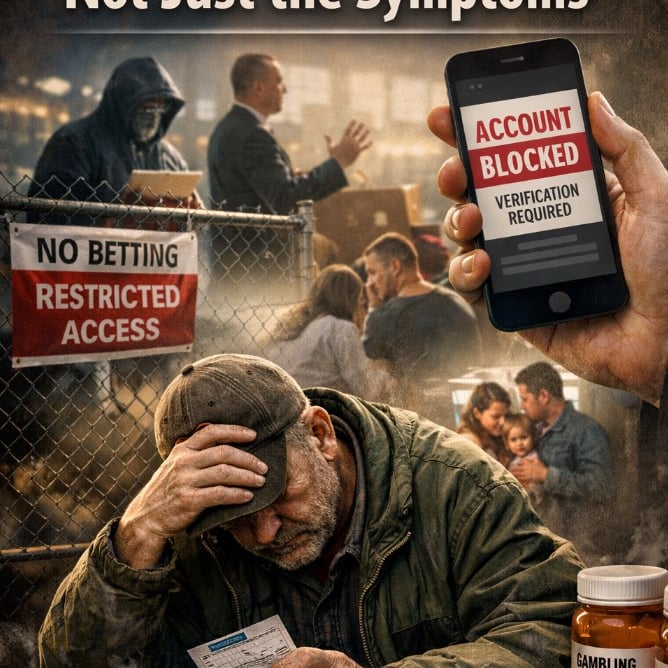
The Regulator Who Knew Before He Looked
There is a particular kind of institutional certainty — impervious, self-sealing, magnificent in its indifference to contradiction — that flourishes only in bodies insulated from the consequences of being wrong. Andrew Rhodes cultivated it at the Gambling Commission with the dedication of a master gardener, building a regulatory philosophy on the proposition that gambling is primarily a public health emergency, causation is essentially settled, and the appropriate cure is a combination of credit checks, pop-up warnings, and a self-exclusion register that a determined twelve-year-old could circumvent before breakfast.
Rhodes has now departed. The Commission has a new incumbent. The crusade, naturally, continues — because the crusade was never really about one man's convictions. It was about an institutional architecture that, once constructed around the language of harm, cannot easily dismantle itself without simultaneously dismantling its own justification for existence. The vocabulary of harm, the research roadmaps, the longitudinal evidence-gathering exercises, the psychological autopsy studies — these are not incidental features of the Commission's operation. They are its load-bearing walls. Remove them and the building falls down.
So the affordability check remains. The surveillance apparatus remains. The presumption that the adult recreational punter is a vulnerability statistic awaiting correct identification remains. The new Chief Executive will be briefed, will absorb the institutional priors, and will shortly be delivering speeches about robust, evidence-based consumer protection that — if you closed your eyes — you could not distinguish from the speeches of the predecessor. Welcome to the affordability check, now in its second generation of justification. Mr Rhodes is no longer personally watching. The system he built is watching in his place, which is considerably more efficient.
The Numbers That Were Built to Arrive
Let us talk about the statistics. The 96%. The 97%. The figures that float, authoritative and precise, through every Commission document, every harm-reduction white paper, every parliamentary briefing on the gambling crisis — and that deserve far more scrutiny than they have received.
These numbers did not emerge neutrally from the data. They were produced by instruments designed by clinicians who, in the overwhelming majority of cases, do not gamble, have never gambled seriously, and bring to the task the same cultural distance that a Victorian temperance campaigner brought to the study of the working-class pub — genuine concern, genuine compassion, and a fundamental incapacity to understand what they are actually looking at from the inside.
The Problem Gambling Severity Index — the primary measurement tool underpinning virtually the entire harm-prevalence literature — was not designed by people who understand what it means to back a horse with genuine knowledge, sustain a loss with equanimity, manage a betting bank across a season, and treat the exercise as a discipline of probabilistic thinking. It was designed by clinicians whose professional formation taught them to see patterns of behaviour through a pathological lens — and who applied that lens to a domain they did not inhabit, producing instruments calibrated to find what they were designed to find.
The result conflates the recreational punter who had a bad Cheltenham with the genuinely disordered gambler whose life is disintegrating, because both answer "yes" to questions about financial impact carrying no severity weighting, no contextual calibration, and no mechanism for distinguishing a £300 loss representing a considered recreational decision from a £300 loss representing the food budget. Binary instruments applied to a non-binary world produce non-binary nonsense dressed in the clothing of precision. The clothing is very convincing. The nonsense remains.
Those clinicians cannot provide effective treatment for complex gambling disorder either — because effective treatment for a condition embedded within depression, ADHD, trauma, and substance misuse requires a sophisticated, multidisciplinary, longitudinal clinical relationship that neither a six-session CBT protocol nor a self-exclusion scheme can approximate. The Commission researches harm with impressive thoroughness. The treatment of harm proceeds on a shoestring. This is the central irony: an enormously sophisticated apparatus for identifying suffering, and a remarkably primitive apparatus for relieving it.
Harm as Alibi: The Irresponsibility of Responsibility
Here the analysis must become uncomfortable for a different set of reasons, because the deployment of harm language is not only a Commission failure. It is also a failure of the industry — of a particular and revealing kind. The gambling industry has discovered that engaging with the vocabulary of harm is considerably more profitable than resisting it. Not because the industry has developed genuine commitment to harm reduction, but because harm language, properly deployed, is an extraordinarily effective instrument for avoiding responsibility for irresponsibility.
The operator that funds a responsible gambling research centre and installs a GamStop integration is not demonstrably safer than the operator that does none of these things. But it is considerably better insulated from regulatory sanction and considerably better placed to argue that its product design — the variable-ratio reinforcement, the optimised session length, the algorithmically targeted marketing at moments of psychological fragility — is a peripheral concern rather than the central one.
Harm language performs the same function that "Gamble Responsibly" has always performed: it transfers the moral weight of the outcome from the institution to the individual. We provided the tools. You failed to use them correctly. The fault architecture runs downhill, always, towards the person least equipped to bear it. Meanwhile the product remains engineered for extraction. The near-miss algorithm remains. The friction-free deposit pathway remains. The twenty-four-hour accessibility remains.
The Science: Real, Partial, and Catastrophically Misread
Gambling disorder is genuinely neurobiological. Brain imaging reveals measurably reduced activity in the ventral striatum. Heritability sits at 50-60%. This is not weakness of character. The biology is real.
But here — precisely here — the Commission's intellectual honesty quietly excuses itself and leaves the room. Ninety-six percent of people diagnosed with gambling disorder have at least one other psychiatric condition. Depression, anxiety, ADHD, trauma, substance misuse — often several simultaneously. These are not footnotes. They are the central finding of the field. The simple causal model — person gambles, person is harmed, remove gambling, remove harm — looks compelling on a slide deck and collapses on contact with actual human beings. Remove the betting account. The depression remains. The ADHD remains. The trauma remains. The suffering finds another vehicle. The Commission's own research roadmap concedes it still needs to "establish whether and to what extent we can make causational links between gambling and severe harms." The causal architecture is unresolved. The policy built upon it has been operational for years. The house is fully furnished. The foundations are still being excavated.
Gambling as Life: The Stigma That Serves Nobody
What the harm framework systematically ignores is that for the overwhelming majority of people who bet on horses, gambling is a form of life learning — a discipline of probability, pattern recognition, contextual judgement, and the humbling education of being wrong in public and having to think carefully about why.
The serious racing punter who has spent twenty years studying form, understanding going conditions, reading a trainer's equipment changes and a jockey's body language in the paddock is engaged in one of the more cognitively demanding recreational activities available to a British adult. They are not a patient awaiting diagnosis. They are someone who has chosen to engage with uncertainty as a domain of knowledge — and who has learned, through loss as much as profit, things about probability, cognitive bias, and their own psychological architecture that no classroom teaches. The Commission's binary instruments cannot distinguish this person from the disordered gambler. The stigma embedded in the entire architecture does real damage. It pathologises a recreational culture. It generates shame that makes disordered gamblers less likely to seek help. Stigma is not a therapeutic intervention. It is a barrier to one.
The Harm Industry: Solutions That Don't Work, Sold With Conviction
GamBan charges people in crisis for the privilege of being protected from themselves — a subscription model applied to suffering with a certain audacity one cannot help but admire. GamStop locks the casual punter who registered during a difficult month out of their account for five years with no proportionate appeals process, while the genuinely disordered gambler opens a new account with a VPN and a fresh email address in less time than it took you to read this sentence. These are not solutions. They are the performance of solutions — generating compliance metrics and parliamentary reassurance while the underlying suffering continues, efficiently redirected.
The harm management industry is not cynical in its origins. It is cynical in its incentive structure. Its organisations are staffed by people of genuine commitment. But the architecture rewards harm-identification over harm-resolution, intervention-volume over intervention-effectiveness, and continued engagement with the problem over its actual elimination. It is an industry built on a wound it has no structural interest in closing.
Would You Kindly Just Leave Me Alone
And now, if the Commission, its research partners, its responsible gambling technology vendors, its parliamentary advocates, and the extensive cast of empathetic politicians who have discovered that gambling harm is an excellent issue on which to be publicly compassionate without being required to understand anything complicated — if all of them would permit a brief interjection from the person whose liberty is being administered:
Would you please, just this once, leave me alone.
I have been studying racing form for the better part of forty years. I understand value. I understand probability. I understand the difference between a bet made on disciplined analysis and a bet made on impulse, hope, or the desperate arithmetic of the chasing mind — because I have made both, kept records of both, and drawn the appropriate conclusions from both. I have managed a betting bank through losing runs that would have broken a lesser methodology, and I have done so not because I lacked self-awareness but because I possessed rather more of it than the questionnaire you are proposing to administer to me was designed to detect.
I do not require a pop-up to tell me that gambling involves risk. The risk is, structurally, the point. Risk intelligently assessed and deliberately accepted is not a harm waiting to be named. It is the fundamental cognitive act of anyone who has ever evaluated probability under conditions of uncertainty — which is to say, anyone who has ever made a serious decision about anything.
I do not require a politician who cannot distinguish a forecast from a market price to legislate on my behalf. I do not require a bureaucrat who has never felt the specific quality of attention demanded by a race card studied seriously — the integration of form, going, distance, trainer pattern, jockey booking, market movement, and the thousand small contextual signals that separate knowledge from ignorance — to determine whether my recreational expenditure falls within acceptable parameters. Their ignorance of the subject they are regulating is not, in their estimation, a disqualification. It is, apparently, a prerequisite. One must not understand gambling to regulate it, just as one must not understand surgery to commission it, with predictably similar results.
The empathy is not unwelcome in principle. The suffering at the severe end of gambling disorder is real and deserves genuine compassionate response — which is to say, properly funded psychiatric treatment for the underlying conditions that generate it, not a self-exclusion database administered by a quango. But the empathy has been weaponised. It has been deployed by politicians who have identified gambling harm as an issue that allows them to appear both compassionate and decisive without requiring them to understand anything about probability, neuroscience, comorbidity, or the actual lives of the people they are protecting. It plays well to an audience that feels deeply without thinking carefully, that mistakes restriction for protection, and that has never stood in a betting ring and understood, viscerally, what it means to have a considered view and the courage to back it.
That audience does not study form. It does not evaluate probability. It experiences gambling as an abstraction — as the thing that happens to vulnerable people, to families, to communities — and it votes accordingly. And the politicians serve the audience, and the bureaucrats serve the politicians, and the harm industry serves the bureaucrats, and at the end of this long chain of service, the man who knows his horses cannot place his bet without proving his solvency to an algorithm. This is not protection. This is the administrative colonisation of a life competently managed by people who have decided, without evidence adequate to the claim, that it cannot be.
The Verdict
The science is real and partial and has been pressed into service of conclusions it cannot support. The causal model is linear in a domain that is irreducibly multifactorial. The measurement instruments are binary in a world that is not. The clinicians who built the tests do not understand the subject. The clinicians delivering treatment are under-resourced for its complexity. The harm industry requires the harm to persist. The stigma makes everything worse. The self-exclusion tools are theatre. The industry deploys harm language as alibi. The politicians play to an audience that feels more than it thinks. And the man who has managed his betting with more discipline, rigour, and self-knowledge than any compliance framework will ever detect would like, with the utmost respect for the intentions of everyone involved, to be left in peace to get on with it. The long shot — and you would want a very decent price — is that someone in authority eventually asks not "how do we manage the harm?" but "what is actually causing the suffering, and can we treat that instead?"
That would require dismantling an industry built on the alternative question. It would require politicians capable of resisting an empathy audience. It would require regulators willing to acknowledge the limits of what regulation can do.
Which is, of course, precisely why it hasn't happened yet.