The Chair, the Black Market, and the Art of Saying Nothing Decisively
BHA Waffle Speak infects CEO
HORSE RACINGPOLITICS
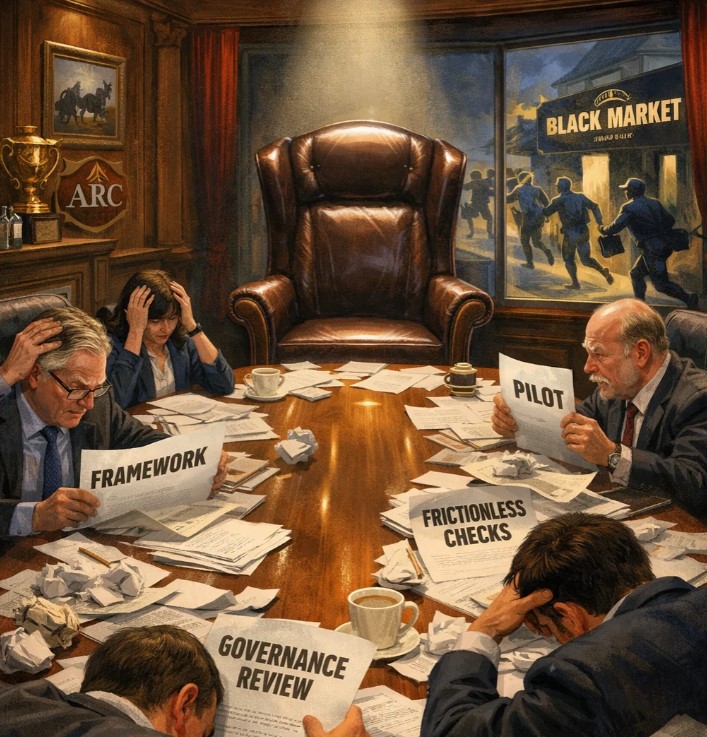
Brant Dunshea's opening line on Luck on Sunday was that his elevation to BHA chief executive had felt like business as usual. He meant it as reassurance. It landed, for anyone with a passing acquaintance with reality, as a confession. British racing enters spring 2026 without a permanent chair, without delivered digital infrastructure, without a coherent response to the regulatory assault on its betting base, and with a foal crop declining at an accelerating rate that would alarm a demographer, let alone a breeder. Business as usual is not, in these circumstances, a comfort. It is the diagnosis.
Nick Luck, performing that rare act of British broadcasting radicalism — asking for plain English — spent forty minutes trying to get behind the language. Not the strategy language, that ghastly Esperanto in which every failure is a "learning" and every vacuum is an "ongoing engagement process," but the substance underneath. Who is in charge? What, precisely, is being done? What will change, and when? The answers were abstract, frequently near the point, and — at the critical moments — always just short of it. A man perpetually one sentence away from saying something useful is not a stupid man. He is an institutionally constrained one. The institution has a name for what is constraining him. The name is Chair. The chair is empty.
The Void at the Top
An empty chairmanship does not merely leave a vacancy. It creates a climate. Executives become caretakers. Strategy becomes interim upholstery. And every public statement carries the implicit asterisk of impermanence — readable, and duly read, by every regulator, minister, and well-funded lobby group the sport needs to confront.
A chair authorises the chief executive to speak with institutional force rather than diplomatic caution. Without that authorisation, Dunshea is left doing something genuinely difficult: sounding decisive while describing an organisation that is, structurally, waiting for somebody else to be decisive later. He confirmed that the recruitment process — new nominations committee, external consultant, proper member engagement — will take a further three to six months. This is the second attempt. The sport has now operated without settled top-level leadership for the better part of two years, during which the regulatory environment has deteriorated comprehensively. A further three to six months is not a plan. It is the continuation of a vacancy that has already cost the sport its most important advocacy window.
The Black Market Racing Quietly Built
Here is the number that ought to be tattooed somewhere visible in every BHA meeting room: licensed betting turnover has fallen from £6 billion to £4.8 billion since 2022. In the same period, the black market has grown by nearly threefold. Dunshea cited these figures himself, calmly, as evidence to present to government. What he did not say — what his institutional position does not yet permit him to say at full volume — is that the BHA has been a passive co-author of the problem it is now trying to solve.
Affordability checks — financial risk assessments applied to licensed operators — followed the identical moral logic: the concern is real, the intervention is proportionate, objectors are merely commercial interests dressed as consumer advocates. The practical consequence is also identical: licensed operators bear costs and friction that unlicensed operators do not. The recreational punter who wanted twenty pounds on the 3.15, subjected to document requests his offshore alternative would never dream of making, has opened a different browser tab. He has done so with a clarity that thirty workstreams have not addressed.
Dunshea made the precise mechanism explicit but failed to address bookmaker instigated restrictions and data mining. An adverse risk check — triggered at the Commission's low thresholds — prompts the cautious operator, acting rationally in the absence of adequate guidance, to request bank statements and payslips. The Commission calls this frictionless. The punter calls it something else entirely and acts accordingly. The 97% frictionless headline figure measures the door. It says nothing about the corridor behind it. That this has not been stated publicly, loudly, and repeatedly as a straightforward misrepresentation of the pilot's effects is a direct consequence of an institution arguing from a position of unsettled authority. A properly constituted board, with a chair behind the chief executive, could call it what it is. Instead it is described, with commendable precision but insufficient force, as a matter requiring further engagement with the interim chief executive of the leaderless regulator.
Project Beacon and the Strategy That Forgot Itself
The interview's funniest moment — and it was genuinely funny, in the way institutional comedy always is — came when Dunshea invoked Project Beacon as evidence of strategic clarity and then could not, under the gentlest possible pressure from Luck, produce the six "jobs to be done" at its heart. Luck's observation was forensic: if they haven't resonated with the chief executive, they are unlikely to resonate on the Clapham omnibus. This is not unkind. It is how organisations work. Frameworks propagate by genuine belief or they die in the filing cabinet, continuing to appear in presentations long after their operational influence has expired.
The deeper problem with Beacon's welfare-first marketing conclusion is analytical. That 30% of the attainable market cites equine welfare as a barrier to engagement is real data. That welfare assurance messaging will convert that 30% into racegoers does not follow without an additional step the research apparently did not take. Stated barriers and actual behavioural drivers are different things, and conflating them produces campaigns that manage reputation without building audiences. Nobody ever fell in love with a sport because a billboard implied its compliance department was broadly satisfactory. Wimbledon does not advertise itself on the strength of its physiotherapy standards. If your headline pitch is an anxious assurance rather than an invitation to joy, you are not marketing a spectacle. You are pre-emptively filing a defence statement.
The Conclusion the Interview Couldn't Reach
The case that needed making — and still needs making, harder and louder than anything heard on Sunday — is not complicated. The affordability regime has not protected consumers. It has displaced them from a regulated environment to an unregulated one, reducing Levy yield, reducing prize money, reducing breeding investment, and building a black market that contributes nothing to the sport and everything to the problem it was designed to solve. These are not assertions. They are the logical consequence of Dunshea's own numbers. A sport losing £1.2 billion in licensed turnover while the black market triples is not a sport whose regulator is protecting anyone. It is a sport whose regulator has, with the best possible intentions, made things measurably worse.
That argument requires someone authorised to make it without three paragraphs of throat-clearing in front of it. That authorisation has a title. The title is Chair. The chair is empty. The black market is not.
Until the first fact changes, the second will keep growing. And British racing will continue administering itself, with great diligence and considerable intelligence, toward a future it is too structurally cautious to prevent.
Business as usual. Which is, and always was, precisely the problem.