“Satire so sharp, it cuts deeper than the truth.”
The BHA's Cheltenham Fix, Translated: Please Stop Doing the Thing You're Mathematically Forced to Do
Cheltenham's False-Start Problem Isn't About Discipline. It's Game Theory.
HORSE RACING
Ed Grimshaw
7/16/20263 min read
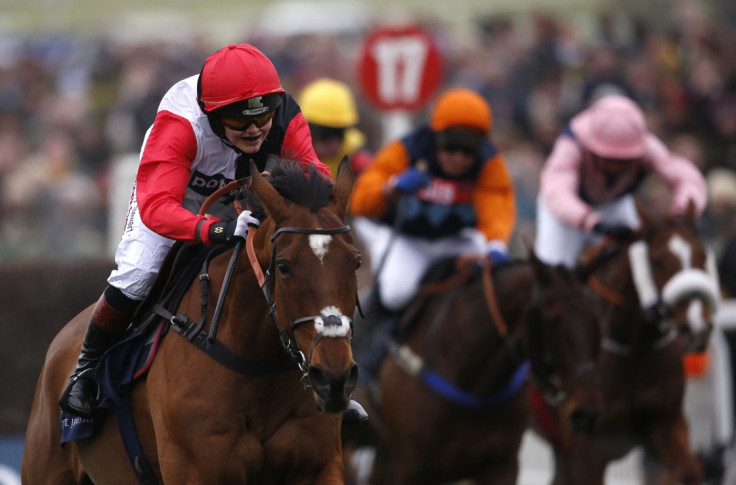
The BHA has just published five recommendations to fix the farce of Cheltenham Festival starts. New pens. Clearer language. A visible start zone. Bigger fines. Recorded audio. Every one of them treats the symptom. None of them treats the disease.
Because the real problem at Cheltenham was never bad behaviour. It was a coordination trap — and coordination traps don't respond to better manners.
The maths every jockey already knows
Picture twenty-two horses converging on a two-mile start with a bend close behind it. Every rider in that field faces the same silent calculation: if I hold my ground and the others edge forward, I lose four lengths before the tape even lifts.
There is no version of that equation where standing still is the rational choice. So nobody does. The field creeps, then surges, then the starter recalls it — and the entire charade resets with everyone twenty seconds more wound up than before.
This is what game theorists call an assurance game: a situation where the best outcome for everyone depends on mutual trust that nobody will defect first, but the individual incentive to defect is overwhelming. Poker players call it the same instinct that makes a table go all-in. Economists call it a race to the bottom. Racing has simply never called it anything, which is why the BHA keeps trying to solve it with vocabulary.
It is, in essence, twenty-two half-tonne animals playing a very high-stakes game of "last one to move is a coward" — and the BHA's response has been to ask them, politely, to stop.
Swapping "walk or jig-jog" for "walking pace" doesn't touch the incentive structure. It just gives stewards a marginally tidier phrase to disagree about afterwards.
Punishing the wrong actor
Consider the penalty proposal. Stronger sanctions for anticipation sound decisive — until you ask a simple question: in a genuine collective surge, who anticipated?
The rider at the front who edged forward because the horse behind was breathing down his neck? The horse three back who got carried along by twenty tonnes of moving momentum? Punishing the three most visible jockeys after a mass surge isn't justice — it's scapegoating dressed as enforcement. It treats a systems failure as a discipline failure, which is precisely the mistake that produces public cynicism rather than public confidence.
You do rather suspect this particular recommendation was drafted by people who have never once stood in a fifty-strong jump field with a bookmaker's clock running and a Gold Cup favourite buried on the rail. It reads beautifully on a flipchart, in a room with biscuits. It falls apart the instant an actual horse turns up.
What actually fixes coordination traps
Every sport that has solved this problem has done it the same way: by removing the incentive to defect, not by threatening the defectors.
Formula 1 doesn't ask drivers to "be responsible" at the grid — it uses a set of lights that costs less than a jockey's saddle and has never once needed a strongly worded memo to enforce it. Sprinters don't self-police reaction time — starting blocks and false-start sensors do it mechanically. Ireland's trial of flag starts from fixed marker poles, quietly running while Cheltenham burned through headlines this spring, points at exactly this logic: give horses a spatial anchor that makes the incentive to creep forward disappear, rather than a rule that merely criminalises it after the fact.
The BHA's new start zone is a step in that direction — but only if it functions as a genuine release window rather than another line for twenty jockeys to race towards first. Get the geometry right, and the behavioural problem largely solves itself, because there's nothing left to gain by jumping the gun.
The uncomfortable truth
Cheltenham doesn't have a jockey discipline problem. It has a mechanism design problem, dressed up for three days a year in the sport's brightest spotlight. Ordinary British jump racing runs false starts at 3–4%. The Festival hit almost 40% in 2026. That gap isn't explained by jockeys suddenly forgetting how to behave — it's explained by field size, course geometry and the collision of national starting cultures, none of which a strongly worded memo can fix.
The BHA has bought itself better paperwork. Whether it has bought itself a fair start is a different question entirely — and one that won't be answered until twenty-two horses are asked to prove it in March.