The BHA Didn’t Choose Reform. It Chose a Fresh Nameplate
A permanent CEO who changed nothing, a recycled interim chair, and a board that couldn't deliver reform now congratulating itself for ratifying failure — British racing isn't being rescued. It's being taxidermied.
HORSE RACINGPOLITICSSPORT
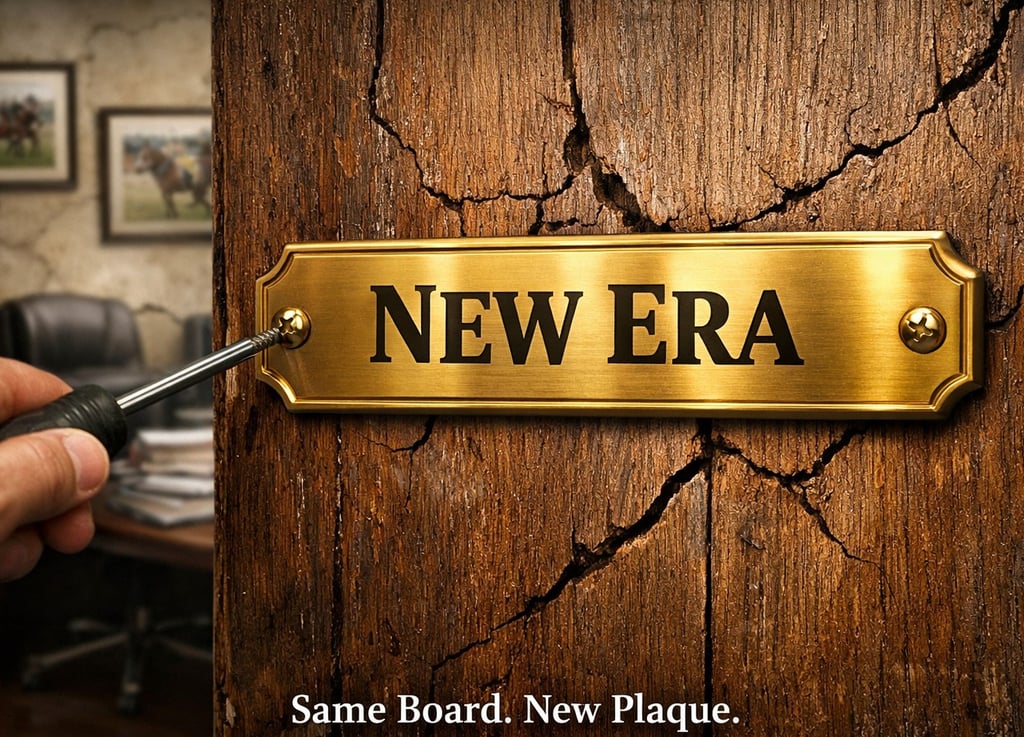
There comes a point in the decline of any British institution when it mistakes a new brass plate for a new beginning. The British Horseracing Authority has now reached that point with the confidence of a man reversing a horsebox into a duck pond and calling it a strategic manoeuvre. A chairman resigns after six months in office. The acting chief executive is made permanent. The acting chair becomes acting again. The same board that has just demonstrated all the structural authority of a blancmange in a tumble dryer announces stability, energy, integrity and a bright future for people and horses. One half expects the next statement to report that the building is on fire but morale in the corridor remains excellent.
And there, really, is the problem. British racing is not merely badly governed. It is governed by people who appear to believe the rest of us are stupid enough to mistake continuity for cure, permanence for progress and another temporary arrangement for adult supervision. The latest sequence is not reform. It is administrative taxidermy. Something has died, and they have brushed its fur.
The same driver, a shinier badge
Let us start with the obvious question, which is also the rudest and therefore probably the most useful. If Brant Dunshea was already acting chief executive, why exactly are we meant to believe that making him permanent changes anything of substance?
Acting chief executive does not mean ornamental foliage. It means doing the job. It means being in charge while the institution remains strategically muddled, politically weak and operationally inconsistent. It means presiding over the period in which governance reform collapsed, the board tied itself in knots and the chairman departed. So what magical power does the word permanent suddenly confer? Does it untangle the fixture list? Improve prize-money? Dismantle the veto structure? Cause racecourse factions to discover civilisation? No. It changes the stationery.
Now, Dunshea may be competent. He may be diligent, able and respected. Fine. But institutions are not redeemed by biography. They are redeemed by changed structures, changed incentives and changed outcomes. If the acting chief executive was already at the controls while the broader machine produced paralysis and revolt, then the permanent appointment is not a strategic dawn. It is a filing decision with a trumpet fanfare attached.
The revolving chair strikes again
Then there is David Jones, back as interim chair for the second time. At this stage he is less an interim chair than a reusable emergency prop, wheeled back on whenever the BHA mislays a permanent answer. One imagines him kept in a glass cabinet marked: Break in case of another governance embarrassment.
Again, this is not personal. He may be conscientious, experienced and admirably calm. But there is something deeply unhealthy about a system that treats recurring temporary authority as continuity rather than as a symptom. An interim chair is supposed to hold the fort, not redraw the empire. The job is to keep the machinery running, recruit the person who will own the next phase and avoid doing anything that narrows the room before that person arrives.
Yet that is precisely what this sequence risks doing. A temporary chair helping to ratify a permanent chief executive while the permanent chair has not even been appointed is not the picture of restraint. Formally, it may all be proper. Governance, however, is not merely about what is permitted. It is about what is prudent. Some decisions should wait for the person who will have to live with their consequences.
A revolving acting chair should not be making permanent weather. Otherwise the next permanent chair arrives not as an authority but as a latecomer, invited to admire choices already made on his behalf.
Allen was not just unlucky. He was outmatched
At this point, etiquette demands that one speak tenderly of Lord Allen, as the latest distinguished figure to discover that British racing contains more trapdoors than a touring farce. But he deserves sterner treatment than the usual soft-focus obituary for a departed chairman.
Allen was not simply thwarted. He was also ill-suited to the specificity of the fight. He seems to have understood reform in theory but not the terrain on which reform in British racing actually has to be fought. This is not a normal corporate tidying-up exercise. It is a medieval patchwork of racecourse empires, participant grievances, commercial trench warfare, historical fudge and committees that breed like damp. A man can arrive with the right ideas and still be wholly unequal to the battlefield.
That appears to have been Allen’s problem. He grasped the destination — more independence, more commercial clarity, less capture by vested interests — but not the minefield between here and there. British racing did not need a chairman who could merely say the right things about reform. It needed one who knew exactly where resistance would come from, who would brief against him, which alliances were real and which smiles concealed sharpened cutlery. Allen looked, in the end, like a man invited to command the campaign before anyone told him the artillery belonged to somebody else.
The board that failed at reform now wants credit for ratification
Which brings us to the grotesque heart of it. How can a board that has just demonstrated it is not the solution suddenly present itself as the wise and stabilising body that ratifies the future? That is the real joke. The board could not deliver the reform on which its chairman had accepted the role. It could not align the interests around the table. It could not turn strategic direction into executed change. But it could move briskly to confirm the acting chief executive and congratulate itself for doing so. This is a very British kind of competence: when the constitution catches fire, bolt down a filing cabinet and declare the building safe.
A functional board tests decisions. A dysfunctional board times them. It fails at the large question and compensates by acting briskly on the smaller one. It cannot produce legitimacy, so it manufactures certainty. It cannot fix the machine, so it polishes a visible cog and hopes the public mistakes movement for engineering. That is what this feels like. Not confidence. Relief wearing a lanyard.
When the chair changed, the choir suddenly found its hymn books
There is another smell to all this, and it is not healthy. During Allen’s tenure, governance reform generated blockage, acrimony and resignation. Once he exits, however, the atmosphere softens. The hymn books come out. Everyone rediscovers shared purpose, stability and the joys of moving forward together. How marvellous. One man leaves and suddenly the room becomes harmonious, like a Victorian family improved by the death of the uncle who asked rude questions.
One begins to suspect that consensus in British racing is simply the noise made after the dissenter has left the room. If a permanent chair resists and the result is muttering, paralysis and eventual exit, but the temporary arrangement produces instant harmony, then what is being sold as principle begins to look much more like preference. The system likes agreement only when agreement means acquiescence. That is not governance. That is factionalism with biscuits.
Kill the word collaboration
And while we are identifying the dead language that has helped get the sport into this mess, may I suggest that the next chair do one useful thing immediately: kill the word collaboration. Kill it stone dead. Bury it at midnight. Nail it to the stable door as a warning to others.
British racing has been collaborated half to death. It has collaborated its way into paralysis, consultation fatigue, strategic mush and the sort of decision-making timidity that makes a parish council look Napoleonic. Every time the place catches fire, somebody appears with another appeal for collaboration, by which they usually mean that nobody must be upset, nobody must lose and nothing must happen that cannot later be described over lunch as constructive engagement. That is not leadership. That is a sedative.
The sport does not need another chairman rising to deliver an uninspiring Gimcrack speech about coming together, shared values and our great sport’s proud traditions. It has had enough warm prose and noble uplift. Enough managerial incense. Enough upholstered surrender. It needs somebody prepared to make enemies by teatime. Somebody willing to say that the equilibrium is the disease, not the cure, and that not every interest deserves a veto merely because it has learned to speak in committee English.
No more Zoom governance and no Westminster convalescents
It would also help if the BHA ceased to project the atmosphere of a middle-management Teams call that has somehow wandered into responsibility for a national sport. Racing ought not to look as though it is being governed from spare bedrooms, kitchen islands and softly lit studies containing a Labrador, a ring light and a bowl of heroic almonds. Institutional authority is not strengthened by the suspicion that the whip rules may have been discussed between an Ocado delivery and the school run. A regulator in low-grade constitutional crisis should probably give the impression that its leaders occasionally leave the house.
And while we are at it, let us kill off another dreadful temptation: the idea that some political candidate might be the answer. British racing does not need a former minister, ex-adviser or Westminster refugee arriving to audition for a third career reinvention in a decent tie and borrowed binoculars. It does not need a man whose chief qualification is having once sat through a select committee and now believing this entitles him to govern an industry held together by horseflesh, grievance and leverage. The BHA is not a convalescent home for overpromoted politicians. The sport needs a governor, not another parliamentary escapee looking to swap the whips’ office for the whip rules.
The real vacancy at the BHA: adult supervision
What the sport now needs is something rarer and far more specific than another respectable chairman. It needs an insider without partisan allegiance to the racecourse power blocs. Not an outsider learning on the job while the building smokes. Not a racecourse executive whose loyalties are already spoken for. Not a participant representative whose perspective, however valid, is too narrow for the regulator’s top office. And certainly not some professional political retread in search of a softer landing. It needs somebody with three kinds of experience.
First, experience of racing itself. Not pageantry. Not lunch. Not a sentimental attachment to the Derby. Real understanding of how the sport functions when the cameras leave and the bills remain: levy mechanics, data rights, fixture politics, breeding economics, prize-money tensions, ownership fragility, the lot.
Second, experience of conflict. Not a taste for moderated panels and stakeholder workshops, but proof of having fought serious institutional battles and won some. Racing is not suffering from a misunderstanding curable by another away day and a tray of dying pastries. It is suffering from entrenched interests and veto points. Conflict here is not the failure of governance. It is the medium through which real governance will occur.
Third, experience of effective governance itself. Not decorative chairmanship. Not collecting non-executive titles like commemorative spoons. Real governance: making decisions stick, containing factions, imposing discipline and surviving the outrage that follows. Because that is the real vacancy at the BHA. Not simply chief executive. Not simply chair. Adult supervision.
So here is the question hanging over the whole operation. If Dunshea was already acting CEO while the sport drifted, if Jones is again the revolving acting chair, if Allen proved that broad reforming rhetoric is no match for entrenched racing politics, and if the board has just shown that it is not equal to the structural problem, why should anyone believe this latest arrangement marks the beginning of improvement rather than merely the tidying up of failure?
That is the question they do not want asked. And until somebody answers it, every fresh nameplate at the BHA will mean exactly what the last one did: nothing much, beyond proving that in racing administration even the revolving doors have become part of the fixture list.