The ARC: France Galop Has Fixed a Problem That Didn't Exist
"The world's greatest breeding test has just been opened to horses that cannot breed"
HORSE RACINGCULTURE
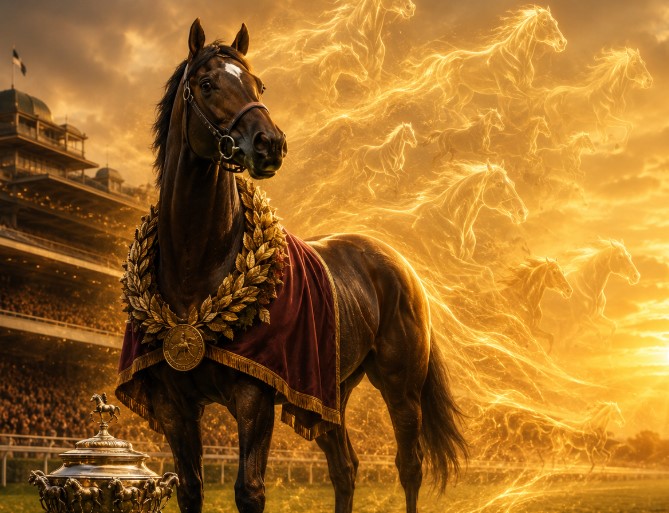
There is a doctrine now embedded so deeply in the institutional bloodstream that it has become simply the way things are done — the first principle, the thing that doesn't need defending because questioning it would reveal you to be the sort of person who needs re-educating. The doctrine holds that any rule which prevents a person, or a group of people, or indeed a horse, from participating in something is, by its very nature, suspect. The rule may have existed for a hundred years. It may have been devised by clever people with precise reasons. It may be doing exactly the job it was designed to do. None of this matters. The rule excludes. The rule must therefore go.
We encountered this logic first in the HR department, where it found fertile ground, and from there it spread with the enthusiastic efficiency of something that has not been properly vaccinated against. It reached the committee rooms of national sports governing bodies and the boardrooms of ancient institutions, and now — inevitably, really — it has arrived at Longchamp.
France Galop announced earlier this month that from 2027, the Prix de l'Arc de Triomphe will for the first time in its 105-year history be open to geldings. The board voted for it overwhelmingly. Several distinguished trainers called it wonderful. It is being celebrated as a triumph of openness, of modernity, of barrier removal. It is a historic moment. And it is completely wrong.
The Prix de l'Arc de Triomphe is not a horse race. I realise that is a peculiar thing to say about a horse race, but stay with me, because the distinction turns out to matter rather more than the people who voted for this change appear to have noticed. The Arc is a breeding championship.
When Montjeu won the Arc in 1999 — in that long, relentless, unstoppable style that made the race look as though it was being conducted at a pace the other horses hadn't been informed about — he was not simply winning a trophy. He was earning his admission to the stud. And the consequences of that October afternoon in Paris took about three years to become visible, and then kept becoming visible for the next decade. Camelot, who won the 2000 Guineas and the Epsom Derby and the Irish Derby. Pour Moi, who won the Derby. Hurricane Run, who won the Arc himself. Motivator. Authorized. Four Epsom Derby winners from a single stallion. Thirty-five individual Group 1 winners. The winners of more than fourteen million pounds in prize money. Montjeu did not merely win a race. He created a decade of racing.
Sea the Stars, who won in 2009 with a serenity and authority that made everyone else look as though they were competing in a parallel but slightly slower event, has had his progeny win the Epsom Derby, the Oaks, the Irish Derby, the Irish Oaks — and the Arc itself. What happened at Longchamp in October 2009 is still happening now, in bloodlines still deepening, in horses not yet retired, in race cards not yet written.
This is what the Arc does. It selects which horses will shape the next generation. The winner goes to stud. The winner's progeny fill the race cards at Goodwood and Leopardstown and Longchamp for the following ten, fifteen, twenty years. The International Pattern — the whole system of Group races of which the Arc is the summit and the final examination — was not constructed to find the fastest horse in Europe. It was constructed to find the best breeding stock, to calibrate the industry, to set the genetic direction of the thoroughbred for the next generation and the one after. It is an enterprise that measures not just speed but continuation. A gelding will carry the trophy to the grave and nowhere further.
That, obviously, is the definition of a gelding.
I understand why this feels like an injustice. The horse that prompted all of this is called Calandagan, trained by Francis Graffard — and here is the irony that nobody has dwelt on sufficiently — for Aga Khan Studs, which is one of the great breeding operations on earth. Calandagan was rated 130 by the International Federation of Horseracing Authorities last year, making him the best horse on the planet. He won the Grand Prix de Saint-Cloud. He won the King George VI and Queen Elizabeth Stakes at Ascot. He then flew to Tokyo and won the Japan Cup, which no European-trained horse had managed in twenty years, in a race so good they broke the track record. He is magnificent. He is a gelding. He has never run in the Arc. Looking at those facts in a line, you can see why sensible people get cross. I can see it myself.
There is also the argument — and even André Fabre, who has won the Arc eight times and who is firmly against the change, concedes this — that some trainers have kept horses entire against the evidence, against their temperament, against their soundness, against what their vet was plainly telling them, because the Arc demanded it. If that is true, and it probably is, it is not entirely clean. A rule that causes unnecessary suffering in order to preserve a tradition is not a wholly good rule.
But.
Strip the breeding stakes from the Arc and you have the richest turf race in Europe. Which is, God knows, not nothing. But it is less than what it is. Geldings are wonderful animals and they have their races. The Melbourne Cup is essentially theirs. The Champion Hurdle, the Grand National, the Ascot Gold Cup — jump racing would be barely recognisable without the great neutered warriors at its heart. These are races that demand courage, stamina, and an almost contemptuous indifference to the opinion of the fence, and geldings own them absolutely.
But those races do not create stallions. They do not ask their winner to matter beyond the afternoon. The Arc asks something different: are you complete? Not merely gifted, not merely fast, but complete in the sense that you will carry something forward into horses not yet born? Will there be race cards in 2035 that are richer because you existed? A gelding has already answered this question, and the answer — honestly and bravely given — is no.
What concerns me about the France Galop vote is not that the people who cast it are stupid or cynical. They are neither. What concerns me is the ease with which the inclusivity doctrine colonises institutions that had been functioning perfectly well without it. You identify a rule. The rule excludes someone. You remove the rule. You feel you have done something useful. What you have actually done is remove the rule without investigating why it exists, which is the intellectual equivalent of pulling out a load-bearing wall because it was blocking the light.
In a sport in which so much is already being flattened — in which the jump season contracts and the winter programme thins and the cards fill with Class 5 handicaps sponsored by companies that appeared from nowhere eighteen months ago and will have disappeared again by spring — the Arc was one of the last places where something beyond pure athletic performance was being measured. Where the question was not merely who is fastest but who will matter. Who will create the races of the next decade. Who will be written into the future of the sport in a way that the winner of a rich handicap at Kempton simply will not. France Galop should have said no.
Obviously, they didn't. Calandagan can now, in theory, run in the 2027 Arc. He will be five years old. He may well be the best horse in the race. He will win the most luminous trophy in European racing, carry it to the grave and nowhere further, and the race that chose him will be, in some very precise and very important sense, less than the race that chose Montjeu in 1999 and Sea the Stars in 2009 — those horses that didn't merely win the Arc but went on to write the race cards of the decade that followed.
Perfection.