STEVE DAVIS CALLED IT AN EMBARRASSMENT. HE'S WRONG. IT WAS THE BEST THING I'VE SEEN IN FIFTY YEARS OF WATCHING THIS SPORT.
Mark Allen led by thirty points with eight reds on the table. He lost. Nobody potted a ball for fifty-five minutes. I have never been happier.
SPORTGENERAL

There are moments in sport that you do not so much watch as endure, and endure in the very best sense of that word — the way a man endures a great meal, or a long evening of exceptional conversation, or the final movement of a symphony that seems to have discovered new rooms within itself just as you thought the house was ending.I want to say something that may get me banned from World Snooker and possibly escorted from the premises of the Crucible Theatre by a man in a lanyard. I loved it.
I loved every baffling, logic-defying, crowd-enraging, gravity-insulting minute of the fourteenth frame between Mark Allen and Wu Yize at the 2026 World Championship. All one hundred minutes and twenty-one seconds of it. Including — perhaps especially — the bits where nothing whatsoever happened for so long that viewers began quietly questioning their own grip on reality.
This was not great snooker. This was something considerably more interesting than great snooker. This was snooker having a complete and spectacular nervous breakdown in front of a sold-out crowd and a BBC television audience, and refusing — absolutely refusing — to be talked down from the ledge. I wouldn't have missed it for anything.
Let me set the scene, because the scene deserves setting with the care usually reserved for significant historical events — which, in its own magnificently deranged way, this was.
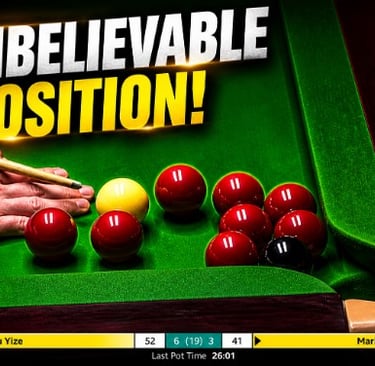
Mark Allen led 43-13 in the fourteenth frame with eight reds remaining. This is, by any conventional measure, a position of such serene comfort that the only remaining question is whether Allen fancied a tea before closing it out. What followed instead was fifty-five minutes — I want you to really sit with that number — fifty-five consecutive minutes during which not a single ball was potted.
The BBC deployed a graphic to confirm this. The BBC. An organisation not given to unnecessary drama deployed a graphic to tell the nation that no, you are not imagining this, and no, the television has not frozen, and no, this is what is actually happening at the World Snooker Championship.
The cause was the eight reds, which had — and I can only describe this as a collective decision — gathered themselves around the black ball near the top corner pocket in a formation of such density and mutual interdependence that they appeared to have formed a small government. The black was jammed against the pocket like a bouncer who has had an absolutely tremendous Friday and is not going home under any circumstances. The reds surrounded it loyally. Nobody was getting in. Nobody was getting out. Democracy had failed.
Allen's tactical response was to kiss the reds with the cue ball and dispatch it serenely to the far end of the table, where it could have a little think. Wu's counter-response was to roll it gently back. Allen sent it away again. Wu fetched it back. This continued, I want to emphasise, for fifty-five minutes. It was like watching two extraordinarily talented men play the world's most expensive game of catch.
The crowd — God bless the Crucible crowd — responded with the full repertoire of British passive aggression. The slow handclap. The sarcastic cheer after each shot, delivered with the gusto usually reserved for a particularly good firework. The theatrical sighs. And then, inevitably, the hero. Some magnificent individual in the darkness, a person I would like to shake warmly by the hand, cut through the charged Crucible air with a question the entire building had been composing for the previous forty minutes: "Can we have a re-rack?"
Referee Marcel Eckhardt turned, squared himself, and with the magnificent self-possession of a man who has decided that today — today of all days — he is not taking instruction from the audience, replied: "Thanks for the advice, but we can do it without you."
Somewhere in the building, WST officials had apparently abandoned conventional management and pivoted to the supernatural, collectively attempting to will the black ball into the pocket through focused institutional telepathy. I like to imagine them in a side corridor. Several lanyards. Eyes closed. Breathing deeply. Nothing working.
Meanwhile Steve Davis, in the BBC studio, was polishing the word embarrassment until it shone. Kyren Wilson called it "quite painful," which is the snooker equivalent of screaming. Stephen Hendry, who spent seven world titles rendering this kind of deadlock unnecessary by the simple expedient of potting absolutely everything, was similarly uncharitable. I understand their position entirely. I simply disagree with it. Because here is what I witnessed, and here is why I will not apologise for enjoying it enormously.
I witnessed a sport defy its own logic so completely that it briefly became performance art. I witnessed eight snooker balls park themselves around a black and essentially go on strike, defying two elite professionals, one referee, several WST officials, a capacity crowd, and the fundamental purpose of the game itself. I witnessed a frame that had the audacity to last a hundred minutes whilst potting precisely the same number of balls you would expect from a man who had wandered into the arena during the interval and found a cue.
This is extraordinary. This is glorious. Sport produces the predictable by the mile. The genuinely, bewilderingly, defiantly weird arrives once in a career.
And then — because the frame had clearly decided that mere absurdity was insufficient and it needed a third act — the whole thing went completely sideways. Eckhardt, following a word from a superior with presumably some strong feelings, gave both players three shots to change the pattern of play or face a re-rack. Allen, who was still ahead and objected to this intervention with considerable feeling — the delicious irony of a man protesting against being prevented from continuing to do nothing apparently lost on nobody except Allen — duly cannoned into the reds and potted the black. A foul. Wu made 41. Led by 28 at the blue. Then accidentally knocked the black in attempting to pot the blue, leaving Allen needing one snooker to win a frame he had led by thirty points with eight reds on the table. At this point I was no longer watching snooker. I was watching a Samuel Beckett play that had somehow acquired a scoreboard.
And then — then — Wu Yize, twenty-two years old, found himself trapped behind the black on the pink, the same black that had spent an hour as an immovable obstruction and had now cheerfully reinvented itself as a defensive weapon with all the versatility of a true professional. The escape he produced was exceptional. He potted the pink to a baulk corner. Frame to Wu, 88-62. They went into Saturday level at 7-7. Allen had lost a frame he led by thirty points, via a sequence of events that would be rejected by a fiction editor as implausible.
I stood and applauded. Metaphorically. I was on my sofa. But the spirit was there.
Now. Do I want this every frame? Of course not. The genuine hundred-minute frame — the kind built on two elite competitors refusing to concede an inch, where every safety shot carries the accumulated weight of everything that preceded it, where the crowd is not slow-clapping but barely breathing — that is one of sport's great experiences. It is chess at gunpoint. It earns its length.
And it earns its length precisely because it is rare. Scarcity is value. The extraordinary only exists in contrast to the ordinary. If every frame becomes the fourteenth frame, then the fourteenth frame becomes merely a Thursday.
Davis is right that the associations must look at this. The rules need teeth. The referee — and I say this with affection for a man doing an impossible job under impossible circumstances — needed to intervene approximately thirty minutes before a superior arrived to suggest that intervention might be advisable. There are lessons to be learned. Regulations to be written.
But let us learn them without entirely extinguishing the glorious, ungovernable, utterly inexplicable spark that produced one of the most talked-about frames in World Championship history — a frame that nobody who was watching will ever forget, for reasons they will never be quite able to fully explain. Snooker, at its best, makes you hold your breath. At its deranged, logic-defying, black-jammed-in-the-pocket worst, it makes you question whether you have ever understood anything about anything.I find both conditions completely irresistible.
Ed Grimshaw has watched every World Championship since the smoking was still permitted. He has never previously seen fifty-five minutes without a ball being potted, has not entirely recovered, and is already looking forward to next year.