Save Our Bookmakers (Profits)
A campaign by the people who broke British betting, for the people who fund it, dressed as a crusade for the people being robbed by both
HORSE RACINGBUSINESS

"Save Our Bets is a campaign for your right to lose freely, brought to you by the same people who made winning commercially inadvisable. Read that sentence. Read it again. Then ask yourself why nobody in British racing said it out loud until now — and specifically why nobody said it four years ago when it would have actually mattered."
Four years ago, this column ran a petition opposing the financial checks being proposed for punters. The grounds were straightforward: the checks were disproportionate, bluntly designed, structurally exploitable, and ripe for abuse by an industry that had spent the previous decade demonstrating — with impressive consistency and absolutely no apparent shame — its appetite for using any available mechanism to identify, manage, and quietly remove its most competent customers from any market they showed signs of understanding. The argument was evidence-based, specific, and entirely correct.
The racing industry's response was silence. The BHA's response was the particular, expensive silence of an organisation that had not yet run the levy numbers. The Racing Post — that fearless tribune of punter rights on the precise occasions when punter rights happen to align with bookmaker advertising revenues — did not stir. The Betting and Gaming Council did not call. The racecourse chief executives who have now signed an open letter with the urgency of men who have just noticed their trousers are on fire were, apparently, all simultaneously unavailable for the better part of half a decade.
Then months later someone updated the levy projection.
And suddenly, magnificently, like a field of meerkats hearing a distant twig snap, four hundred and eight people swivelled as one and discovered they cared enormously about the British punter.
I note this not to score points — the argument was right, which is sufficient reward for anyone who has spent time operating in British racing governance — but because the timing tells you precisely what this campaign is and is not for. It is not for punters. It never was. It is for the funding model. The punter is the human shield, deployed with the kind of strategic cynicism that would earn genuine admiration if it were not quite so transparently cynical.
Remember that. We will return to it repeatedly and with enthusiasm.
FIRST, A BRIEF DIVERSION INTO WHAT THESE CHECKS ACTUALLY ARE — BECAUSE THE CAMPAIGN HAS FOUND PRECISION INCONVENIENT AND DECIDED TO DISPENSE WITH IT
Before we proceed, a technical observation the campaign has found sufficiently uncomfortable to ignore entirely.
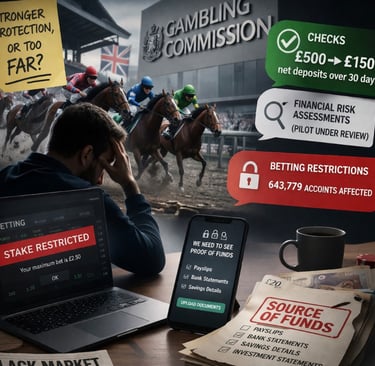
The Gambling Commission has not, in formal regulatory language, been proposing "affordability checks" in the mortgage-interview sense that the campaign's rhetoric implies. What it actually introduced from August 2024 were "light-touch financial vulnerability checks" — initially triggered at £500 net deposits over 30 days, then lowered to £150 net deposits over 30 days from February 2025. These use publicly available data and are described by the Commission as deliberately low-friction. The Commission has been at considerable pains to distinguish these from the separately proposed "financial risk assessments" — a more targeted regime for higher-risk cases, currently being piloted — and has explicitly said it is not implementing full affordability checks.
The campaign uses "affordability checks" throughout because it is politically useful, rhetorically alarming, and considerably better for headlines than "light-touch financial vulnerability checks at a £150 net deposit threshold using publicly available data." This is understandable. It is also worth noting, because the gap between what the Commission is actually proposing and what the campaign describes it as proposing is doing a substantial amount of the campaign's argumentative work without acknowledgement.
Similarly, the claim that the Commission "went silent" in May 2025 is more editorial poetry than documentary record. The Commission was still issuing updates through 2025. The more accurate complaint — and it is a legitimate one — is that those updates contained insufficient reassurance about CRA inconsistency and that the independent NatCen evaluation has not been published. That is a real problem. It is a different problem from regulatory silence, and conflating them weakens an otherwise solid argument.
The campaign is overstating. This column declines to follow suit. With precision thus established, we proceed.
THE CAMPAIGN IS CORRECT. IT IS ALSO BEING RUN BY THE PEOPLE WHO CAUSED THE PROBLEM. BOTH THINGS ARE SIMULTANEOUSLY AND MAGNIFICENTLY TRUE.
Before the demolition begins — and there will be demolition, conducted methodically, with hard hats optional — let us exercise the intellectual honesty the campaign itself declines to attempt and give credit where it is genuinely due.
The financial risk assessment pilot is not ready for implementation. This is not a racing industry talking point. It is the finding of the operators who participated in it. Credit reference agencies were returning inconsistent data for the same customer — not marginal variations, but the kind of structural discrepancies that would produce arbitrary outcomes at scale. The Commission acknowledged in May 2025 that post-pilot analysis was still exploring inconsistency between CRAs. The NatCen independent evaluation has not been published. The Commission is now proposing to proceed to sign-off in May 2026 with the transparency of a man announcing the verdict before the jury has reported. When a regulator's own post-pilot analysis is still working through data inconsistencies and its independent evaluation remains unpublished, the correct response is not deference. The campaign is right to say so, and right to say it forcefully.
The light-touch vulnerability check thresholds are blunt instruments. £150 net deposits over 30 days — using publicly available data, the Commission asserts — sounds modest until you understand that any regular punter operating across multiple platforms is clearing this threshold in the normal course of recreational betting. The Commission describes the checks as low-friction. The campaign disputes this in practice. The pilot evidence suggests the dispute has merit.
The black-market argument is overstated — the Commission's own chief executive said so publicly, which is the institutional equivalent of a builder condemning his own extension — but it is not invented. The BGC's figures on illegal betting volumes should be treated as advocacy estimates from an interested party, not neutral measurement. What is not in dispute is that the Treasury took the illegal market seriously enough to allocate £26 million specifically to tackle it in the 2025 Budget. You cannot simultaneously acknowledge illegal betting as a structural threat and implement friction that pushes regulated customers towards it. That contradiction belongs entirely to the Government. The campaign is entitled to point at it with both hands and a degree of theatrical indignation.
And the 66% of punters who told the Commission's own survey they would be uncomfortable with operators accessing their credit reference data are simply, clearly right. Financial privacy is worth defending. The campaign is right to say so.
So: the financial risk assessment regime should not proceed until the NatCen evaluation is published and CRA inconsistency is properly resolved. The frictionless standard — explicitly committed to by two successive governments as a genuine condition of implementation — should be enforced as a test rather than a slogan. These are correct conclusions. They deserve to prevail.
Now. Let us talk about who is advancing them, why, and — most revealingly — what is happening in the building they are so magnificently not discussing.
MEET THE 408 SUDDEN CHAMPIONS OF PUNTER LIBERTY
Brant Dunshea. Jim Mullen. Martin Cruddace. Tom Kerr of the Racing Post. The bookmakers' own trade body. United in passionate concern for your right to have a flutter. Provided you lose it. Quietly. Without inconveniencing anyone.
The open letter to Lisa Nandy is, one must concede, an impressive production. Four hundred and eight signatories. Racecourse managers from venues whose annual attendance could be comfortably accommodated inside a moderately ambitious marquee. Trainers. Breeders. Lords. A Baroness. The Senior Steward of the Jockey Club. The CEO of the BHA. The CEO of Arena Racing Company. The general manager of Fakenham Racecourse — and, in a remarkable mobilisation of corporate governance, nine further directors of Fakenham Racecourse, apparently convening an emergency board session to confirm that they too are deeply concerned about the levy situation. Nine directors of Fakenham. In case you were wondering quite how seriously the sport is taking this.
It is, in the vernacular, a coalition. And like all coalitions assembled at speed when money is at risk, its internal tensions are magnificent once you look for them rather than accepting the press release at face value.
Brant Dunshea's statutory purpose is to govern British horseracing in the public interest. He has signed a letter whose primary concern is protecting bookmaker turnover from state interference. Jack Barton's policy update — the most honest document associated with the campaign, written by someone who had the decency not to dress up a financial argument as moral philosophy — tells us the sport "cannot accept this further damage to racing's finances." Not punters' finances. Racing's finances. The distinction is small. It is also everything.
The BGC — the bookmakers' own trade body, staffed by people whose salaries are paid by bookmakers, whose modelling is produced for bookmakers, whose institutional interests are precisely aligned with bookmakers — produced the financial projections that racing is now citing as though they arrived from an independent actuarial review. This is the evidential equivalent of asking a man accused of arson to quantify the structural damage. He may be entirely accurate. He is not independent, and that distinction should probably have been mentioned somewhere between the first and four hundred and eighth signature.
Tom Kerr of the Racing Post has signed the letter. This is the Racing Post whose coverage of bookmaker account restrictions — stake limitations, arbitrary exclusions, the silent commercial reclassification of profitable customers as unwelcome — has been, across the years during which this practice became endemic and defining, remarkable chiefly for its absence. The Racing Post, which has the readership, the resources, and the moral authority to campaign as hard for winning punters' right to trade on fair terms as it is now campaigning against the Commission's checks — and which has chosen, with magnificent and consistent discipline, not to. Tom Kerr signing a punters' rights letter is the journalistic equivalent of a man who spent ten years ignoring a gas leak now demanding the right to light a match, and describing the resulting fireball as a heating initiative.
THEY WANT YOUR DATA. THEY DON'T WANT YOUR WINNINGS. THIS IS NOT A PHILOSOPHICAL NUANCE — IT IS THE ENTIRE BUSINESS MODEL, IN THIRTY-POINT FONT.
The double standard at the heart of "Save Our Bets" is not a flaw in the argument. It is the argument. It just happens to be facing the wrong way. Here, permit me to make the argument the campaign will not, because making it would require its bookmaker signatories to consider the view from the other side of their own terms and conditions.
Under the proposed financial risk assessment regime, an operator can require payslips. Bank statements. Evidence of savings. Documentation of income sources. The Gambling Commission confirms that in regulated contexts, source of funds evidence can include bank statements, investment statements, and P60s. All of this, theoretically, to ensure a customer is not betting beyond their means. The campaign calls this unprecedented intrusion into private financial life. It is right.
What the campaign does not mention — with an editorial precision suggesting that someone in a meeting deliberately decided not to mention it, and everyone else nodded — is that bookmakers already possess extensive powers to demand precisely equivalent financial documentation under existing source of funds rules. Betfair states publicly that it may request payslips, bank statements, savings evidence, and other documents related to betting activity. Not theoretically. Actually. This is live policy, operating now. And it is deployed not randomly, not on a consistent risk-based schedule designed to identify harm, but targeted with considerable commercial sophistication at customers whose profitability has made them inconvenient.
The Commission's own published data makes the restriction picture concrete. As of their most recent figures, 643,779 active accounts across the regulated market carry commercial restrictions. Among those accounts, 62% are stake-factor restricted — which is the industry's preferred euphemism for "we've decided you understand this game too well and we'd rather you didn't." That is not an anecdote. That is the Gambling Commission's own data, describing a market in which restricting profitable customers has become routine operating practice at industrial scale.
The logic, once stated plainly, is straightforward enough that one wonders how a 408-person campaign managed not to notice it:
The state wants your financial data to check you can afford to lose. The bookmaker wants your financial data to check you are losing enough. The campaign is furious about the first. The campaign has nothing whatsoever to say about the second.
The campaign is therefore not opposed to intrusive financial demands in betting. It is opposed to intrusive financial demands that interfere with bookmaker revenue. The punter is not a person whose privacy deserves protection. The punter is a revenue stream whose accessibility deserves protection. These are not the same thing, and the campaign's language implies they are identical — which is the precise measure of its bad faith.
Follow this to its logical destination. Under the proposed regime, if you decline to provide financial documentation, you may be refused access to a legal activity. The campaign calls this intolerable. Correct. But those same bookmakers already deploy source of funds demands selectively against customers identified as winners rather than losers — with 643,779 accounts carrying commercial restrictions as documented evidence — and the campaign says nothing. Because if it did, it would be campaigning against its own signatories.
"Save Our Bets" is not an argument that intrusive financial demands in betting are wrong.
It is an argument about who should not be permitted to make them.
The state: unacceptable. The bookmaker: entirely fine, apparently. Certainly fine enough to go unmentioned across four hundred and eight signatures, one portal, and a Sun front page.
BRITISH BETTING IS NOW A CASINO WITH HORSES, BUILT AND OPERATED BY PEOPLE ASTONISHED THE CUSTOMERS KEEP LEAVING
643,779 restricted accounts. An industry that systematically identifies and removes its sharpest customers, then holds conferences about declining turnover, has achieved something genuinely historic in the annals of commercial self-destruction
Every serious punter in this country understands the sequence. You open an account. You deposit sensibly. You back a few favourites, lose a few tenners, receive pleasantly designed marketing emails with cheerful graphics. Everything is warm and welcoming. The app is good. There is a free bet for your birthday, subject to a rollover requirement calibrated to ensure it cannot be profitably deployed on anything you would actually want to back.
Then you start winning. Not dramatically. Not suspiciously. You simply pay attention, understand value, notice that a horse with strong sectional figures is being underestimated in a field of moderate closers, and back it at a price reflecting the market's error rather than the horse's true probability. You do this a few times. You are, by any rational measure, doing exactly what a functioning betting market is supposed to permit and reward.
Within a fortnight, your maximum stake has been quietly reduced to a figure so specific in its absurdity that the specificity itself communicates the message more clearly than any letter could. You have not been warned. You have not been consulted. You have received no explanation, no communication beyond the silent appearance of a new and insulting maximum, delivered via terms update rather than the honest language of a bouncer. Among the 643,779 restricted accounts on the Gambling Commission's own data — 62% of which are stake-factor restricted — yours is now one.
Your account has not been closed. You are still receiving emails about the Grand National, casinos, slots and those products that guarantee greater bookmaker profits. There is still a free bet available if you deposit another hundred pounds. You remain, technically, a customer. You have been reclassified — without explanation, without appeal, without any regulatory body having the slightest interest in the matter — as a customer to whom no meaningful service will be provided.
IBAS cannot help you. Its remit explicitly excludes refused bets and restricted accounts — a structural feature, not an oversight. The Gambling Commission publishes data showing 643,779 such accounts and has not made rectifying the practice a regulatory priority. The BHA has signed a letter about protecting punters and has chosen not to mention any of this. The Racing Post has covered the story extensively from the angle that does not require its advertisers to change their behaviour.
What has been constructed — what the bookmakers built, with the regulator's studied inattention and the racing industry's cheerful acquiescence, because the turnover funded the levy and questions about how that turnover was being generated were considered bad manners in polite company — is a market architecturally designed for losing. Losing is profitable. Losing is the product. Losing gets you a loyalty scheme and a personalised email. Winning triggers a review. Winning gets you progressively restricted until the restriction makes a complete mockery of the word "customer."
British betting is now a casino with horses. A casino where the house has the edge built in, the exit signs are permanently illuminated for anyone showing signs of competence, and the admission policy operates in practice as a self-selecting filter that gradually removes everyone interesting until only the reliably unprofitable remain.
The horses are wonderful. This is entirely not their fault. They are running as fast as they can and deserve considerably better than to serve as the decorative flourish of a loss-extraction mechanism with good turf management, a heritage narrative, and 408 signatories to a letter that doesn't mention them.
WHY "SAVE OUR BETS" WILL NOT STOP THE DECLINE IN TURNOVER EVEN IF IT WINS EVERYTHING IT IS ASKING
Assume the campaign wins. Completely. Financial risk assessments paused. NatCen evaluation published. Frictionless standard genuinely enforced. Lisa Nandy writes back apologetically. The Gambling Commission retreats to its corner to reconsider. Racing celebrates. Jack Barton produces an excellent policy update. The Racing Post runs it prominently, between advertisements for the bookmakers whose restriction practices it has declined to investigate.
British betting turnover continues to decline.
It continues to decline because the punters being driven away from the legal market are not primarily being driven away by financial vulnerability checks. They are being driven away by an experience that has taught them, with patient repetition, that the market welcomes their losses and regards their competence as a problem to be managed. The Gambling Commission's own data shows 643,779 active accounts with commercial restrictions. That is not a marginal friction problem. That is a structural customer relationship failure of the first order, and it predates the current regulatory debate by the better part of a decade.
The light-touch vulnerability checks trigger at £150 net deposits over 30 days using publicly available data. The population of punters meaningfully impeded by this threshold is a fraction of the population already impeded by commercial restriction practices the campaign carefully avoids discussing. Remove the regulatory check and you address a small source of friction while leaving the enormous source of structural customer alienation entirely intact. Turnover continues its trajectory. Racing continues to be underfunded. The 408 signatories reconvene with fresh letterheads and a new Secretary of State to identify the next external factor responsible for a problem sitting patiently in the room with them, waiting to be acknowledged.
The illegal market is growing. It is growing partly because of regulatory friction. It is growing substantially because a significant and expanding cohort of competent punters has found that the regulated market has already stopped offering them a meaningful service. The Betfair Exchange has partially absorbed them. Asian handicap markets have partially absorbed them. For those without the knowledge or resources to navigate alternatives, the illegal market has partially absorbed them.
An industry that systematically identifies and excludes its sharpest, most engaged, most commercially valuable customers — and then expresses bafflement at declining turnover, reduced media rights revenues, and a shrinking betting relationship with its own fanbase — has achieved something genuinely remarkable in the history of commercial self-harm. It has built a machine for destroying its own market and presented the machine as a customer service initiative.
"Save Our Bets" addresses the regulator's contribution to this problem. It says nothing about the industry's. That asymmetry is not an oversight. It is the operating principle.
WHAT A CAMPAIGN FOR ACTUAL PUNTERS WOULD DEMAND
Five things "Save Our Bets" will not ask for. And the one complete and sufficient reason it will not ask for any of them.
A campaign genuinely organised around punter interests — rather than levy income dressed in punter clothing — would demand at minimum the following. Publication of the NatCen evaluation before any decision on the financial risk assessment regime is made. Not after. Before. Because a regulator still working through CRA inconsistency in post-pilot analysis has not completed its evidential homework, and proceeding without publishing the independent evaluation is not a regulatory process — it is a conclusion in search of retrospective justification.
Reform of IBAS to bring commercial account restrictions and stake limitations within its adjudication remit, with genuine enforcement powers attached. The Commission's own data shows 643,779 accounts carrying commercial restrictions. The body theoretically available to adjudicate punter complaints cannot touch a single one. That is not a gap in the system. It is the system.
Mandatory written explanation for any restriction or stake limitation decision, subject to independent review. "Business decision" should trigger regulatory inquiry, not end the conversation. A customer whose account has been restricted from the terms on which it was opened deserves a reason that contains actual words describing an actual rationale.
Separation of source of funds documentation demands from commercial restriction decisions. Financial documentation requirements should apply on consistent, publicly stated, risk-based criteria — not be deployed selectively against customers whose profitability has made them commercially inconvenient.
And — since we are apparently now building a movement — an honest public acknowledgement that a funding model requiring racing to defend bookmaker commercial interests in order to survive the levy calculation is a funding model that has already been captured. Captured funding models tend to end badly for everyone except the people doing the capturing.
None of these appear in the campaign materials.
The reason is the same reason for all of the above omissions, and it is a complete and sufficient reason requiring no further elaboration: the campaign is funded by, signed by, and designed to serve the interests of the organisations these demands would constrain.
That is the one reason. It accounts for everything.
THE VERDICT
Save Our Bets: a campaign for your right to lose freely, brought to you by the people who made winning commercially inadvisable, and dedicated with great sincerity to a version of the British punter that exists primarily in their marketing materials
The financial risk assessment regime should not proceed until the pilot evaluation is published and CRA inconsistency is resolved. The frictionless standard was a genuine commitment made by two successive governments and should be enforced as one. These conclusions are correct and deserve to prevail.
The campaign advancing them is a coalition of bookmakers and racing bodies defending a funding model, performing consumer advocacy, through a media partner whose commercial interests are aligned with the gambling industry, carrying the signatures of 408 people not one of whom has committed to addressing the commercial restriction practices that — per the Gambling Commission's own data — are affecting 643,779 active accounts right now, today, as you read this.
The punter who cannot afford to lose deserves protection. The checks, properly calibrated, evidentially grounded, and applied with tools that actually work, could provide it.
The punter who can afford to win deserves a market in which winning is permitted. The campaign, as designed, delivers nothing for that punter — because that punter is not the customer the business model is built around.
Both punters exist. Only one of them is in the letter to Lisa Nandy. It is not the one with 643,779 company, staring at a stake restriction so insulting in its specificity that it constitutes a message, delivered without words, from an industry that has decided winners are a defect to be managed rather than customers to be served.
Four years ago this column said all of this. The industry was not listening.
It is listening now, in the narrow and specific sense that it has adopted the argument whilst surgically removing the conclusion that would have cost it anything, wrapped the remainder in a punter's rights campaign, handed it to The Sun, launched a portal, and asked the public to write to their MP on its behalf.
That is progress of a sort. It is the sort that leaves the punter exactly where they were.
Except now they have a portal.
Ed Grimshaw was a Financial Turnaround Director founding member of the Racing Innovation Group, He ran the petition. He was right then. He is right now. The difference is that being right now has 408 co-signatories who were collectively unavailable four years ago. He notes this without bitterness, with moderate satisfaction, and with the mildly unsettling awareness that the next campaign will almost certainly require him to say it again.