Racing Post Launches New Racecards: Users Advised to Bring Sherpa, Oxygen and Three Hours Spare
What was once a simple search for the 2.30 runners now resembles an alpine expedition through white space, betting ads and desktop despair.
HORSE RACINGBUSINESS
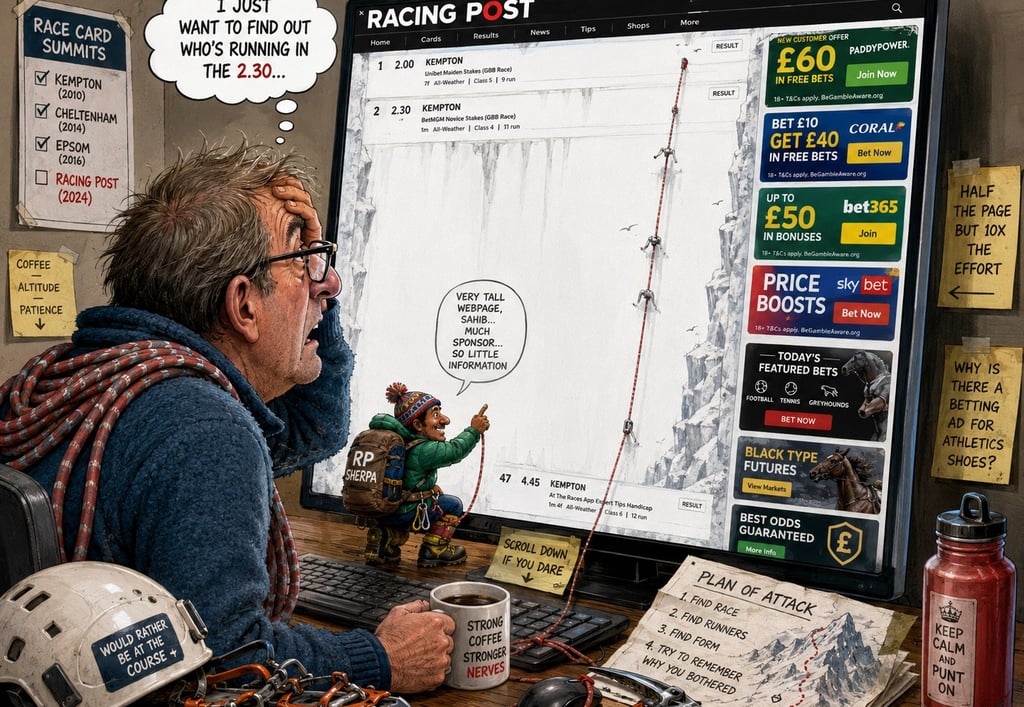

The Racing Post Has Been “Improved”, Which Is Always Where the Trouble Starts
There are few sentences in the English language more frightening than “we’ve redesigned the website”. It ranks just below “your call is important to us” and slightly above “the chef has reimagined the shepherd’s pie”. You know immediately that something simple, useful and faintly beloved has been dragged into a meeting room, strapped to a trestle table and beaten to death with a flipchart by people called Jayden and Imogen who say “frictionless” when they mean “annoying”.
And so we arrive at the Racing Post racecards, where a man wanting to study tomorrow’s racing now appears to need crampons, a sherpa and a working knowledge of app-based despair. According to the complaints doing the rounds, you open the thing on a perfectly normal desktop computer and are greeted not by a clear field of horses, races, form figures and useful details, but by two visible races, acres of white space and enough bookmaker furniture to make a branch of Ladbrokes look like a Quaker meeting house.
The Racing Post’s own help pages say its odds comparison includes live movements, each-way terms, Best Odds Guaranteed indicators and betting offers for new accounts; its app also promotes integrated bookmaker partners and betting without leaving the app. That may all be commercially sensible. It may even be convenient for the punter who wakes each morning thinking: “What I really need today is yet another login with a bookmaker I don’t use.” But for the poor soul trying to work out whether a six-year-old gelding is well treated off 82 after wind surgery, it is like asking for a library and being handed a casino with footnotes.
This is not merely a website grumble. It is a small, glowing parable of British racing’s wider genius for taking loyal customers and treating them as though they are an unfortunate legacy system. Racing is forever telling us it wants to modernise. It wants younger fans, better engagement, improved competitiveness, bigger fields, brighter Sundays, smarter data, broader appeal, cleaner funnels, shinier dashboards and, presumably, a TikTok account in which a clerk of the scales explains Rule 4 deductions while doing a little dance.
Fine. Modernise. Please do. Nobody sensible wants racing preserved in aspic, with every racecard printed by monks and every betting slip written using a quill plucked from Lester Piggott’s hat. But modernisation should mean making the product better for the people who use it. What we keep getting instead is “modernisation” as understood by people who confuse the customer with a monetisable obstacle.
This is the disease of our age: the thing you came for is now hidden behind the thing they want you to click.
The British Horseracing Authority’s strategy language talks about attracting the next generation of customers and using customer behaviour data to increase engagement and activity. Again, nothing wrong with that in principle. The sport needs money. Owners need returns. Racecourses need crowds. Media businesses need revenue. But when the phrase “customer engagement” is translated into lived experience as “scroll through this glowing hedge of affiliate opportunities before you can see the 2.10 at Pontefract”, then something has gone wrong in the boiler room of the brain.
And this is where the question must be asked: is anyone really listening? Not nodding gravely in a meeting. Not “taking feedback on board”, which in modern corporate English means burying it in a PDF graveyard beside last year’s diversity pledge and the sandwich budget. Actually listening. Listening to the punter who uses the product every day. Listening to the form student who wants information, not an obstacle course. Listening to the people who know the difference between modernisation and vandalism with a digital lanyard.
The trouble is that racing has a long and proud history of assuming that its existing audience will simply put up with things. Fixture tinkering? They’ll cope. Race times shuffled around for abstract commercial reasons? They’ll cope. Confusing initiatives with names that sound like minor regional airlines? They’ll cope. Website redesigned so a desktop screen behaves like a phone having a nervous breakdown? They’ll cope.
But they may not. That is the bit racing’s priests of engagement never quite seem to grasp. The old customer is not captive. He is merely patient. And patience is not the same thing as loyalty. The man who spends two hours studying form is not an addict to be funnelled, nor a dinosaur to be managed, nor a data point to be nudged towards a partner bookmaker. He is the sport’s bloodstream. He knows which trainers improve one for a step up in trip. He notices draw bias before the pundits. He can remember when novice handicaps had runners in them and websites displayed information in a format detectable by the human eye.
Alienate him and you do not gain a sleek new audience of urban content consumers in sustainable trainers. You just lose the bloke who cared enough to come in the first place.
This is the great corporate farce. First, a thing works. Then someone asks whether it could “work harder”. Then a consultant discovers “untapped commercial inventory”. Then the screen fills with boxes, buttons, offers, prompts, gaps, banners and helpful little traps. Finally, the company announces that a “small number of users” are “experiencing the change emotionally”, which is how modern management says: “Everyone hates it.”
The customer is not always right, of course. Sometimes the customer wants impossible things, such as cheap beer, full fields and a bookmaker who welcomes winners. But when the customer says, “I cannot see the races on the racecard,” this is not a focus-group insight requiring six months of stakeholder alignment. It is a fire alarm.
Racing’s problem is not change. Racing’s problem is change inflicted from above, insufficiently tested below, and then defended in the holy language of progress. It is the same mistake every bureaucracy makes. They ask what the system needs, what the partner needs, what the dashboard needs, what the revenue line needs. Only at the end, usually by accident, does someone ask what the customer needs.
In this case, he needs to see the bloody horses.
And if that sounds old-fashioned, then God help modernity.