Racing knows the Price of Everything — Except This
The allegation against Nico de Boinville has exposed an awkward truth: racing can calibrate a whip offence to the day, but still seems unsure how to punish something far uglier
HORSE RACINGGENERAL
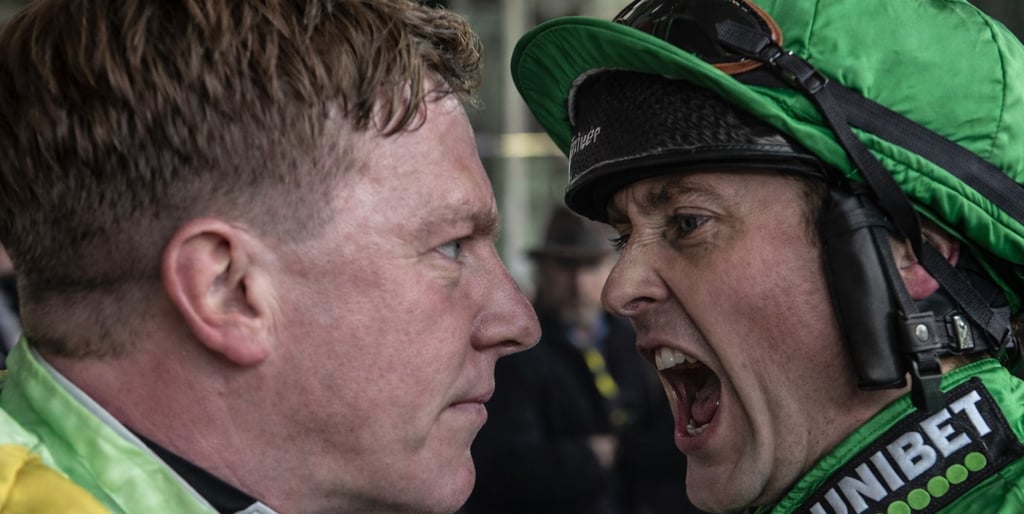
An ugly moment on the sport’s grandest stage
Cheltenham depends, more than most sporting occasions, on a certain amount of mutually agreed nonsense. We call it the Festival, as though it were a tasteful celebration of equine excellence and rural tradition, when in truth it is four days of tribal score-settling conducted in peaky blinders caps and sponsored hospitality. Britain likes to imagine it is hosting jump racing’s greatest week; Ireland increasingly treats it as an annual away pilgrimage at which to demonstrate the opposite. Trainers speak of preparation, owners of dreams, broadcasters of theatre. Everyone else keeps score in a condition of high emotional agitation. That is all part of the charm. Indeed, it is very nearly the whole point. Yet rivalry has its limits, and on the second day of this year’s meeting one of them appeared, quite publicly, to have been crossed.
Before the start of the Turners Novices’ Hurdle, Declan Queally, an Irish amateur rider from Waterford, alleged that he was subjected to repeated racial abuse by Nico de Boinville. He also said de Boinville called him a “fucking prick” a couple of times in front of the ITV cameras. That moves matters rather briskly from the realm of competitive friction to something much more serious. Cheltenham can accommodate plenty — chaotic starts, flying elbows, bad temper, muttered grievances, entire conferences of men explaining that they “just got a bit warm” — but an allegation of racial abuse on the sport’s biggest stage is another category altogether.
“Nothing says Festival decorum quite like calling someone a ‘fucking prick’ in front of the cameras.
Queally’s account was measured rather than theatrical, which made it all the more striking. He told the Racing Post that he had received repeated racial abuse from de Boinville as they came round the corner and had then been called a “fucking prick” in front of the television cameras. Speaking to ITV shortly afterwards, he said: “Being abused by an English rider, Nico de Boinville, is not very nice. I’m an amateur, I’m coming over riding in front of my kids. Horrific.” It was not the language of a man performing outrage for effect. It was the language of someone trying, quite carefully, not to lose his composure in public.
De Boinville, given an opportunity to respond, said: “Maybe he should look in the mirror.” This was, from a public-facing perspective, not ideal. One hesitates to criticise a man in the immediate aftermath of a charged exchange, but there are moments when silence is one’s best and most loyal friend. This was emphatically one of them. “Maybe he should look in the mirror” is not a denial, not an expression of shock, and not even the usual athlete’s refuge of saying the matter will be dealt with in private. It is the sort of line that sounds, even as it is leaving the mouth, like something one will later wish had remained an internal thought.
The stewards could adjourn the matter, but not the implications
Both riders were spoken to by Shaun Parker, the BHA’s chief steward, and the official report stated that an inquiry had been held into Queally’s complaint. Having heard initial evidence from both men, the stewards adjourned the matter to obtain further evidence. That was plainly the correct procedural course. Whatever else one might say about racing administration, even it was unlikely to attempt to dispatch a matter of this gravity between races with a light rebuke and a suggestion that everyone have a sit down.
The adjournment, however, does not postpone the wider question the sport now faces. Once an allegation of repeated racial abuse is made at Cheltenham, on camera, involving one of the best-known jockeys in the country, the matter ceases to belong solely to the two men involved. It becomes about the sport’s standards, the sport’s rules and, more awkwardly still, the sport’s instincts. Racing has spent years trying to present itself as modern, inclusive and serious in its governance. It now has the opportunity to demonstrate whether that is a settled reality or merely the sort of language institutions borrow when they are trying to appear aligned with the age.
A rulebook of great intricacy and curious priorities
And here one arrives at the BHA’s somewhat embarrassing difficulty. British racing possesses a rulebook of extraordinary detail. It can tell you, often to the nearest aggravating factor, what penalty should apply if a jockey misuses the whip, causes interference, rides without sufficient vigour or commits any number of technical offences. It is a regulatory culture that enjoys calibration. There are ranges, entry points, tables, categories, gradations and enough procedural structure to make one suspect that, given time, it would also like to regulate disappointment.
The obvious rule in this case is Rule (A)32.1, dealing with violent or improper conduct. Under the Guide to Procedures and Penalties, abusive verbal behaviour towards another rider falls under “abusive behaviour (verbal only)”, with a penalty range of one to 21 days and an entry point of four. Four days. There it is, neat as a pin: the starting point for verbal abuse in British racing.
If the allegation here were proven and one were somehow to consider it only through that narrow prism, the result would be absurd. Four days is the sort of sanction that suggests temporary inconvenience, not moral seriousness. It is the regulatory equivalent of saying: yes, yes, terribly regrettable, but let us not spoil the card. One does not need to be especially censorious to notice the oddity of a sport that has developed a highly sophisticated penalty architecture for whip offences yet appears, at first glance, to have a remarkably underpowered tariff for abuse of a fellow participant.
The satire, at that point, nearly writes itself. Racing can tell you exactly how sternly to respond if a jockey uses the whip once too often after the last. It is rather less direct on what should happen if one rider racially abuses another. This is not a distinction that flatters the sport.
The BHA does have heavier artillery — but why is it needed?
To be fair, the answer does not lie in Rule (A)32.1 alone. The racial element, if proven, would properly engage the BHA Code of Conduct, which expressly covers discriminatory behaviour and allows serious cases to be referred to the Independent Disciplinary Panel. That body has real powers: substantial fines, lengthy suspensions, withdrawal of licence and, in the most serious cases, exclusion from all BHA-licensed premises. In other words, the machinery exists to deal with the allegation in a manner commensurate with its seriousness.
But that does not entirely rescue the sport from the criticism. It rather sharpens it. Why, one might ask, is the ordinary disciplinary framework so meticulously evolved in relation to technical riding matters and yet so comparatively thin in the first instance when it comes to something as elementary as racial abuse? Why does one have to move into a separate code, a separate forum and a more exceptional process before the sport’s seriousness becomes fully visible? It gives the unfortunate impression of a regulatory system built in loving detail around the mechanics of racing, and only later amended to account for the behaviour of the humans doing it.
The Code of Conduct also contains provision for what is termed a “solutions-based approach” in minor first-time cases: apology, education, a charitable donation, remedial steps of that sort. All perfectly sensible where appropriate. Institutions ought to leave room for error, contrition and reform. But one struggles to imagine that “maybe he should look in the mirror” will be entered into evidence as the opening sentence of a redemptive journey. It does not sound especially like remorse. It sounds more like a man still having the row.
The context is not flattering
The problem for de Boinville is that the allegation does not arrive in a vacuum. Before the Festival, he had already complained publicly about starts, blaming “some of the Irish lads” and the amateurs, saying they “just don’t care”. Racing people will recognise the tone at once: the seasoned professional lamenting the disorder introduced by lesser elements. Sometimes there is something in it; Festival starts are not exactly models of smooth civic order. But remarks of that kind also tell you something about a rider’s cast of mind. They establish categories. They identify the people who, in one’s view, are causing the trouble. That is unfortunate here, because the man making the allegation is both Irish and an amateur.
Queally’s response to that earlier framing was quietly effective. He said that Jack Kennedy and Paul Townend would know he was as entitled to be there as much as they were, and that they would not single someone out because he was an amateur. Quite so. There is a difference, after all, between hard professionalism and theatrical disdain. The former is commonplace in elite sport. The latter is usually most visible in people who believe the world has declined in quality around them.
The detail no satirist would dare invent
Then there is the part that gives the whole affair its especially sour absurdity. Queally was suspended for one day for his part in the ragged start. De Boinville was not. So the Irish amateur who says he was racially abused watched from the stands while the rider he accused continued through the rest of the Festival.
Had this appeared in a novel about British racing, one imagines an editor might have objected that it was too neat, too symbolic, too eager to make the point. Reality, however, is under no obligation to observe literary restraint. There it sat instead, a perfect little vignette of institutional awkwardness: the complainant parked, the accused riding on, the sport still trying to decide what sort of scandal it was looking at.
What the BHA does next will matter
This is why the eventual outcome matters so much. If the allegation is proven, a token sanction would be ruinous. Four days would be laughable. A fine alone would look contemptibly inadequate. A bland package of education and “learning” would convince only those already determined to find the whole thing a misunderstanding inflated by modern sensitivities. The minimum credible response would be a meaningful suspension, a substantial fine and mandatory education, delivered with sufficient clarity to make plain that racing is not merely against racial abuse in theory but is prepared to punish it seriously in practice.
If, on the other hand, de Boinville is exonerated, that too must be made plain and done properly. Not through one of those bloodless disciplinary statements in which verbs go missing and every sentence sounds as though it has been rinsed in lukewarm legal caution. If the evidence does not support Queally’s account, then the sport must say so clearly and openly, and deal with the consequences of that conclusion with equal seriousness. Cases like this cannot be allowed to sink into the usual grey pool of adjournment, procedural language and collective amnesia. Because this was Cheltenham. It was on ITV. It was seen. It was heard. It was not some obscure weekday squall at a half-empty meeting. Racing cannot resort, as it so often has in the past, to its old institutional reflex of mumbling, delaying and hoping that the next winner changes the subject.
The awkwardness has already happened. The spotlight is already on. The only thing left for the BHA to decide is whether it wants to look like a modern governing body or a slightly baffled old club that has suddenly discovered the outside world is paying attention.
And, to its discomfort, that is no longer a choice it can make quietly.