Racing Backed the Wrong Horse on Affordability — and Now the Punter Is in the Car Park
Discover how British racing spent a decade normalizing the noose and is now faced with unexpected consequences.
HORSE RACINGPOLITICSSPORT
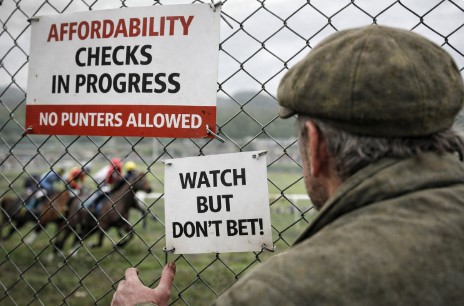
The art of going broke in a blazer
There is a peculiarly British art form in which institutions collapse in slow motion whilst maintaining the full ceremonial apparatus of solvency. The minutes are circulated. The subcommittee convenes. The catastrophe is described, in each successive document, as "a challenging backdrop" or — for the truly committed — "an opportunity to reimagine our stakeholder proposition going forward." Nobody sweats. Nobody raises their voice. The Titanic sinks, and someone moves that the minutes of the previous meeting be accepted as a true and accurate record.
British racing has been living inside this art form for years. Betting turnover over two years the decline has been 10.7 per cent, with average turnover per race down 11.6 per cent. This is not a blip. This is a structural haemorrhage that has learned to dress in blip's clothing and stand very still whenever someone with a clipboard walks past. In a sport where betting funds operations to the tune of £350 million annually — a dependency that makes the word "dependency" seem almost quaint — when Brant Dunshea called in early 2026 for affordability checks to be halted, he wasn't delivering a position paper. He was describing a patient on a drip being told the next treatment was a compulsory blood donation, and that the consent form had been signed, cheerfully, by someone who left in 2022.
Two men, one arithmetic problem, one government with its fingers in its ears
Warnings arrived from different directions with different supporting evidence and still vanished into the DCMS like correspondence into a black hole — except that a black hole at least exerts gravitational force on its surroundings.
Martin Cruddace pressed for intervention on affordability and the levy. James Noyes and the Social Market Foundation produced a rigorous case for gambling tax reform that would stop treating a pari-mutuel betting culture with four centuries of roots as interchangeable with a 3am slot machine operated by someone already working through the family cutlery. The SMF's proposal — cut General Betting Duty on racing bets, increase the Levy, generate materially more for the sport without increasing aggregate burden — required government to do the one thing it finds genuinely exhausting: think carefully, then act on the conclusion rather than commissioning a further review of it, having been behind affordability checks for 2 years.
The officials nodded with the slow gravity of people who have learned that nodding is considerably cheaper than deciding, then returned to the policy equivalent of staring out of the window until the awkward visitor found his umbrella. The anti-gambling lobby possesses the three most powerful assets in modern public advocacy: moral certainty, media sympathy and total freedom from the burden of factual nuance.
The fatal mistake: borrowing the prosecution's script, then objecting to the verdict
The most significant damage to racing's position was not inflicted by DCMS or the Gambling Commission. It was self-administered, steadily, by an establishment that chose to perform moderation — and discovered too late that performing moderation in a debate framed entirely by your opponents means accepting their premises whilst quibbling over footnotes nobody reads. It completely neglected is main customers, the punters.
Once you concede the foundational anti-gambling premise — that betting is primarily a social hazard to be managed and preferably reduced — the argument is structurally over. You are not an advocate for racing. You are a technical consultant to the other side, helpfully drafting the specification documents for your own constraint.
Racing needed to insist, loudly and persistently, that betting is not some regrettable vestigial habit a mature sport might evolve beyond — like brown sauce at the owners' lunch, nautical metaphors in chairman's speeches, or hospitality suites decorated as though 1987 was the pinnacle of interior design. Betting is the economic cardiovascular system of a £4 billion industry employing tens of thousands of people. The punter is not the problem that betting creates. The punter is the entire reason betting exists. This distinction is not subtle. It required a double-digit turnover collapse to make it legible to those at the top of the stands.
Too close to bookmakers to represent punters — too cautious to be honest about either
The BHA can point to its surveys, its consultations, its stated commitments to bettor representation. These are not nothing. A charitable analyst would call them a start. A less charitable analyst — and the situation increasingly demands one — would note that structures matter more than sentiments.
An industry routing £350 million annually into the sport, a governing body launching #AxeTheRacingTax in explicit alignment with bookmaker commercial interests, a chief executive publicly discussing "repairing the relationship with bookmakers" post-budget — this does not resemble an independent punter advocate. It resembles a trade association that has learned to speak in two registers and has not entirely mastered the transitions.
What has emerged is not a conspiracy. It is a conflict of interest so thoroughly embedded that those inside it have long since ceased to perceive it as a conflict. It has become the water they swim in. Racing and bookmakers achieve almost touching solidarity whenever taxation threatens the shared revenue model. When the punter's liberty is being excavated by intrusive checks, the institutional response shifts — more hesitant, more lawyerly, more carefully moisturised in the emollient language of balance. The smart money read this years ago, formed its conclusions quietly and moved on.
What 10,000 punters said — and why the official fantasy belongs with Soviet harvest statistics
The Racing Post's survey of just under 10,000 punters is the closest thing British racing has produced to an honest audit of its customers' lived experience, as opposed to the version presented to parliamentary committees and described as "broadly positive with areas for improvement."
The findings are what the technically minded call alarming and the rest of us call a bucket of cold water delivered to a boardroom full of people who had convinced themselves it was warm. Nearly 24 per cent had been caught in affordability checks. Close to 30 per cent reported betting less — mapping, with accusatory precision, onto the aggregate turnover decline. More than one-third of the highest-staking punters admitted using an unlicensed operator. The policy designed to protect customers from themselves is, in statistically significant proportions, directing them towards operators whose idea of consumer protection does not extend much beyond not getting arrested by anyone with the correct paperwork.
The distributional texture adds a dimension that is almost comic in its perversity. One in five punters staking a modest tenner had experienced an affordability intervention. More than half averaging £100 stakes had been asked for financial documentation — as though understanding a form book and backing your judgement with a meaningful sum were, in themselves, indicators of personality disorder.
The sharp money gets frisked, fingerprinted and asked for three years of bank statements. The casual punter who selects a horse because its name evokes a departed relative or a vague sense of cosmic alignment gets waved through with a loyalty voucher. This is not consumer protection. It is classifying customers by how politically convenient their losses appear in a regulatory filing — which tells you a great deal about what the framework is actually optimising for.
The bookmakers' exquisite irony: the machinery nobody wanted, and everyone quietly kept
Bookmakers lobbied lightly against affordability checks, warned they would drive customers to unlicensed operators, and were entirely correct. They built the machinery anyway — because the alternative was regulatory non-compliance — and discovered with a gratitude corporate communications will never permit them to express that it is, in several useful respects, rather good.
Comprehensive financial profiling delivers something years of expensive CRM investment never quite managed: a regulator-approved mechanism for deciding which customers represent an attractive long-term relationship and which represent a cost centre in human form. Customers who study form, maintain an edge and win with uncomfortable frequency can now be declined not on the naked basis of commercial inconvenience — which even bookmakers find difficult to say aloud — but on the basis of a safeguarding process conducted entirely in the customer's own best interests. Unwelcome machinery, when you are compelled to build it, has a habit of becoming useful machinery once you understand what it can do.
Racing has no equivalent utility to extract from declining enthusiasm. There is no pivot from a shrinking punter base. There is only the number, declining, and the funding model that depends on the number continuing to exist. After #AxeTheRacingTax visibly aligned the BHA with bookmaker fiscal interests, the sport has achieved the neat trick of appearing passionate about punters precisely when bookmaker revenue is threatened and managerially nuanced precisely when punters themselves are being processed like mildly suspicious credit applications. It is not difficult to understand why the sport's most committed customers have concluded that nobody in authority represents them. On the available evidence, they are correct.
The answer racing has avoided with the stubbornness of an EU commissioner defending a car-parking policy
The levy-and-bookmaker settlement that sustained British racing for sixty years is in structural decay, and no amount of lobbying or relationship-repairing will restore it. Even if affordability checks were suspended tomorrow — and they should be — the underlying problem remains.
The sport needs genuine revenue diversification — not as a decorative aspiration in an executive summary nobody implements, but as the operational difference between a viable business and an elaborate hostage note addressed to an industry itself under pressure. Media rights that reward digital engagement. Data products that monetise racing's analytical richness. Ownership products designed by someone who has actually met a prospective owner rather than merely theorised about one. Digital content built around the sport rather than compliance documentation.
None of these are new ideas. They appear in every strategy document since 2008. They are new only in the sense that they have never been executed with the urgency the situation has always demanded — and now demands with the added menace of a double-digit turnover decline and a punter base that is actively, measurably, statistically leaving.
What the sport requires is not another taskforce whose report will be warmly received and comprehensively ignored. It requires commercial expertise with actual authority — people who understand how to build something genuinely desirable rather than merely governable. The difference between those two things is the difference between a sport and a regulatory burden with grandstands.
The sport had a decade to make the argument loudly, build the commercial alternatives seriously and represent its customers with genuine conviction. It spent that decade trying to look responsible in front of people who had already decided what responsible meant.
The bill has arrived. It is addressed, with the system's characteristic tidiness, to the punter.
He is, as usual, the last to know and the first to pay.