Once There Was Argument. Now There Are Drone Shots
How a sport built on noise, opinion and the Bismarck became Britain's most carefully sanitised television product.
HORSE RACINGBUSINESS
Football Focus is dead.
The BBC announced its end on 23 April 2026 with the institutional regret normally reserved for discontinued biscuit ranges. Fifty-two years of Saturday lunchtime television, audience figures collapsed from 849,000 in 2019 to 564,000 at the trough, official cause of death "changing audience behaviours." Actual cause of death: it became a programme about football that forgot to be interesting about football.
Racing television watched from the paddock and drew precisely the wrong lesson. The wrong lesson is: at least we're not them. The right lesson is: we're them, just slower, with worse weather, and considerably more pleased with ourselves about it.
Two Farewells
Two departures, between them, describe everything that has been lost.
On 22 July 2025 at Wolverhampton, two weeks short of his seventy-fifth birthday, Derek Thompson called his final race. Two contests were named in his honour, including the Thanks For Everything Tommo – Happy Retirement Handicap. He had begun behind a microphone at fifteen, at a point-to-point, and signed off with a final ceremonial photo! The sport, which had received six decades of his enthusiasm without quite earning all of it, sent him off with grace.
Nine months earlier, on 1 November 2024, Alastair Down died at sixty-eight. The Cheltenham press room had been renamed in his honour exactly one week before — a piece of timing so apt it reads like fiction the man himself would have pushed for. Down's prose made the form book sound like Tolstoy and a maiden hurdle at Plumpton sound like the siege of Troy. He was avuncular and fierce in equal measure, and his absence has made his irreplaceability unanswerable.
When Thompson and Down were part of the Channel 4 ecosystem — alongside McCririck, Francome, Jim McGrath, Cattermole, Brough Scott, and the controlled chaos of The Morning Line — racing television was something you watched because it was genuinely interesting. It is now something you watch because the race is about to start. The distinction is the difference between a publication people buy and a freesheet they pick up because it is there.
The 2012 Cull
In late 2012, IMG Sports Media "refreshed" Channel 4's coverage. McCririck, Thompson, Down, Cattermole — collectively dispensed with. Francome departed in circumstances on which accounts vary. McCririck, thirty-one years a betting voice across ITV and Channel 4, said he was "devastated" and died in 2019 without ever returning.
What was lost was structural rather than aesthetic: a willingness, on live television, to say a jockey had ridden a stinker, a field was thin, a sponsor's flagship was a circus. Francome had ridden seven champion-jockey titles and was clinically prepared to render those judgments without seeking permission first. That faculty has been progressively bred out of the coverage. What replaced it was a roster calibrated, consciously or otherwise, for access and palatability.
Channel 4 lost the rights to ITV at the end of 2016. The Morning Line is gone. Down is gone. Thompson is retired. McCririck is dead. The current product, in the executive suites, continues to be described as "award-winning" — which it technically is — and "engaging," which is rather more debatable.
A 1970s Product in a Bland Sauce
Racing television has, through sustained effort and no detectable self-awareness, preserved the structural conservatism of the 1970s product, stripped away whatever character it once possessed, and presented the result garnished with the thin, flavourless sauce of contemporary brand-safe production values.
In fairness, the past was not gilded either. Julian Wilson and Jimmy Lindley were drier than a five-year-old tin of cream crackers left in a warm garage. But that era had one decisive advantage: if you wanted racing on television, you watched what was offered. The alternative was the garden. That captivity has ended. The broadcasters have not absorbed the implications.
The Opening Show, broadcast on ITV4, sponsored by Betfair — with Paddy Power as headline sponsor of ITV Racing's main coverage, both Flutter brands, which tells you everything about the ecosystem — manages the considerable feat of being less compelling than ITV4's reruns of The Big Match from 1973. At least Brian Moore was describing something historic. At least Rodney Marsh being chopped down in the box generated authentic drama. There is a serious argument, only partly frivolous, that forty-five minutes of vintage footage carries more honest sporting tension than the average modern racing preview.
Whatever value the markets actually held has, in any case, been extracted before the opening credits roll. The professional money moved at midnight. The algorithms cleared the tissue prices before dawn. By the time the studio panel delivers its considered view on the day's banker, the information carries the market freshness of last Tuesday's newspaper, presented with some ceremony as insight.
The Big Match reruns, at least, have the good grace not to pretend they are current.
Boxes Ticked, Audiences Untouched
The current ITV lineup — Chamberlin fronting, Cumani co-presenting, Bell on The Opening Show and the "Social Stable" segment, with Chapman, Plunkett, Mulrennan, Nicholls and Weaver in support, Hoiles on the call — is, to a person, professionally competent and personally inoffensive. Chapman, on his day, is the closest thing the studio possesses to a pulse. Several others are knowledgeable and, in a different broadcasting culture, might be permitted to be compelling. The presentation is to put it bluntly ....boring and uninspiring. I mention the Opening Show but other racing channels commit the same crimes, same faces, hackneyed views and opinions. Talk everything up and keep any criticism to yourself.
The problem is institutional design. The lineup has been assembled to satisfy every visible demographic criterion while disturbing no commercial relationship and upsetting no stakeholder of consequence. The access trap operates with quiet efficiency: the presenter who challenges the wrong trainer finds the stable door unaccountably stiff next time; the analyst who interrogates a thin field finds fewer invitations to preview evenings. The coverage drifts, reliably, into warmth, smiles, and trainer quotes that read like press releases because, structurally, they are.
Conduct a simple experiment. Watch an hour of midweek coverage on any channel. Count the challenges to a poor ride, the interrogations of a weak field, the pointed questions about why a fixture exists and who it serves. Your tally will be modest. The word interesting will appear seventeen times. Nothing uttered could not be safely reproduced in a Paddy Power press release or a BHA governance summary.
The Punter Cannot Get a Bet On
Beneath all of this sits the deepest absurdity, which the coverage never addresses.
The engaged punter racing television implicitly flatters with its analytical content can barely get a bet on. The serious, informed, analytically literate viewer — the precise person the studio segments ostensibly cultivate — finds accounts restricted, stakes throttled, and custom politely not wanted. The recreational punter who loses cheerfully and consistently is welcomed with free bets and a personalised app notification.
A presenter recommends a 5–1 chance with evident enthusiasm. Somewhere, a viewer attempts to place the advised stake with four operators and is declined by three of them — one of whose logo appears in the broadcast frame. The analysis is delivered. The tip is rendered. The market is inaccessible. The television continues regardless.
Thin gruel, served with a confident smile, by organisations profiting directly from the thinness.
What Has Been Earned
Racing television once had Thompson's energy, Down's passion, McCririck's magnificent aggression, Francome's forensic authority and McGrath's quiet encyclopaedic weight. It had The Morning Line, which was what informed argument about a sport looked like before informed argument became a stakeholder-management problem. It was imperfect, anarchic, occasionally embarrassing. It was, in the sense that actually matters, alive.
What has replaced it is a 1970s product in a bland sauce: technically presentable, commercially neutered, existentially timid, competing in the most ferocious entertainment market in history with the strategic confidence of a sport that believes its audience has nowhere else to go.
They do. They have four hundred places to go. They are finding them, one drifted smartphone at a time.
There was, once, a sport that knew how to put itself on television. Peter O'Sullevan calling the Grand National with the calm of a man who already knew the result and was being kind enough not to spoil it. Julian Wilson delivering Newmarket like a solicitor reading the family will. John Oaksey in tweed, the patrician's son who could break your heart over a fallen horse in a sentence and a half. McCririck in mustard checks and deerstalker, gloves the size of crash mats, bellowing tic-tac at a national audience that genuinely understood him. Francome dismantling a bad ride with the weary precision of a master saddler examining a knot. McGrath quietly giving you the breeding, the trip and the form line, and three sentences later the result. The Morning Line on a Saturday morning at half past nine — three opinions, four sausages, one working microphone, and an argument that actually mattered. It was rough at the edges, occasionally chaotic, frequently embarrassing. It was also, in the sense that actually matters, watched.
The remedy now is not mysterious, merely unfashionable. Treat the loyal audience as adults who can read a sectional time without requiring a graphic that bursts into flames. Permit analysts to say, on air, what the weighing room already knows. Interrogate the fixture list rather than dressing it. Restore something resembling The Morning Line, where informed people were allowed — even encouraged — to disagree informedly. And find the nerve, just once a meeting, to interview a restricted punter rather than another recipient of a free bet. None of it requires more money. It requires only the institutional courage to disturb a sponsor relationship in service of a viewer relationship — and to remember that the audience the sport actually depends on long ago learned to tell the difference between analysis and advertisement, and is in no mood to mistake the second for the first.
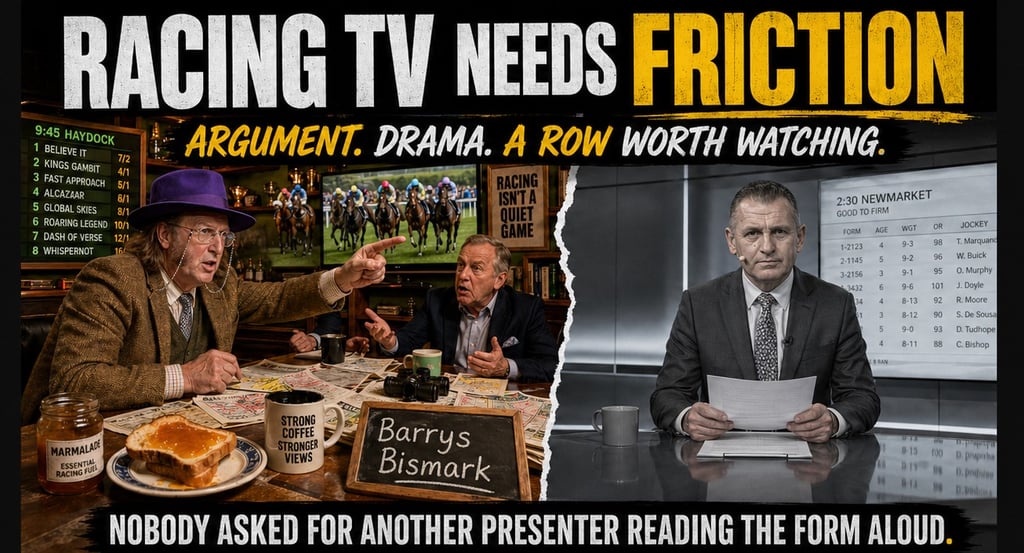
What the viewer actually needs is friction. Argument. The full-blown Saturday morning row of the kind Barry Dennis used to start on The Morning Line by naming his Bismarck with the conviction of a man who had already laid the price himself and meant to be proved right by Sunday lunch. Half the panel disagreed with him, the other half disagreed with each other, and the viewer at home — marmalade still on the toast — suddenly cared about a 9–4 favourite at Sandown they had not, ten minutes earlier, intended to back. That is drama. That is what television, at its best, used to deliver, and what racing in particular used to deliver better than most. The sport has somehow contrived to strip the drama out of an activity in which half-tonne animals run flat out at thirty-nine miles an hour with serious money on the line. What the viewer does not need — and never once asked for — is a presenter reading the Racing Post form line aloud
Until that courage returns, the atmosphere, as always, is absolutely fantastic. The going is good to soft. The fixture is sponsored. The expert verdict has been thoroughly press-released. And on ITV4, a man in a polyester shirt is pulling on his shorts in 1973 to score a goal more interesting than anything broadcast at any British racecourse this afternoon.
Ed Grimshaw is a founding member of the Racing Innovation Group