MURRELL: THE MAN WHO STOLE SCOTLAND AND SPENT IT ON PEPPER GRINDERS
Peter Murrell embezzled £400,000 from the SNP. The Crown Office has the receipts. All forty-nine of them. John Swinney has forgiven him. God, apparently, is fine with it too
POLITICSCULTURE
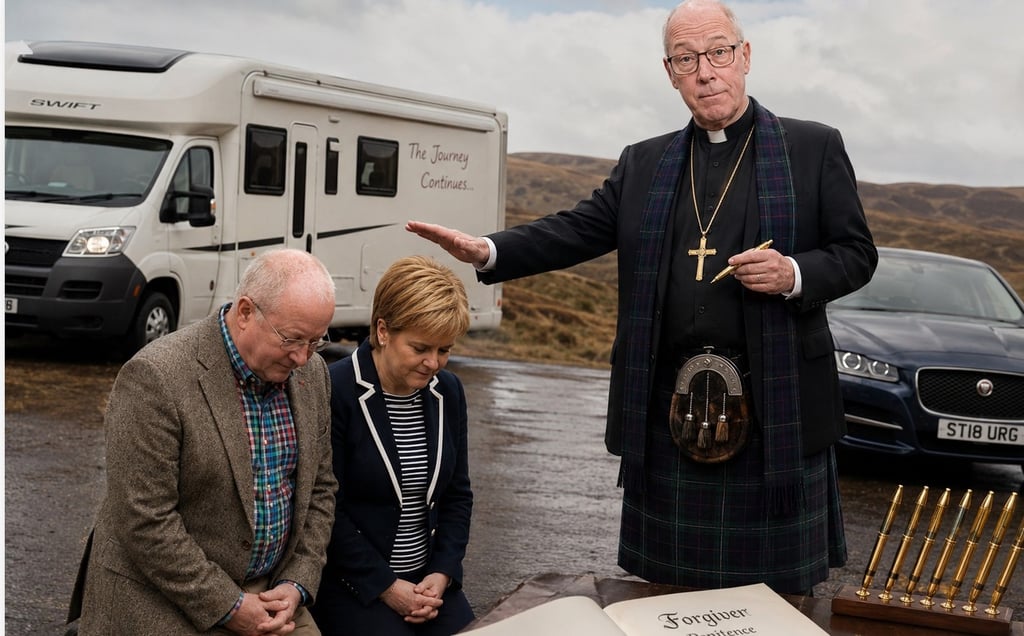
Let us start with the salt and pepper grinders.
Not because they are the biggest item on the list — they are not, not by some distance — but because they are, in their quiet, crystalline, Lalique-branded way, the most perfectly diagnostic purchase Peter Murrell made with the £400,000 he stole from the Scottish National Party over twelve years. Two salt and pepper grinders. Lalique crystal. Two thousand, six hundred and eighteen pounds. Two thousand, six hundred and eighteen pounds. For things you put salt in.
Everything else that follows — the motorhome, the nine Montblanc gold fountain pens, the Grand Theft Auto V, the Andrex — makes considerably more sense once you understand that this was a man who looked at a pepper mill and thought: yes. £1,309 each. The SNP will cover it. The SNP, as it turned out, covered everything.
NINE PENS. NINE.
Here is an incomplete inventory of what Peter Murrell purchased with funds donated by Scottish National Party members who believed, genuinely believed, they were financing the route to independence.
A £124,550 Niesmann and Bischoff motorhome, stored at his mother's house rather than the family home — because apparently there is a limit to how much a First Minister wants a £124,000 motorhome appearing in the driveway on the six o'clock news. A Jaguar I-PACE, £81,000, funded with £57,500 of party money. Nine Montblanc fountain pens — including a white gold model at £4,225, a yellow gold one at £2,370, and a second yellow gold one at £2,137, because once you have bought two gold fountain pens the third represents a modest incremental step — along with four Montblanc pen pouches, between £115 and £135 each, to protect them. One gold pen is an indulgence. Two gold pens is a collection. Nine gold pens is a man who has stopped thinking about money altogether.
He bought two Jura coffee machines. The first cost £1,866. That was not, evidently, good enough. The second cost £3,232. He bought fourteen Le Creuset mugs. He bought eight umbrellas at a combined cost of £1,990, in Scotland, where the umbrella market should by rights be saturated beyond all commercial possibility. He bought a Celestron computerised telescope, a personal weather station, a 1:30 scale model helicopter from Airbus Operations Limited, and six bottles of Avon Skin So Soft — which Scottish hillwalkers use as midge repellent, confirming both the outdoors hobby and the nationality.
And then, in between all of that, he found time to go online, add a copy of Women Hold Up Half the Sky: Selected Speeches of Nicola Sturgeon to the basket, enter the SNP's card details, and click confirm. He bought his wife's book. With his wife's party's money.
I have been staring at that sentence for two days and I still do not know what to do with it.
THE REMARKABLE TIMING OF GRAND THEFT AUTO V
On September 18th, 2014, Scotland voted No to independence. The SNP's great project — the thing members had given years of their lives to, the reason people had stood in church halls and knocked on doors in driving rain — was defeated. Nicola Sturgeon, about to become First Minister, was composing herself for the long road back. Her husband bought FIFA 15.
Then, in December 2014, still surrounded by grieving activists, Peter Murrell purchased Grand Theft Auto V for the PlayStation 4. A game about stealing things, evading the police, and constructing a criminal empire through a combination of audacity and zero moral scruple. Made, with exquisite geographical irony, by Rockstar Games of Edinburgh, Scotland. I am not saying anything. I am simply presenting the facts and allowing you to draw your own conclusions.
THE WOMAN WHO WANTED TO RUN A COUNTRY
Nicola Sturgeon has said, through her lawyers, that she had no idea.
No idea about the Smythson handbag (£466) that arrived in her house. No idea about the Smythson oyster jewellery box (£2,495). No idea about the Molton Brown hand cream (£10 from Amazon — and no, there is no minimum spend on this list, that is precisely the point). No idea about the hairdryer, the two Jura watches from the same jeweller, or the Lalique crystal salt and pepper grinders sitting on the kitchen counter seasoning food with the crystalline authority of objects that cost two thousand, six hundred and eighteen pounds.
Let us be precise about what Peter Murrell was earning. As SNP Chief Executive, his salary was approximately £115,000 a year. Which is, by most measures, a comfortable income. It is not, under any honest reading of arithmetic, a nine-gold-fountain-pen income. It is not a £124,000-motorhome-AND-a-£81,000-Jaguar-AND-two-Jura-coffee-machines income. The numbers do not add up. They do not come close to adding up.
Nicola Sturgeon — the woman who during a pandemic stood at a podium every single day and delivered R numbers, confidence intervals, and seven-day rolling averages with the focused precision of a senior statistician — apparently did not notice.
This is the same woman who spent eight years telling Scotland it was ready to run its own economy. That it could manage its own fiscal levers, fund its own institutions, administer its own currency. The SNP's independence case rested, above all else, on financial credibility: the claim that Scotland could be trusted with its own money. That the adults were in charge.
The adults, it transpires, had mislaid £600,000 of ring-fenced independence referendum funds and could not find them. The Chief Executive had been charging Andrex to the party account since 2011. And the First Minister, the one who knew the R number in Inverclyde to two decimal places, had no suspicion about the Lalique grinders. As Scottish Labour's Jackie Baillie put it with forensic economy: "Why no-one within the SNP had any curiosity about the state of the party's finances" is a question that remains entirely unanswered. Swinney has refused a parliamentary inquiry. One can only assume he feels the question has been adequately addressed by the pepper grinder photographs.
THE MAN WHO WAS RIGHT ABOUT EVERYTHING AND IS NOW DEAD
Alex Salmond spent the last years of his life insisting, at considerable volume and to increasingly sceptical audiences, that the SNP under Nicola Sturgeon was rotten. He founded a rival party to say it. He gave interviews. He was dismissed as a bitter man, rattling the cage he used to occupy, unable to accept that his time had passed. Polite Scottish society found him tiresome. He died in October 2023, in North Macedonia, before the Crown Office released forty-nine photographs of the consequences.
The Chief Executive of the SNP has been convicted of stealing £400,000 from the party. The judge who sentenced him noted that the fraud was "not particularly sophisticated." The money went on a motorhome, nine Montblanc pens, eight umbrellas, Lalique crystal condiment vessels, and — at the precise bottom of the list, confirming that no transaction was too trivial to charge to the independence movement — toilet paper.
Andrex toilet paper. On the SNP's account.
Salmond was wrong about many things across a long and eventful career. He was right about this one. He was spectacularly, receipts-now-published-by-the-Crown-Office right about this one. And the maddening truth is that even he — a man whose relationship with understatement was never affectionate — could not have imagined the Andrex. Nobody could have imagined the Andrex.
He'd have put it in a speech. He'd have waved the Crown Office photographs across the chamber and the Presiding Officer would have asked him to sit down and he would not have sat down. The speech writes itself. He just isn't here to give it.
THE THEOLOGY OF FORGIVENESS
Into this landscape of stolen mugs and forensic incompetence steps John Swinney, First Minister, man of profound Christian faith, carrying the institutional wreckage of the Murrell years like a man attempting to relocate a burning building one charred brick at a time.
Asked whether he could forgive Peter Murrell — a man he has known since his teenage years, a man who ran the party Swinney now leads, a man who stole £400,000 from members who raised it in village halls and online fundraisers and monthly direct debits of £3 a month — Swinney said: "I am a forgiving person. It's part of what my faith is about. It's about forgiving people when they make mistakes. I don't believe, in my faith, that people should carry the mistakes that they make forever."
This is, theologically speaking, perfectly orthodox. Forgiveness is indeed a central Christian virtue. One does not dispute the sincerity of Swinney's faith, which is genuine and longstanding, nor the instinct to extend mercy to someone who has confessed and accepted his sentence. What one does dispute, mildly but firmly, is the deployment of forgiveness as a substitute for accountability.
Swinney will not hold a parliamentary inquiry into how a man he knew personally ran a twelve-year fraud through an organisation whose finances he and his colleagues were supposed to oversee. He will not say whether Nicola Sturgeon should apologise for the culture of financial non-scrutiny that made it possible. When asked precisely that question — should Sturgeon apologise to members? — he said: "The person who was responsible for the crimes has been to court." That is not an answer. That is an evasion wearing the collar of an answer.
The question was not about criminal liability. The question was about institutional failure. About why nobody — not Swinney, not the NEC, not the treasurer, not the First Minister who shared a house with the Chief Executive — noticed that the party was being systematically stripped of its funds by a man buying crystal pepper grinders and PlayStation games and fourteen Le Creuset mugs and a motorhome he hid at his mother's house.
Murrell's own lawyer confirmed at sentencing that his client "had sufficient funds to repay the money embezzled." He was not stealing out of financial desperation. He was stealing because the opportunity was there and nobody was checking. That is not a failure of one man's character. It is a failure of an entire organisation's governance. And forgiveness, however genuine, however scripturally grounded, does not address it. What it does do, rather conveniently, is change the subject.
John Swinney is a decent man leading a party that is not, at present, a decent institution. His faith is real. His instinct to forgive is admirable. His refusal to hold an inquiry into how this happened is not forgiveness. It is something else entirely — and it has nothing to do with God. It has to do with the SNP