Lights Out at the Races: How British Racing Let the Pictures Die and the Accountants Take Over
From Betfred blackouts to affordability checks and ARC’s iron grip on media rights, the sport isn’t collapsing — it’s being monetised to death by men protecting margins in a shrinking market
HORSE RACINGBUSINESS

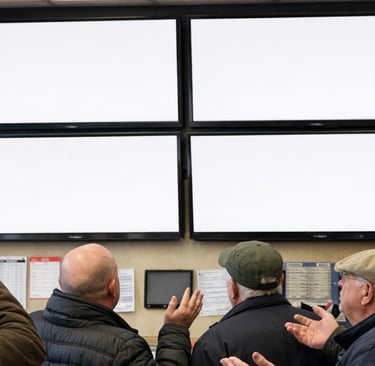
There comes a moment in every farce when the audience realises the actors aren't pretending anymore—they're genuinely lost. In British racing, that moment arrived on New Year's Day 2026, when 1,287 Betfred shops showed not live racing but the cold, blank stare of "No Signal." Punters placed bets on races they couldn't see, at tracks they weren't sure still existed. The cause? Arena Racing Company decided its product should cost Betfred 30% more. Betfred refused. ARC turned off the taps. Welcome to the Turf's Cold War: not a battle over integrity, but a hostage negotiation denominated in pixelated horses.
The Canary Nobody Noticed
The Betfred blackout grabbed headlines, but the obituary was written months earlier. On 12 September 2025, independent bookmaker Macbet announced it would cease offering bets on ARC tracks from 1 October, unable to absorb a shift from a flat £15,000 annual data fee to a 2% turnover charge.
Independent bookmaker Geoff Banks laid bare the asymmetry: ARC adopts a "take-it-or-leave-it" approach with smaller operators, who pay more than larger rivals with negotiating muscle. The increased charge, he warned, might be "the difference between a tenable and completely untenable business." Macbet's departure was the canary expiring. The industry barely glanced at the corpse. Now Betfred's 1,287 shops have gone dark, and the question becomes: who's next?
The Pyrrhic Carve-Out
Racing's leadership spent 2025 in battle mode. The 'Axe The Racing Tax' campaign culminated in unprecedented strike action on 10 September, with fixtures cancelled as the industry protested Treasury proposals to "harmonise" remote gambling duties. The fear was existential: a rise from 15% to 21% could cost £66 million annually. On 26 November, Chancellor Rachel Reeves delivered apparent salvation. Racing's remote betting tax would remain at 15%, recognising the sport's "unique circumstances." The BHA celebrated. Cruddace declared victory.
But the carve-out was cosmetic.
Remote Gaming Duty—the tax on online casino products that subsidise bookmakers' racing operations—will rise from 21% to 40% from April 2026. General Betting Duty on non-racing sports jumps from 15% to 25% from April 2027. These are body blows to the operators who fund the levy, pay for media rights, and sponsor flagship events.
The BGC's Grainne Hurst saw through it immediately: "Let's be clear, there is no real exemption here for racing. Its income will now be severely damaged." Racing secured an exemption from direct taxation while the ecosystem sustaining it was subjected to fiscal carpet-bombing. It's rather like celebrating that your house wasn't hit while the neighbourhood burns.
The Black Market Bonanza
Here lies the dimension that transforms policy failure into catastrophe. The punters driven from regulated betting haven't stopped gambling. They've simply migrated to operators beyond the Gambling Commission's reach—beyond the levy, beyond media rights fees, beyond any contribution to British racing.
The BGC estimates the black market pocketed £100 million in bets on Boxing Day alone. One hundred million pounds. In a single day. These are wagers generating nothing for racing—no levy, no media rights, no sponsorship. Pure leakage from the regulated ecosystem into the pockets of operators who contribute nothing.
The arithmetic is devastating. Total betting turnover on British racing has fallen 16.5% over two years. First quarter 2025 saw another 9% decline. Cruddace himself estimates affordability checks will directly cost racing £250 million over five years. But this understates the haemorrhage, because it counts only regulated turnover. The billions migrating offshore simply vanish from the sport's revenue base entirely.
Affordability checks haven't reduced problem gambling by one demonstrable case. But they have redirected billions from operators who fund racing to operators who don't. The policy succeeded only in destroying its own ecosystem. And as regulated turnover collapses, media rights follow. ARC raises prices not from confidence but desperation—extracting maximum value from a diminishing base while the extraction remains possible. Like charging more for umbrellas during a drought.
The All-Weather Stranglehold
ARC operates four of Britain's six all-weather racecourses—Lingfield, Newcastle, Southwell, and Wolverhampton. These aren't marginal assets; they're the infrastructure keeping British racing functioning twelve months a year.
The remaining two? Kempton Park and Chelmsford City. Both are under siege.
Kempton exists in suspended execution. Property developer Redrow holds an option to develop the site until 2028, potentially 2030. New Jockey Club CEO Jim Mullen admits the future is "out of my hands." External factors, initiated by a company with no interest in racing, will determine whether this treasured venue becomes housing. Chelmsford's distress is more immediate. On New Year's Day 2026—the same day Betfred's screens went dark—staff received only 80% of their salaries. Management blamed "circumstances beyond our control." Britain's newest racecourse cannot pay its workers in full.
If both venues exit—through development or insolvency—ARC controls all remaining all-weather racing in Britain. At that point, Cruddace doesn't merely dominate the winter programme; he is the winter all weather programme. Every owner, trainer, bookmaker, and broadcaster needing all-weather content would have precisely one supplier. This is not conspiracy; it is gravity. Private equity creates market dominance by surviving while others fail, by having the balance sheet to absorb short-term losses that bankrupt competitors.
The Policy Cult: James Noyes, Affordability, and Racing's Intellectual Capture
And let us not forget the spiritual architect of this financial bonfire: Dr James Noyes, the Social Market Foundation's senior fellow, who helped sell Westminster on affordability checks that have since hollowed out the sport's financial foundations. Noyes, a Cambridge-educated former adviser to Labour deputy leader Tom Watson, was lead author of the 2020 SMF report calling for a £100-a-month "soft cap" on gambling spend. The proposal emerged from a think tank whose financial supporters include Derek Webb, the Three Card Poker inventor turned anti-gambling crusader who has poured millions into reshaping the regulatory landscape.
The circularity is exquisite. Webb made his fortune from a casino game. He now funds campaigns to restrict gambling. Those campaigns destroy betting turnover. The destruction of turnover starves racing of levy and media rights income. And into the vacuum steps Noyes, offering racing a lifeboat—if only it will sever ties with the wider betting industry. Here's the conjuring trick: Noyes now describes affordability as a "fiasco," yet he drove the policy irresponsibly into existence. His new gambit? Convince racing to "cut the cord with online casino," as his ally Matt Zarb-Cousin put it on the Barstewards Enquiry podcast. The SMF's July 2025 report laid out the terms: Remote Gaming Duty up to 50%, the levy doubled to 20%, racing's betting duty halved to 5%, and General Betting Duty raised to 25% for other sports. Gordon Brown endorsed it. The Treasury pens practically unsheathed themselves.
The strategy was made explicit in a leaked email from Zarb-Cousin: the goal was to "peel off and neutralise racing, which has been used by the BGC… to water down affordability checks." Racing, in other words, was never the beneficiary of reform—it was the obstacle to be removed.
How Might This Play Out?
The trajectories are now discernible, and none favour the sport's collective interest.
Scenario One: Managed Consolidation. ARC continues acquiring distressed assets and squeezing weakened counterparties. Independent bookmakers exit racing markets entirely. Chelmsford fails; Kempton falls to developers. ARC achieves effective monopoly on all-weather racing and near-monopoly on media rights. The BHA becomes a licensing body with no commercial leverage. Racing survives, but as an ARC content product with heritage branding.
Scenario Two: Betting Operator Retreat. Faced with 40% RGD and 25% GBD, major operators slash marketing, sponsorship, and media rights expenditure. Levy income collapses further. Prize money contracts. Owners exit. Field sizes shrink. The betting product deteriorates, accelerating turnover decline in a death spiral. Racing becomes increasingly dependent on whatever terms ARC and the remaining operators choose to offer.
Scenario Three: Black Market Dominance. Regulated turnover continues migrating offshore. Within five years, the black market handles more British racing turnover than the regulated sector. The levy becomes functionally meaningless. Media rights collapse as operators can access offshore streams for nothing. Racing's formal governance structures persist, but the economic foundation has been hollowed out entirely.
Scenario Four: Regulatory Reset. A future government recognises the policy catastrophe and reverses affordability checks, reduces gambling duties, and actively pursues black market operators. Turnover recovers. Media rights stabilise. Racing rebuilds. This scenario requires political courage, policy humility, and an admission that the "public health" approach to gambling regulation has failed on its own terms. The odds are not favourable.
The Strategic Victors
Through every scenario, certain parties emerge advantaged.
ARC benefits from consolidation regardless of the pathway. The Reuben Brothers can afford to wait while competitors fail, setting whatever terms the diminished market will bear. The black market operators benefit from every regulatory restriction that drives punters offshore. They pay no levy, no duty, no media rights. They compete on pure margin against regulated operators carrying 40% tax burdens.
The anti-gambling lobby benefits from racing's weakened state. A sport financially dependent on government support is a sport that cannot oppose further regulatory restrictions. The losers? Punters, who face either intrusive surveillance or unregulated markets. Owners and trainers, whose prize money evaporates. Stable staff, whose jobs disappear. And racing itself—a sport that spent centuries building an ecosystem now being dismantled in a decade.
Conclusion
British racing is not in decline. It is in managed retreat. ARC isn't causing the collapse—they're exploiting it, building a fortress from the rubble with Cruddace at the parapets, invoice book in hand. The black market is the ultimate beneficiary. Every affordability check that drives a punter offshore, every tax rise that closes a betting shop, every media rights dispute that leaves screens dark—all of it feeds the unregulated operators who return nothing to the sport.
The pictures are going out. The money is flowing elsewhere. The staff aren't getting paid. And the only thing still racing is the exit strategy.