Killing Our Bets and Driving us to the Black Market
How Open Banking, AI Profiling and a Compliant Regulator Are Quietly Designing the End of the British Punter
POLITICSHORSE RACINGSPORT
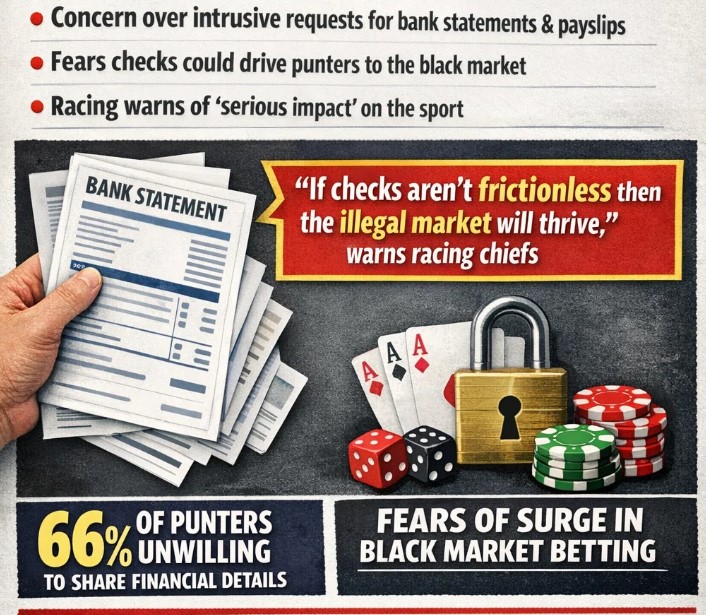
There is a phrase that recurs in nearly every sales deck pitched to British bookmakers this decade. The phrase is “friction-free.” It sounds benign. What rational consumer objects to convenience? Yet in gambling, friction is not a bug. It is frequently the only thing standing between a punter and a decision he will regret before the horse has passed the furlong pole.
The British betting market has crossed a threshold almost no one has publicly acknowledged. The surveillance apparatus that once watched which pages you clicked now reads your bank account in real time, scores you by machine before you place a bet, and decides whether you are a customer worth keeping or a liability worth removing. The technology marketed as safer gambling is, by any honest reading of its own commercial metrics, a profit-optimisation engine wearing a compliance badge. The regulator best placed to examine this has, so far, declined to look.
This is how the end of the British punter is being engineered — not by prohibition, but by precision.
The Two Faces of Open Banking
The face open banking presents to the Gambling Commission is that of a compliance tool: a clean, auditable, consent-based mechanism for verifying source of funds and identifying financial vulnerability before harm occurs. The face it presents to its actual paying clients — the bookmakers — is something else. TrueLayer markets its Signup+ product as combining registration, identity checks and first deposit in under sixty seconds, halving drop-off and more than doubling first-time depositing customers. Trustly claims conversion rates of up to 98.8% on its gaming vertical pages. These are not the metrics of a safeguarding programme. They are the metrics of a sales funnel.
Under the bonnet, the framework splits in two. Payment initiation is the faster, cheaper bank-to-bookmaker transfer most punters think they are authorising. Account information services — AIS — are substantially more: a conditional licence for a provider to read your transaction history, income patterns and spending categories, and pass that material onward to the merchant. The merchant, here, is the bookmaker.
Most customers clicking “Pay by Bank” at bet365, Paddy Power or Sky Bet do not pause to distinguish between the two. They see one screen, one button, one moment of consent. What they are actually authorising is considerably broader than they realise — and behind the screen, something is already running.
What They Can Actually See
Most industry commentary elides this. The question is not what the operator’s open banking provider is supposed to see. It is what the data architecture makes technically available, and what AI inference extends that into.
They can see your salary or benefit payments — amounts, frequency, whether regular or erratic. They can see your mortgage or rent, your standing orders and direct debits, and therefore the shape of your committed obligations before any discretionary spend. They can see your overdraft usage — how often you dip in, by how much, and whether you recover before payday. They can see credit repayments, payday loans and buy-now-pay-later activity, all strong proxies for financial stress. They can see your spending at every other gambling operator, because every transaction tagged to a betting merchant code appears in the same bank feed. Your bookmaker does not merely know what you stake with them; via open banking, they can see the shape of your entire betting life across the market.
They can see your lifestyle expenditure — food, travel, subscriptions — and model gambling as a fraction of discretionary income. They can see whether you bet more heavily in the days immediately after payday, a pattern diagnostic of impulsivity rather than control. They can see bonuses, inheritances, tax refunds as they arrive. They can see, in short, substantially the entire architecture of your financial life, in real time, updated with every transaction. And they can begin seeing it not when a problem emerges, but at the point of onboarding — before you have placed a single bet.
The betting public has not been told this. The consent journey does not explain it. The marketing copy talks about “secure payments” and “instant withdrawals.” The inventory above is what actually passes through the connection.
Full Visibility Up, Zero Visibility Down
The asymmetry would be troubling in any commercial context. In gambling — an activity already defined by an information asymmetry between operator and customer — it approaches structural injustice. The bookmaker can see everything above. The customer cannot see what the bookmaker has concluded from it.
A Subject Access Request under UK GDPR will typically return a sanitised package: name, address, contact history, betting records, transaction logs. What it almost certainly will not return is the derived data — the AI-generated risk scores, profitability ratings, vulnerability classifications and churn probabilities that actually drive how the account is treated. Operators routinely argue this material is trade secret, exempt from disclosure. The Information Commissioner’s Office has not systematically challenged the position.
Under Article 22 of UK GDPR, individuals have rights in relation to solely automated decisions producing legal or similarly significant effects. The ICO has not issued a specific interpretation clarifying whether gambling account restrictions fall inside that definition. The problem is not that the regulator has ruled narrowly. It is that it has declined to rule at all — leaving a gap through which virtually every account management decision now passes untouched.
Contrast credit markets. A customer refused credit has a statutory right to know the principal reasons, access their file, challenge inaccurate data and escalate to the Financial Ombudsman with reasonable prospect of review. None of these protections exists in gambling with comparable force. That is not an oversight awaiting correction. It is the intended operating model.
The Line We Already Crossed
Earlier generations of gambling surveillance tracked cookies, keystrokes, mouse movements and device fingerprints. The old systems knew how long you hovered over the 2:30 at Kelso, whether you compared prices, whether you hesitated on the stake. That was prologue.
Under the current architecture, the operator knows whether your mortgage goes out tomorrow. They know whether you are three weeks from payday and already in your overdraft. They know whether your gambling spend across all operators this month has exceeded your previous monthly maximum. They know whether the stake you are about to place represents two per cent of your discretionary income, or eighty. They know this at the point you open the race card — before you have touched the bet slip. On that basis, they can decide whether to let the bet stand, or trigger an affordability escalation that delays it past the off while appearing to be a routine system check.
The distance between watching which page you viewed and reading your bank account in real time is not a difference of degree. It is a difference of kind. The old surveillance profiled you inside the product. The new surveillance has reached outside it and taken hold of the financial life you live when you are not betting at all.
The Gambling Block Illusion
The practical failure of this architecture falls hardest on the customer who most needs protection: the self-excluder who has asked his bank to block gambling transactions and believes he is protected. He is not. Or not reliably.
Multiple Financial Ombudsman Service decisions across 2023–2025 have established the point on the public record. In DRN-4649878, the Ombudsman found a Barclays customer’s gambling block — which works on merchant category codes for debit cards — simply did not apply to his open banking payments. In DRN-4365712, Monzo confirmed that open banking faster-payment transfers cannot be identified at the point of payment and cannot be blocked in the same way. In DRN-5236700, Nationwide confirmed that its block covers card transactions but not bill payments. The pattern is consistent, multi-bank and documented. It is not an edge case. It is the design.
Some banks have moved further — Monzo has extended coverage to integrated open banking flows; HSBC has restrictions on its Pay by Bank app — but coverage remains partial and inconsistent across the high street. The financially organised punter on a modern challenger bank may be better protected, while the impulsive, financially stressed customer on a legacy account — the one who most needs the block to hold — may have the weakest protection at the moment of greatest vulnerability. The Gambling Commission, the ICO and the banks have all known this for years. None has treated it as an emergency.
AI, the Final Filter
The open banking feed does not flow into a spreadsheet monitored by a compliance officer. It flows into machine-learning systems whose function, at core, is segmentation. Every customer is continuously scored against a profitability model. The inputs now include, via AIS, a far richer picture of financial behaviour than was previously available.
The output is not binary. It is a finely graded menu: enhanced bonuses for customers whose profile suggests they will lose them back; withdrawal friction for those whose win rate is trending positive; affordability escalations timed not to protect but to create a decision point at which a profitable customer may disengage; and ultimately, closure or severe restriction for anyone whose net contribution turns negative.
The profitable customer — the sharp punter, the value-seeker, the racing analyst who actually understands what he is doing — is identified earlier, restricted sooner and exited more efficiently than ever before. The losing customer is identifiable earlier too, and retained with greater precision. TrueLayer’s own performance data confirms that Pay by Bank generates an average transaction value around 30% higher than card payments. That is not a safeguarding outcome. It is a metric that describes larger losses, faster.
The claim that this system is primarily a harm-reduction tool inverts the reality. It is primarily a profit-optimisation tool that uses the language of harm reduction as its regulatory cover. For the profitable punter, the endgame is simple: the game is to stop him betting — not through moral scruple, but through the commercial logic that a consistent winner is a liability, and the faster a liability is removed, the better the margin. The punter who connected his bank to get his winnings faster has provided the AI with exactly the data it needed to decide he should not be permitted to win at all.
The Structural Irony of the Industry’s Campaign
The British Horseracing Authority campaigned under the banner “Right to Bet,” a petition that gathered over 100,000 signatures and triggered a parliamentary debate. The Betting and Gaming Council ran parallel positioning under “Save Our Bets.” The distinction matters — because the BHA endorsing a consumer-rights framing while administering a levy that structurally depends on losing customers is a tension worth naming separately from the operators’ campaign.
The Gambling Commission’s proposed affordability framework sets thresholds of £1,000 net loss in 24 hours or £2,000 over 90 days before enhanced checks trigger. The BGC’s own estimates indicated roughly 120,000 racing punters would face document checks, with around 96,000 expected to disengage — and approximately 45,000 of those projected to migrate not to abstinence but to the unlicensed offshore market. The Treasury acknowledged the trajectory by allocating £26 million to the Commission specifically to combat illegal market growth. When the government’s own fiscal response to its own regulatory policy is an emergency allocation to counter the black market that policy is producing, structural irony has passed into documented fact.
What the affordability check regime and the operators’ AI profiling share is not a concern for the customer. What they share is a preference for the losing customer. The Commission’s checks create friction that falls disproportionately on engaged, high-frequency bettors — the racing community — while the operators’ AI eliminates profitable ones from the licensed market entirely. The combined effect is a licensed sector retaining primarily losing customers while informed bettors migrate offshore, beyond UK regulatory reach, beyond Levy jurisdiction, beyond UK consumer protection.
Understood accurately, “Save Our Bets” is not a consumer protection argument. It is a defence of the operator’s right to select which bets to accept — which in practice means only those from customers it expects to beat. The losers’ bets are saved. The winners’ bets are killed. In the only sense that matters commercially, the industry’s campaign is a Kill Our Bets programme. Open banking is the technology that makes the targeting precise enough to operate at scale.
Racing’s Silence
Racing is not a bystander. The 2024/25 Horserace Betting Levy closed at £108.9 million — confirmed in the HBLB’s December 2025 Annual Report — the highest since the 2017 reforms, despite the fourth consecutive year of material decline in underlying betting turnover. The arithmetic is worth pausing over. Record operator gross profits on falling turnover mean one thing: the money per remaining punter is going up. The ecosystem is extracting more from fewer customers.
Racing has historically sold data about horses to bookmakers. Bookmakers are now harvesting data about the customers who bet on those horses — without governance reciprocity, without structured oversight from racing’s own bodies, and without public acknowledgement from racing’s leadership that the asymmetry exists. A record Levy yield on the back of favourable Cheltenham results and improved operator margins from open banking conversion tells you where the money flows in a good year. It tells you nothing reassuring about the structural direction. A market that systematically eliminates its most capable participants while driving the remainder to unregulated alternatives is not a market whose Levy yield should be expected to stay at record levels.
What Punters Can Actually Do
The case for open banking as a compliance tool, used narrowly and with genuinely informed consent, is real. The case against the current implementation is overwhelming. Until the regulatory position is corrected, a few practical steps materially improve the individual punter’s position.
Use a dedicated gambling-only current account, funded by a fixed monthly standing order. This caps exposure and sharply limits the financial data any operator can see via AIS — because all they get is the wallet, not the life. Distinguish at every consent screen between payment initiation and account information services: if the flow offers AIS and you do not explicitly need it, refuse it. Confirm with your bank in writing whether its gambling block covers open banking transactions, and cite FOS decisions DRN-4649878, DRN-4365712 and DRN-5236700, which establish the gap on the public record. Submit periodic Subject Access Requests — but do not merely request personal data. Request, specifically, any derived scores, risk classifications, profitability ratings and automated decision outputs, citing your Article 22 rights explicitly. When the operator refuses, complain to the ICO. Individual complaints are the only thing that forces regulators to interpret the ambiguities they have preferred to leave open.
And do not assume, without evidence, that any organisation positioned as your protector has interests cleanly aligned with yours. Some do. Many do not. The test is simple: follow the data, and follow the money.
What Kill Our Bets Actually Means
We have moved, without public debate and without meaningful regulatory scrutiny, from a world where bookmakers watched which pages you visited to one where your bank account is read in real time, scored by a machine before you place a bet, and the decision to accept or reject you is taken automatically — with no statutory duty of explanation and no effective route of appeal.
The 2:30 at Kelso is a Tuesday afternoon handicap hurdle at a small Scottish track. Under the old system, they watched how long you looked at it. Under the new system, they know whether your mortgage is due tomorrow, whether your overdraft is live, whether your total spend this month marks you as someone worth keeping — and whether the race card you just opened will be the last one the algorithm lets you see.
They know all of this. You know none of it.
The vault is open. The AI is reading it. And for the punter sharp enough to win, every actor in the system — the operator, the payment provider, the regulator — has a structural reason to ensure he is never permitted to bet again.
That is what Kill Our Bets actually means. That is what, from the beginning, it has always meant.