Jeff Astle Died. The FA Still Pretends It Doesn’t Know Why.
Twenty-four years after a coroner ruled industrial disease, football’s governing body is still hiding behind legal language while its own research points to heading and brain damage.
SPORTFOOTBALL
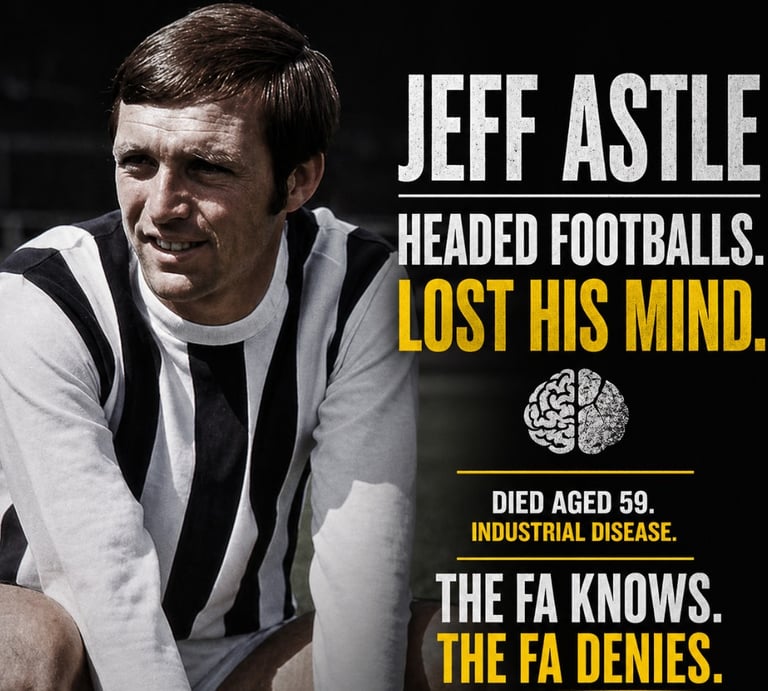
Jeff Astle headed a football for a living. He was brilliant at it — a barrel-chested, fearless centre-forward who rose above defenders like a man with springs in his boots. West Brom. England. The 1968 FA Cup final, won with a header. He died in 2002, aged 59, unable to recognise his own family.The coroner's verdict was industrial disease. The neuropathologist who examined his brain found the kind of damage you'd expect from someone who'd spent thirty years doing exactly what Jeff Astle spent thirty years doing: heading heavy leather footballs, hundreds of times a week, for money, under the governance of the Football Association.
The FA's response, essentially, was to wait and see. Twenty-four years later, they're still waiting. Still seeing. And still, with breathtaking audacity, telling us that the science isn't settled. It is settled. And the most damning proof of that comes not from the FA's critics, but from the FA itself.
The Game the FA Is Actually Playing
Let's be clear about what is happening here, because the FA is very good at obscuring it. The FA is not saying there is no risk. It has already accepted there is risk — it introduced heading restrictions for children in 2020, and it funds research programmes specifically designed to understand the neurological harm done to former players. You don't do any of that if you genuinely believe there's nothing to worry about.
What the FA is saying — very carefully, in very precise legal language — is that causation has not been established. That heading has not been proved to cause brain damage. That the link, however compelling it looks, remains technically unconfirmed.
This is not a scientific statement. It is a litigation strategy. And once you understand that distinction, everything the FA says on this subject can be translated from corporate-legal into plain English, and it reads very differently indeed.
Plain English: we have not yet been forced by a court to pay.
The Research They Commissioned — and Then Quietly Buried in Plain Sight
Here is where it gets genuinely extraordinary.
In 2019, the FA co-funded a landmark study through the University of Glasgow — the FIELD study, led by Dr Willie Stewart. It examined the health records of 7,676 former Scottish professional footballers and compared them to 23,028 matched controls from the general population. It was published in the New England Journal of Medicine — not some fringe publication, but the most prestigious medical journal on earth. The results should have stopped football in its tracks.
Former professional players were 3.5 times more likely to die of neurodegenerative disease. Alzheimer's risk was elevated five-fold. Motor neurone disease risk was four times higher. Parkinson's was more than twice as common. These are not marginal statistical signals. These are enormous effects, consistently pointing in one direction.
Then, in 2023, the FA published the findings from its own FOCUS study — again, research it commissioned, funded, and put its name to. Former professionals were 3.46 times more likely to report neurodegenerative disease than matched controls. Cognitive testing independently confirmed the players were performing measurably worse than they should be.
The FA published this research. Then stood up in public and said causation has not been established.
Think about that for a moment. The organisation that paid for the evidence is simultaneously citing the absence of evidence. It commissioned the studies that documented the harm, and is now using legal technicality to deny that harm exists. This is not scepticism. This is institutional doublethink on a scale that would make a tobacco executive blush.
The Goalkeeper Test Nobody Can Explain Away
Science rarely hands you a clean natural experiment. Football did. If heading causes brain damage, then the players who head the ball least should show lower rates of neurological disease. Goalkeepers, across a full professional career, head the ball a fraction as often as outfield players. They share the same pitches, the same dressing rooms, the same lifestyle, the same physical demands — everything except heading frequency. The FIELD study found the gradient exactly where you'd predict it. Outfield players carried dramatically higher neurodegenerative disease risk than goalkeepers, who sat much closer to population norms. A subsequent Swedish cohort study published in 2023 independently confirmed the same pattern: the more you headed, the worse your outcomes. The less you headed, the better your chances.
In epidemiology, this is called a dose-response relationship. It is one of the most powerful indicators of causation available to researchers. It is, in simple terms, what you'd expect to see if heading was the thing doing the damage — and it is exactly what every study that has looked has found. The FA has never addressed this finding in public. When the evidence fits so perfectly and an institution refuses to engage with it, that silence is itself a form of answer.
It's Not Even the Concussions — It's Every Single Header
Here is the science the FA most desperately doesn't want discussed.
For years there was an implicit assumption — convenient for football's administrators — that the real danger was dramatic concussive events: the collisions, the knockouts, the incidents serious enough to take a player off the pitch. If that were true, you could argue the sport needed better concussion protocols, not a fundamental rethink of the game itself. That assumption is now comprehensively dead.
The neurological literature has moved firmly to subconcussive impacts as the primary driver of CTE — Chronic Traumatic Encephalopathy, the progressive degenerative brain disease found in the brains of former contact-sport athletes worldwide. Subconcussive means below the threshold of symptoms. No headache, no dizziness, no report to the physio. Just the routine mechanical stress of a footballer's head meeting a ball at pace, dozens of times a week, across an entire career.
In 2025, the National Institutes of Health published findings that should have been front-page news across every sports desk in Britain. Researchers found that repeated subconcussive impacts cause measurable neuron loss and neuroinflammation in young athletes before CTE can even be diagnosed pathologically. The damage begins early. It accumulates silently. And it cannot be managed by better concussion protocols, because it happens in the thousands of headers that never look like injuries at all. Ann McKee of Boston University — the neuropathologist who has examined more CTE-afflicted brains than anyone alive — has been stating this for years. Her lab has now confirmed CTE in 345 of 376 former contact-sport athletes examined post-mortem. Her position on the causal relationship between repetitive head impacts and CTE has not wavered: the evidence is overwhelming.
The FA knows this research. It cannot credibly claim otherwise. And it continues to describe causation as unestablished.
The Bradford Hill Problem the FA Cannot Solve
There is a reason the FA's position looks increasingly cornered, and it's not just the accumulating epidemiology. It's that the epistemological argument underpinning their defence has already been publicly and formally demolished. In 1965, the statistician Sir Austin Bradford Hill set out the criteria by which scientists should assess causation in situations where randomised trials are impossible — you can't ethically assign humans to decades of industrial exposure and wait for them to die. His framework — covering strength of association, consistency, biological gradient, plausibility, coherence, and analogy — became the foundation of public health decision-making. It's how we established that tobacco causes cancer, that asbestos causes mesothelioma, that lead causes cognitive impairment in children.
A major peer-reviewed review published in 2022 in the British Journal of Sports Medicine applied the Bradford Hill criteria systematically to the evidence on repetitive head impacts and CTE. The conclusion was unambiguous: there is "convincing evidence of a causal relationship." Bradford Hill is not a fringe methodology. It is the established scientific standard specifically designed for exactly this kind of question. The FA is not saying the Bradford Hill framework was misapplied. It is not engaging with the framework at all — because engaging with it would require acknowledging that causation, by the appropriate scientific standard, has been established.
The standard the FA implicitly demands — a randomised controlled trial randomising players to career-long heading exposure — would be illegal to conduct and impossible to design. Demanding it is not intellectual rigour. It is a deliberate category error deployed as a shield.
Children, and the Contradiction the FA Cannot Escape
In 2020, the FA recommended that children under 12 should not head the ball in training, and that teenagers should have restricted heading practice. This guidance exists. The FA published it. It is still on the FA's website.
Pause on that.
You do not restrict an activity for children — in official guidance, bearing the FA's name and authority — without implicitly acknowledging that the activity causes harm sufficient to warrant restriction. The precautionary principle, which underpins child safety guidance across every regulated domain from food to pharmaceuticals to traffic, requires that harm be plausible and credible before restriction is imposed. The FA imposed restriction. Therefore the FA finds the harm plausible and credible.
And yet the FA simultaneously maintains that it does not accept heading causes long-term brain damage.
These two positions cannot coexist. They are logically incompatible. The FA is, in effect, protecting children from a danger it publicly denies exists — which means either the guidance is unjustified, or the denial is dishonest. There is no third option.
The situation is made worse by what the guidance does not cover: competitive matches. Children continue to head the ball in games. Given the NIH's 2025 findings that subconcussive impacts cause measurable neuronal damage in young athletes — whose brains are still developing, whose skulls are proportionally thinner, whose neuroinflammatory responses are less robust — restricting practice heading while leaving match heading untouched is not a safety policy. It is a performance of a safety policy.
The Deception Has a Name, and It Has Previous
What the FA is doing is not new. It has a well-documented history, a name, and a brilliant anatomy. Naomi Oreskes and Erik Conway's 2010 book Merchants of Doubt traced the tobacco industry's decades-long campaign to manufacture the appearance of scientific uncertainty as a means of avoiding regulatory and legal accountability. The strategy was not to disprove the science — that was impossible. It was to ensure that doubt persisted in public and legal discourse long enough for the commercial and institutional interests at stake to be protected.
The playbook has four moves. Acknowledge the association — yes, we know players are getting ill. Dispute causation — but science hasn't proved heading is responsible. Fund research selectively — commissioning studies that document risk while framing findings narrowly. Move the goalposts — as each evidentiary threshold is crossed, raise the bar for what would constitute proof.
The FA is running this playbook in near-perfect sequence. And the reason it runs it is not complicated: the potential liability exposure to former players and their families, if causation were legally established, runs to hundreds of millions of pounds. Every year that the legal position is maintained is a year in which that liability stays off the balance sheet.
This is not a cynical interpretation. It is the straightforward logic of institutional self-interest. The FA has a profound financial motivation to maintain its current position, and it is maintaining its current position. The simplest explanation is usually the correct one.
The Names Behind the Numbers
Statistics have a way of sanitising what is actually an intimate human catastrophe.
Nobby Stiles — European Cup winner, World Cup winner, the toothless terrier who harried Eusébio into submission at Wembley in 1966 — developed dementia and was moved to a care home. He died in 2020 having spent years unable to speak coherently.
Martin Peters, who scored England's second goal in that 1966 final, developed Alzheimer's. He died in 2019. Gordon Banks, widely considered the greatest goalkeeper in English football history — and, crucially, a goalkeeper, a man who headed the ball less than virtually any other professional in his era — died of kidney disease without neurological impairment. He outlived three of his outfield teammates from 1966.
Jeff Astle's daughter Dawn has campaigned for justice for her father for over twenty years. She has sat across the table from FA officials. She has watched the governing body commission research that confirmed her father's fate, then retreat behind legal language to avoid accountability for it. These are not abstract cases. These are men whose skills were celebrated, whose bodies were used up, and whose governing body — the institution paid to protect them — is now using the most sophisticated legal and communications machinery available to avoid answering for what happened to their brains.
What Should Happen — and Why It Won't Unless Someone Forces It
The answer to what the FA should do is not complicated.
It should acknowledge, publicly and unambiguously, that the scientific evidence establishes a causal relationship between repetitive heading and long-term neurodegenerative disease. Not "may suggest a link." Not "supports further research." A causal relationship, on the appropriate scientific standard. It should establish a properly funded welfare programme for former professionals and their families, modelled on the NFL's settlement structure — which, for all its inadequacies, at least represented a public reckoning with institutional culpability. It should immediately extend heading restrictions to competitive youth football matches, bringing its safety policy into line with the science rather than performing compliance with it.
And it should stop using technical legal language to maintain a public position that its own science has already demolished. None of this is likely to happen voluntarily. The FA has demonstrated, across two decades and at least two major commissioned research programmes, that it will not move unless forced. The question is who does the forcing.
The lawyers pursuing compensation claims on behalf of former players and their families are part of the answer. The Department for Culture, Media and Sport is another. The broader public health community — which has the Bradford Hill precedent firmly on its side — is another.
But there is also a role for journalism, and for the kind of clear, direct statement of what the evidence actually shows that the FA's communications machine is specifically designed to prevent.
The evidence shows this: professional footballers are dying of brain disease at three to five times the rate of the general population. The dose-response gradient tracks precisely to heading exposure. The biological mechanism is characterised and confirmed at post-mortem. The FA's own research documents the harm. The appropriate scientific standard for causation has been met.
Jeff Astle died of industrial disease. The industry knew. The industry is still pretending otherwise.