Good News but British Racing Has a Power Problem
The money may be arriving, the crowds may be back, but the sport is still being run too far from the people who fund it, fill it and keep it alive.
HORSE RACINGPOLITICSSPORT
British racing is not accustomed to good news, and it has learnt — often painfully, occasionally expensively, and in at least one memorable instance whilst dressed in morning coat at Epsom watching nobody in particular — to be suspicious of it when it arrives. So the events of the past fortnight deserve careful examination. A Jockey Club chief executive talking confidently about £100 million of inward investment. Cheltenham crowds reversing a four-year decline. A nascent governance coalition prodding the Racecourse Association with what appears, from a safe distance, to be a sharp stick. Are these genuine green shoots, or are they the sport's periodic capacity for collective self-congratulation asserting itself before the ground has thawed?
The honest answer is: both, simultaneously. And the critical variables that will determine which interpretation prevails are not the investment quantum, not the crowd data, and not whoever ends up chairing whatever working group the RCA convenes to review itself at glacial pace. They are: first, the quality and character of the next BHA Chair; second — a point conspicuously underweighted in current debate — what happens to the money once it arrives; and third, a problem so structural and so long-standing that the sport has developed a peculiar talent for discussing everything around it without ever quite looking at it directly.
British racing is largely separated from its own customers. From the punters who fund the levy and provide the liquidity that makes the whole commercial ecosystem viable. From the owners who bankroll the horses, absorb the losses, and sustain the participation base without which there is no sport to govern. The sport has become expert at talking about these groups — at commissioning reports about them, forming working groups concerning them, and expressing warm sentiment in their direction — whilst simultaneously constructing a governance and distribution model that treats their interests as secondary to those of the institutions that house the sport rather than the people who animate it.
Today, as this article is published, the National Trainers Federation holds its Annual General Meeting — the most consequential day in the NTF calendar, and this year carrying a weight that goes beyond the usual management of institutional frustration. Alongside the AGM itself, the sport's leadership will convene for a Racing Leadership Panel hosted by Nick Luck, featuring Fliss Barnard of Ascot, Seb Butterworth of Flutter, Brant Dunshea of the BHA, Dido Harding of the Jockey Club, Paul Johnson of the NTF, and Nick Mills of Racecourse Media Group. It is, in other words, a room in which British racing will look at itself in the mirror. What it sees will depend, in no small measure, on whether the people in that room are prepared to ask the question that was posed at a previous gathering with rather more directness than the panel format typically encourages.
But before we reach either the money or the panel, we must address that question directly.
The Haggas Question: Who Actually Runs Racing?
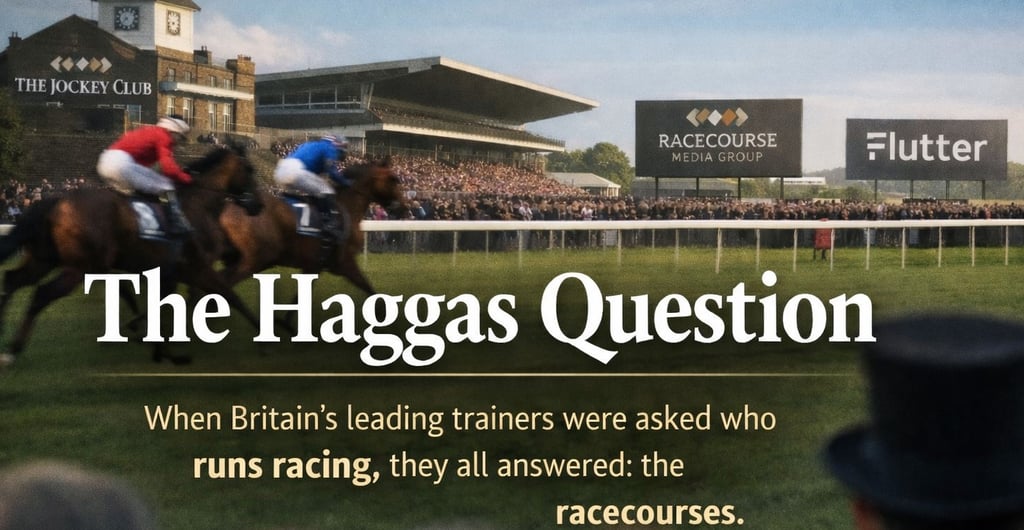
At the most recent National Trainers Federation AGM, William Haggas asked his assembled colleagues a simple question. Who runs British racing?
The room did not pause to reflect. There was no nuanced debate, no carefully worded working group recommendation. There was a chorus. Unanimous, immediate, and unambiguous. The racecourses.
This is William Haggas we are talking about. Not a fringe voice, not a disgruntled peripheral operator nursing a grievance at the back of the room. One of the most respected and successful trainers in the country, a man whose string has carried the silks of King Charles III, whose record of achievement at the highest level of the sport is beyond serious dispute, and whose instinct, when confronted with a structural absurdity, is to name it rather than navigate diplomatically around it. When a trainer of his standing, surrounded by peers representing decades of collective experience, asks who runs racing and receives a unanimous answer pointing at the racecourses — that is not a grievance. That is a diagnosis.
And it is, quietly, one of the most damning indictments of British racing's governance model delivered in recent memory. Not by a campaigning journalist. Not by a disaffected owner writing an angry letter to the Racing Post. By the consensus of the sport's leading practitioners, in a room together, asked a direct question and giving a direct answer.
The Haggas Question is the organising principle of everything that follows. Because if the answer to 'who runs racing' is 'the racecourses,' and if the sport is simultaneously haemorrhaging owners, struggling to sustain trainers at the mid-level, treating punters as a revenue stream rather than a constituency, and watching participation erode whilst premium venues invest in better hospitality for the people who can already afford it — then the governance model is not a background administrative issue. It is the problem.
When a trainer who saddles horses for the King asks his peers who runs British racing and receives a unanimous answer — the racecourses — that is not a grievance. That is a diagnosis.
The Racing Leadership Panel: A Study in Who Gets a Microphone
Which brings us, with exquisite timing, to today's Racing Leadership Panel at the NTF AGM. Nick Luck will host. The panel features Fliss Barnard, Chief Executive of Ascot; Seb Butterworth, CEO of Flutter; Brant Dunshea, Chief Executive of the BHA; Dido Harding, non-executive director of the Jockey Club; Paul Johnson, Chief Executive of the NTF; and Nick Mills, Chief Executive of Racecourse Media Group.
It is an interesting room. Let us examine it with the forensic attention it deserves.
Present: the regulator. The sport's largest and most prestigious racecourse. The world's biggest online betting company. The Jockey Club. The trainers' representative body. The organisation that sells the sport's broadcast and media rights. This is, on the face of it, a reasonable cross-section of racing's institutional landscape — the kind of panel that would look perfectly balanced to someone who had spent the preceding decade inside one of the organisations represented on it.
Absent: an owner. A punter. A breeder. A jockey. Anyone whose primary relationship with British racing is as a customer, a participant, or a provider of the animals without which the entire enterprise is literally impossible. The people who fund the sport, ride the horses, and write the cheques are not, it appears, required for a discussion of racing's leadership. They are welcome to watch from the audience.
We should be careful not to be entirely uncharitable. Paul Johnson will no doubt represent the training profession with vigour, and the trainers' perspective encompasses much of what the absent constituencies would say. Brant Dunshea, to his credit, has shown greater willingness than some of his predecessors to engage with structural questions directly. And Nick Luck, as host, can be relied upon to ask the questions that the panel format might otherwise allow to be navigated around.
But the composition of the panel is itself a data point — an inadvertent but revealing illustration of the Haggas Answer. When racing assembles its leadership for a public conversation, the institutional representatives are there. The racecourse is there. The betting company is there. The media rights body is there. The customers, the riders, the owners, the breeders — the people who create the product and fund the ecosystem — are the subject of the discussion rather than participants in it. This is not a conspiracy. It is a habit. And habits, in governance, are more dangerous than conspiracies because they require no co-ordination to perpetuate themselves.
One trusts that someone in that room will ask the Haggas Question. One hopes, with rather less confidence, that the answer will be different from the one given last time.
The panel features the regulator, a racecourse, a betting giant, the Jockey Club, the NTF and a media rights body. Absent: an owner, a punter, a breeder, a jockey. The customers are the subject of the discussion, not participants in it.
For the benefit of any reader who has recently arrived in British racing from a jurisdiction where governance makes sense, a brief structural explanation may be helpful.
British racing operates as follows. The owners provide the horses, the money, and an optimism that would be touching if it were not so expensive. The trainers provide the expertise, the infrastructure, the staffing, the welfare, and — at the lower end of the prize money scale — a tolerance for financial hardship that would impress a medieval ascetic. The jockeys provide the skill, the bravery, and a weight management regimen that no qualified nutritionist would endorse. The breeders provide the next generation of horses and the next generation of owners, absorbing the cost of doing so across a prize money environment that makes the economics of artisan cheese-making look straightforward by comparison.
The punters provide the levy — the financial mechanism through which betting on racing funds the sport itself — and in return receive a product that is, depending on the day and the venue, somewhere between genuinely thrilling and a masterclass in how to make a compelling sport feel inaccessible. They also receive the Racing Post's tips, the occasional windfall, and the enduring suspicion that the market knew something they didn't.
And then there are the racecourses, who provide the venue, collect the gate money, sell the hospitality packages, take the media rights income, distribute a portion of prize money they have not themselves generated, and — through the RCA — exercise governance influence broadly commensurate with the management of a premium events business that happens to have horses as a theming choice. They are, to extend the analogy, the hotel in which the party is held. The guests, the musicians, the caterers, the people who organised the event and sent out the invitations — all of these have considerably less say in how the hotel is run than the hotel does.
We are not suggesting that racecourses do not matter. Guy Lavender's work at Cheltenham demonstrates precisely the opposite. The difference between a well-run premium track and a volume operator grinding through fixtures on a Tuesday is substantial, and it matters to everyone. But the governance model that gives racecourses, as a class of participant, structural power disproportionate to those who create the product — the horses, the trainers, the owners, the punters funding the levy — is not a defensible arrangement. It is an accident of history that has calcified into an assumption. And assumptions of this kind tend to persist until someone asks, in a room full of colleagues, who actually runs this sport — and the answer proves rather more embarrassing than anyone in an administrative role would prefer.
The racecourses are the hotel in which the party is held. The guests, the musicians, the caterers — the people who actually created the event — have considerably less say in how the hotel is run than the hotel does.
The Missing Customers: Punters, Owners, and the Art of Institutional Indifference
There is a particular kind of institutional relationship that British racing has perfected with its two most important customer constituencies — the owners and the punters — and it can be summarised, with only modest unfairness, as follows: we need you desperately, we think about you constantly, and we have designed almost every structural mechanism in the sport in a way that makes your position progressively less sustainable. We hope you will continue anyway.
The punter is, in the economic architecture of British racing, the foundation stone. The levy — imperfect, contested, and perpetually under renegotiation — exists because punters bet on horses, and that betting generates the funding that flows into prize money, racecourse investment, and the broader ecosystem of the sport. Without the punter, there is no levy. Without the levy, the economic model of British racing does not hold together. This is not controversial. It is arithmetic.
And yet the punter's experience of British racing has, for a generation, been characterised by a sport that treats them primarily as a problem to be managed — or more precisely, as a customer of the bookmaker who happens to provide a revenue stream that racing is entitled to a share of. The product offered to punters: the quality of racing, the integrity of the sport, the accessibility of information, the experience of attendance — has been subordinated, with depressing consistency, to the interests of those who control the venues and the fixtures. A punter who finds the product increasingly opaque, increasingly expensive, and increasingly difficult to engage with does not stop being a punter. They simply redirect their leisure spending somewhere else. This is happening. The data is not ambiguous.
The owner's position is, if anything, more structurally perverse. Owners are the sport's primary investors. They pay training fees, purchase horses, fund travel, absorb veterinary bills, and receive, in the vast majority of cases, a financial return somewhere between modest and non-existent. They do this, in the main, for the love of it — for the thrill of ownership, the community of the sport, the attachment to a particular horse or trainer or stable. They are, in short, the most valuable and most underserved constituency in British racing.
The ownership model is haemorrhaging participants at the mid-market level — the syndicates, the small individual owners, the people who have one or two horses and whose continued participation is the difference between a healthy sport and a sport sustained only by the very wealthy and the very stubborn. These are the people whose investment sustains the training profession, who fill the yards, who make the economic case for breeders, who are the sport's participation base in the most literal sense. And when they look at prize money that does not cover their costs, at a governance structure that has no effective voice for their interests, and at a sport that seems, on its bad days, to be run for the convenience of its most powerful commercial operators — they leave. Quietly, without drama, but in numbers that compound over time.
The uncomfortable truth is that British racing has become expert at discussing the owner and punter problem whilst being structurally unable to solve it, because solving it would require redistributing power and money away from the constituencies that currently hold both. This is the Haggas Question in its fullest form. It is not merely who runs racing. It is: who is racing run for?
British racing has perfected a particular relationship with its customers: we need you desperately, we think about you constantly, and we have designed almost every structural mechanism to make your position progressively less sustainable. We hope you will continue anyway.
The £100 Million Question — and the Rather More Important Question After It
The investment structure Jim Mullen outlined — almost certainly a sale or equity release on the Jockey Club's catering joint venture with Compass Group — is significant, though perhaps not in the way the more excitable corners of racing's commentariat have suggested. £100 million sounds transformational. Distributed across capital programmes at Cheltenham and Aintree over several years, it is substantial but not revolutionary. The Cheltenham Festival alone generates revenues that would make a visiting executive from any other major sports property reach for a calculator and a large drink.
What matters about the deal structure is the accountability it implies. Mullen explicitly acknowledged that returns will be expected. The Jockey Club, which has historically operated with the financial transparency of a particularly secretive medieval guild, will now have a commercial partner with opinions about performance. This is not, on balance, a bad thing.
But the investment question — welcome as it is — is the easier of the two challenges now facing racing. The harder question is not how much money comes in. It is where it goes once it arrives.
British racing has considerable experience of generating and receiving funds that fail to reach the parts of the sport most in need of them. The levy, prize money distribution, the various funding mechanisms that pass through the BHA, the RCA, Horsemen's Group negotiations, and assorted committees whose membership reads like a heritage document from 2003 — all create a system in which money has a remarkable tendency to pool at the top and trickle, with all the urgency of a January morning at a provincial track, towards the smaller trainers, the lower-tier racecourses, and the owners who constitute the lifeblood of the sport's participation base.
A £100 million investment in Cheltenham and Aintree racegoer experience is genuinely good news for people who attend Cheltenham and Aintree. It is considerably less relevant to the trainer in the north of England running fifteen horses on margins that would make a supermarket buyer wince, or to the owner whose prize money cheque does not cover the transport bill, or to the punter whose experience of the product gives them no particular reason to choose racing over the seventeen other leisure options available on their phone. The distribution question is not a footnote to the investment story. It is the story. And it connects directly to the customer disconnection described above: the money follows the power, and the power is not with the customers.
The levy follows the punter, the product depends on the owner, and the prize money reaches the trainer. Unless it doesn't — which, for too many participants, is the more accurate description.
The Cheltenham Signal: What Good Actually Looks Like
Against this somewhat dystopian structural backdrop, the Cheltenham crowd figures are worth examining with genuine care — because they demonstrate, with empirical clarity, what happens when a major venue actually decides to put its customers first.
A 3.7 per cent aggregate increase — with Wednesday's attendance rising by over ten per cent to 46,317 — does not happen because someone put up a slightly more legible sign at the car park entrance. It represents the reversal of a four-year declining trend, coinciding precisely with a deliberate shift under Guy Lavender to place the racegoer at the centre of operational thinking rather than at its periphery — which is where racegoers have historically been positioned, somewhere between an inconvenience and a cash machine with legs.
The lesson is straightforward, if uncomfortable for those who have attributed declining attendances to exogenous factors, adverse weather, the cost of living, the general reluctance of the British public to stand in a field in March. When the product is improved — when friction is reduced, when the experience justifies the cost — demand is latent and recoverable. Racing has a structural audience problem. It does not have an irreversible one. The Cheltenham data provides the empirical foundation for that distinction, and it points, implicitly but unmistakably, at what the rest of the sport could achieve if customer orientation were a governing principle rather than an aspiration.
The RCA Coalition, ARC's Structural Position, and the Kempton Interlude
The most consequential line in Mullen's recent interview was his endorsement of a formal governance review of the Racecourse Association — backed by Ascot, Goodwood, Newbury and York. Students of British racing governance will appreciate the novelty. Getting these organisations to agree on anything beyond the general desirability of horses running in a circle is not a given.
ARC's powerbase rests on three pillars: volume of fixtures giving it disproportionate voice in levy and funding negotiations; RCA representation amplifying that voice at structural level; and the absence of organised opposition from premium tracks. The third pillar has now begun to crack — quietly, without dramatic announcement, in the manner of most meaningful structural shifts.
ARC's capacity to block, dilute, or redirect policy proposals that threaten its commercial model — through RCA process, slow-walking, sympathetic working group populations, and the reliable inadequacy of BHA institutional authority — is not villainy. It is rational self-interest executed with proficiency. But it is also, viewed through the lens of the Haggas Question and the customer disconnection above, a direct expression of who racing is run for and why the answers to both questions remain what they are.
On Kempton: the 'rebirth' framing is admirable in intent, and every penny genuinely reinvested into racing would be welcome. The question of which pennies reach which parts of racing returns us, with the inevitability of a short-priced favourite, to the distribution problem. On Nottingham: a lease expiring in 2029, a local authority considering selling, and Jim Mullen attending a third meeting with the council. One cannot help but observe that when a chief executive has reached meeting number three about a lease, something has either gone very well or not particularly well, and the careful phrasing of the public statement rarely clarifies which. We await the fourth meeting with interest.
Rebalancing Power: Those Who Put In Must Have Their Say
The Haggas Question points towards a prescription as well as a diagnosis. If the answer to 'who runs racing' is 'the racecourses,' and if the customer base — owners and punters alike — is structurally disconnected from the governance that determines their experience of the sport, the response is to rebalance towards those who actually put in.
This is not an anti-racecourse argument. It is a proportionality argument. The owners who fund the horses, the punters whose levy underwrites the sport, the trainers who develop and manage the animals, the breeders who supply the raw material — these constituencies should have governance representation that reflects their contribution and their centrality to the sport's long-term viability. At present, they do not. British racing's governance architecture is roughly equivalent to running a restaurant where the landlord has a seat on the board, the chef is consulted occasionally, and the customers are thanked warmly in the annual report whilst their feedback is filed under 'considerations for future review.'
The rebalancing required is not revolutionary. It does not require a constitutional convention in a Birmingham hotel or the ritual humiliation of any particular organisation. It requires a BHA Board that is genuinely independent of its most powerful stakeholders, a Chair who understands that 'independent' means something specific and demanding, and a willingness to ensure that prize money, levy distribution, and funding flows are structured around participation sustainability rather than commercial concentration. It requires, in short, that the people who put in — the owners, the punters, the trainers, the breeders — have a governing body that is demonstrably and measurably working in their interests as well as those of the venues that house them.
It also requires, frankly, that the next time someone asks who runs British racing, the honest answer is: the governing body does, in the interests of the sport as a whole, with appropriate weight given to those who create its product and fund its existence. That is not where we are. The distance between where we are and where we need to be is the governance challenge of the next five years, and it begins with a single appointment.
The people who put into British racing — owners, punters, trainers, breeders — deserve a governing body demonstrably working in their interests. At present, the governance architecture suggests otherwise. This is not a minor administrative observation. It is an existential one.
The Foundational Principle: Decisions for Racing, Not for Stakeholders
The BHA Board has, for too long, operated as a consensus mechanism — a body whose primary function has been to find outcomes that all major stakeholder groups can live with, rather than to make decisions in the best interests of British racing as a whole. These are not the same thing. They are frequently in direct conflict.
The interests of a major commercial racecourse operator, a betting exchange, a levy-funded horsemen's group, and an independent track with a Sunday market in the car park and seventeen horses expected on a wet Wednesday diverge sharply on fixture scheduling, levy reform, prize money distribution, and regulatory burden. A Board designed to balance these interests will reliably produce decisions that are tolerable to the powerful and damaging to the sport. It will also ensure, with impressive consistency, that whatever money is available accumulates where influence is concentrated rather than where need is greatest — which is to say, away from the customers and practitioners the sport cannot survive without.
An independent BHA Board — genuinely independent, with directors who can demonstrate fiduciary duty to the sport rather than to the constituencies that nominated them — is the structural prerequisite for any of the other reforms to have meaning. The distribution of funding is not a technical question for a finance sub-committee. It is a values question. It reflects what the governing body believes British racing is for. Is it for the venues? Or is it for the sport — the owners, the punters, the trainers, the horses, the communities that racing sustains in places where it is still the central event of the social calendar?
The Chair sets the culture of that answer. A Chair chosen to manage relationships produces a Board that manages relationships and leaves the distribution of power and money broadly as it found them. A Chair who asks — and answers — the Haggas Question differently produces something measurably, structurally different: a sport that is run for the people who fund it, animate it, and, if it loses them, will find it has nothing left to govern.
The Chair as Load-Bearing Variable
All of the threads above converge on the same point, with the insistence of a horse that has spotted the gap on the inside rail. The investment programme needs a regulatory environment capable of directing it where it is most needed. The RCA review needs a Chair with the will to give it teeth. The NTF's concerns — articulated with characteristic directness by a trainer who saddles horses for the King — need a Board that listens to evidence rather than managing vested interests. The customer disconnection needs a governing body that treats owners and punters as the sport's primary obligations rather than its secondary considerations. And the distribution question needs a Chair who understands that the measure of investment is not what arrives at the top of the system but what reaches the bottom of it.
The racing industry has a habit, when confronted with governance questions of this magnitude, of defaulting to the comfortable and the familiar. The departure of Lord Allen creates a moment of genuine optionality. The Nominations Committee would be wise to understand that the industry is watching, the practitioners are gathered today in the NTF AGM having asked the question directly, the owners are leaving in numbers that compound, the punters are redirecting their attention elsewhere, and William Haggas's chorus still echoes in that room — and will, one hopes, echo in today's panel discussion, however politely the format requires it to be phrased.
The green shoots are real. They are also fragile. They require water, decent soil, and governance that knows the difference between tending the whole garden and repeatedly hosing the topiary at Cheltenham because it photographs well. The people who planted the garden — who fund it, who work it, who depend on it — deserve a say in how it is tended. At present, they do not have one proportionate to their contribution. That is the problem. The Chair vacancy is the opportunity. Whether the sport is brave enough to take it is, as ever in British racing, the question that will not answer itself.