From Shell Shock to "Strategic Refinement": George Carlin Meets the BHA
Cut 69% of your Premier Racedays and call it evolution. Secure "friendly fire" instead of tax victory. Model the forecast number of runners and call it analytics. Carlin decoded military euphemisms. The BHA's turned institutional dysfunction into an art form.
HORSE RACINGPHILOSOPHYBUSINESS
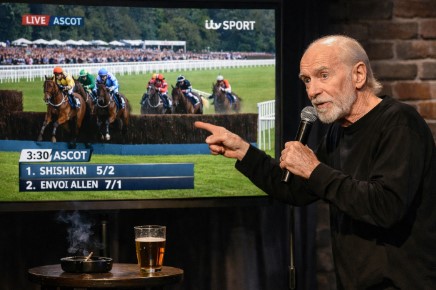

The British Horseracing Authority recently announced it was abandoning 69% of its Premier Racedays policy whilst describing the original plan as having "successfully given major races more visibility." This linguistic gymnastics warrants closer examination not as an isolated failure, but as symptomatic of an organisation whose planning and modelling capabilities belong somewhere between the abacus and the slide rule—tools admirably suited to their time, catastrophically inadequate for ours.
George Carlin once observed that modern language exists to hide reality rather than describe it. "Shell shock" became "battle fatigue," then "operational exhaustion," and finally "post-traumatic stress disorder"—each iteration adding syllables whilst removing humanity. The BHA has mastered this dark art. "Challenges" means catastrophic failure. "Lessons learned" means we were catastrophically wrong. "Evidence-based evolution" means we're abandoning 69% of something we insisted was successful. When organisations deploy this many euphemisms, you're not witnessing communication—you're watching institutional camouflage in real time.
The question isn't whether the fixture trial failed. That's established. The question is whether the BHA possesses the institutional architecture, analytical capability, and strategic coherence to govern a modern sport facing 21st-century challenges. Six pieces of evidence beyond the fixture debacle suggest the answer is grimly clear.
The Premierisation Collapse: Not a Bug, But a Diagnostic
Start with the centrepiece: the BHA's "transformational plan" for 2024 increased Premier Racedays by 50%—from 113 to 170—accompanied by protected windows, restructured scheduling, and soaring rhetoric about growing the sport. By 2026, they'd cut them to 52. That's a 69% reduction from the peak, leaving them with fewer Premier days than before the "transformation" began.
This isn't policy refinement. This is detonation followed by retreat disguised as learning.
But here's what matters: Premierisation wasn't some rogue initiative dreamed up by a maverick committee. It represented the BHA's core strategic response to racing's fundamental challenges—declining betting, weakening attendance, intensifying competition from alternative entertainment. Their answer was to create a two-tier structure: premium fixtures getting maximum support and visibility, with everything else downgraded to supporting cast.
The economic logic was sound. Concentrate resources on the events most likely to attract customers, betting, and media attention. Create genuine marquee occasions rather than diluting quality across too many fixtures. Perfectly reasonable. Exactly how modern sports leagues operate—the NFL doesn't pretend Thursday night games equal Sunday primetime; Formula 1 doesn't market Monaco and Abu Dhabi identically.
The execution, however, revealed an organisation fundamentally incapable of translating reasonable strategic intent into operational reality. They discovered, two years in, that:
Moving fixtures from traditional slots destroyed their attendance (17% average decline)
Protected windows created congestion elsewhere without improving overall betting (down 6.8%)
Racecourses whose fixtures were downgraded to "Core" suffered systematic commercial damage
Jockeys faced welfare impacts from compressed riding opportunities
The entire programme antagonised stakeholders it needed onside
This is the diagnostic revelation. An organisation with 21st-century capabilities would have modelled these impacts before implementation. They'd have run pilot programmes, conducted stakeholder analysis, and deployed proper analytics showing exactly how different formats would perform under various conditions.
Instead, they implemented wholesale change, watched it fail across every metric, spent a year defending it, then quietly abandoned 69% whilst claiming success. Carlin would recognise this instantly: "Friendly fire" isn't friendly, and "challenges" aren't challenging—they're failure wearing a suit.
The Premierisation collapse isn't an unfortunate policy misstep. It's the symptom of deeper institutional dysfunction: an organisation that cannot accurately model reality, cannot execute complex strategy, and cannot admit comprehensive failure without first wrapping it in euphemistic gauze.
The Tax Victory That Wasn't: Friendly Fire, Racing Edition
Carlin loved deconstructing military euphemisms. "Friendly fire" sounds almost cheerful—like your mates accidentally bought you the wrong pint. What it actually means: your own side just killed you. The BHA's recent tax "victory" exhibits precisely this quality.
The outcome? Racing's specific levy was frozen at 15%. Sounds like victory, yes? Except the Treasury implemented two critical increases: Remote Gaming Duty (online casino games, poker, bingo) rose from 21% to 26%, and gaming machine duty increased by 10%. These hit bookmakers' most profitable revenue streams—the ones that actually subsidise racing coverage, shop infrastructure, and the levy itself.
This is friendly fire in its purest form. Racing avoided the direct hit whilst ensuring maximum collateral damage to the very organisations funding the sport. Bookmakers now face significantly higher tax burdens than if racing had simply accepted 21% on betting. The BHA antagonised its "principal funders" through a public campaign positioning them as villains, lost the overall tax battle, secured a narrow exemption, and celebrated whilst their commercial partners absorbed the full blast.
To use another Carlin formulation: This isn't a "technical operational outcome requiring stakeholder realignment"—it's comprehensive strategic failure with a victory lap bolted on.
The bookmaking sector, thoroughly annoyed and facing genuine cost increases, is now rethinking its racing investment. Betting shops—which provide the geographical presence supporting racecourse attendance and casual betting participation—face margin compression potentially forcing closures. The levy might be frozen at 15%, but if betting shop distribution collapses and bookmakers reduce racing coverage to prioritise more profitable online casino products, the net funding outcome could be catastrophically worse than accepting 21% in the first place.
Modern sports organisations facing comparable situations don't orchestrate public warfare with their commercial partners. They build strategic alliances, negotiate sophisticated commercial arrangements, and ensure that even if political battles are lost, the underlying partnerships remain intact.
Governance as Performance Art
Let's address something rather fundamental—actually having leadership. Between November 2024 and September 2025, the BHA managed to lose both its CEO and Chairman in what can only be described as a masterclass in executive musical chairs that wouldn't look out of place in one of Carlin's routines about corporate America.
In December 2025, at the Gimcrack Dinner—one of racing's most high-profile events—the brand new chairman admitted there was "no single silver bullet" to solve racing's challenges . This is rather like a general announcing on the first day of battle that he reckons the war's probably lost, but jolly good show for turning up anyway.
To borrow Carlin's framing: They don't have "leadership transitions requiring interim governance structures"—they've got nobody in charge and are hoping you won't notice.
Modern sports organisations—Formula 1, the Premier League, even the PGA Tour—maintain leadership continuity precisely because strategic planning operates on 3-5 year horizons. You cannot build institutional capability, implement data infrastructure, or execute complex stakeholder negotiations when your executive suite resembles a revolving door at a particularly busy hotel.
The BHA entered its most challenging period in decades with an interim chairman, no permanent CEO, and a fixture strategy they were simultaneously defending and abandoning. This isn't governance. It's institutional performance art.
The Bookmaker Divorce
Lord Allen's December 2025 confession at the Gimcrack Dinner deserves full quotation: "We need to have a much better relationship with the bookmakers. They are our principal funders."
Note the tense. Not "we have a good relationship" but "we need to have" one. This came directly after the BHA's "Axe the Tax" campaign had positioned bookmakers as villains threatening racing's finances whilst mobilising the entire sport in public opposition.
The campaign achieved the worst possible outcome: alienating "principal funders" whilst comprehensively losing the political battle (on aggregate bookmaker taxation), securing only a narrow exemption that ironically makes bookmakers' overall position worse. The BHA deployed megaphone diplomacy, lost, secured friendly fire instead of victory, and is now left pleading for "a much better relationship" with partners it just publicly vilified. This is 1970s trade union tactics applied to 21st-century commercial partnership. The sophistication gap is breathtaking. Or, as Carlin might say: They don't have "stakeholder communication challenges requiring enhanced partnership frameworks"—they've just comprehensively pissed off the people paying the bills.
Data Modelling for Dummies
Here's what the BHA's Racing Director described as their cutting-edge analytical approach to the fixture trial: "My colleagues in the BHA Racing Department have worked with racecourses to make changes to the make-up of the race programme and better spread races across the year to support the delivery of more competitive racing for the sport's fans. The latter has involved modelling the forecast number of runners through the year and then adjusting the volume of races to support field sizes." In Carlin's taxonomy, this would be "pre-planning feasibility assessment modeling" when what they mean is: we counted horses and hoped for the best.
Meanwhile, in actual 21st-century sport
The NBA employs wearable biometric sensors tracking player fatigue, predictive injury models using biomechanical data, AI-powered shot selection analytics, and real-time tactical adjustment algorithms.
Premier League football deploys GPS tracking generating 1.4 million data points per match, expected goals (xG) models using Bayesian inference, neural networks predicting player development trajectories, and GDPR-compliant fan engagement analytics personalising experiences for millions.
The BHA modelled the forecast number of runners. This is the analytical equivalent of NASA planning Mars missions with an orrery and some enthusiasm.
Modern sports organisations don't just count things—they build predictive systems combining physiological data, behavioural economics, weather modelling, competitive analysis, and commercial forecasting. They employ data scientists, not administrators with Excel spreadsheets. They run A/B tests, conduct multivariate analysis, and build digital twins of their operations.
The BHA's "data-driven" fixture trial apparently lacked any meaningful modelling of:
Customer betting behaviour patterns across different fixture formats
Economic elasticity of demand for racing product
Racecourse revenue dependencies on specific time slots
Jockey travel and welfare constraints
Trainer stable management and horse availability
Media partnership commercial requirements
Competitive entertainment market dynamics
They forecast the number of runners, changed the fixtures, and expressed surprise when attendance collapsed and betting declined. This isn't 21st-century planning. It's educated guessing dressed in PowerPoint.
The Supply Chain Death Spiral
While the BHA obsessed over Saturday afternoon timings and orchestrated tax campaigns that secured friendly fire rather than victory, the sport's actual existential crisis intensified largely unaddressed. The numbers are genuinely terrifying:
Horses rated 130+: Down 11.5% in one year (729 to 645) Overall horse population: Declining 1.5% annually since 2022 Foal crop 2024: Down 7% year-on-year Stallions standing in GB: Collapsed from 147 (2021) to 107 (2024) Median loss per yearling sale: £33,000 for breeders
This is a negative feedback loop exhibiting classic market failure characteristics. Reduced betting turnover lowers prize money, making ownership economics worse, which reduces demand for horses, which destroys breeding economics, which reduces foal crop, which weakens competitive quality, which reduces betting interest. It's a death spiral with mathematical inevitability.
Modern 21st-century organisations facing supply chain crises don't tinker with product scheduling—they attack the economic fundamentals. They create incentive structures, deploy targeted capital, restructure value chains, and build strategic partnerships.
The BHA's response? The Elite Mares Scheme (modest subsidies for keeping quality mares), Junior National Hunt Hurdle races (encouraging younger horses over obstacles), and the Great British Bonus (prize money supplements). These are sticking plasters on a severed artery. The BHA has announced "a programme of work aimed at addressing this issue is under way, with a progress report to follow later in 2025." Given that Jump horses take 5-7 years from foaling to peak performance, and the foal crop has been declining since 2009, this casualness borders on dereliction.
Or, channeling Carlin: They don't have "equine supply chain structural degradation"—the sport is running out of bloody horses and nobody's doing anything about it.
The Linguistic Camouflage Problem
Carlin's fundamental insight was that institutional language exists to conceal reality, not describe it. When you hear "revenue enhancement," somebody's raising your taxes. When you hear "therapeutic misadventure," somebody died. When you hear "categorical inoperability," something doesn't work.
The BHA has internalised this approach completely:
"Mix of success and challenges" = Comprehensive failure across every metric "Impacted attendance" = 44% collapse at Ripon, 17% average decline at moved fixtures "Evidence-based evolution" = Abandoning 69% of something we just implemented "Strategic relationship with government" = We lost every political battle "Enhanced partnership frameworks" = The bookmakers hate us now "Modelling the forecast number of runners" = We counted horses
This isn't unfortunate communication. It's systematic reality concealment—the deployment of bureaucratic language to obscure the magnitude of institutional failure.
When organisations reach for this much euphemism, you're witnessing something profound: a complete breakdown in the relationship between language and truth. The words don't describe reality—they construct an alternative reality where failure is refinement, retreat is evolution, and incompetence is learning.
This linguistic camouflage isn't just annoying—it's diagnostic. It reveals an organisation so uncomfortable with truth that it must mediate every statement through layers of obfuscation. And you cannot solve problems you cannot honestly describe.
The Institutional Reality
So is the BHA's planning and modelling geared to the 21st century? The evidence suggests an organisation catastrophically mismatched to modern requirements.
Their "strategic planning" produces Premierisation—a massive policy reversal disguised as evolution—when modern organisations pilot, test, and iterate before wholesale implementation.
Their "political strategy" secures friendly fire instead of victory, antagonising commercial partners whilst achieving worse aggregate outcomes than simply accepting defeat gracefully.
Their "analytics" consists of counting horses and hoping for the best whilst actual modern sports deploy AI, machine learning, real-time biometrics, and predictive modelling as baseline capabilities.
Their "stakeholder management" involves publicly vilifying their principal commercial partners mid-crisis whilst modern organisations build strategic alliances and sophisticated negotiation frameworks.
Their "supply chain strategy" acknowledges a death spiral but proposes modest schemes whilst the mathematics of decline accelerates and modern organisations fundamentally restructure economic architectures.
Their "governance" maintains continuity through nine months of interim leadership and delayed executive appointments whilst modern organisations treat leadership stability as prerequisite for strategic execution.
Their "communication" deploys Carlin-level euphemism to conceal comprehensive failure rather than honestly describing and addressing reality.
The fixture trial, the tax campaign, the Premierisation collapse—none of these are isolated failures. They're symptoms of deeper institutional dysfunction: an organisation that cannot accurately model reality, cannot execute complex strategy, cannot maintain critical partnerships, cannot admit failure, and cannot deploy language that honestly describes what's actually happening.
British racing faces challenges that would stretch the capabilities of even the most advanced sports organisation: regulatory squeeze, supply chain collapse, commercial partner alienation, leadership vacuum, and competitive entertainment fragmentation. These require institutional sophistication operating at the frontier of modern sports governance. Instead, they've got an organisation that counts horses, hopes for the best, secures friendly fire whilst calling it victory, abandons 69% of flagship policies whilst claiming success, and describes comprehensive failure as "a mix of success and challenges."
The 21st century started 25 years ago. The BHA appears to have missed the memo. And British racing—the actual horses, trainers, breeders, jockeys, and courses doing the work—is paying the price whilst being told everything's an "evidence-based evolution" and "enhanced partnership framework."
George Carlin would recognise this instantly. He'd just have funnier names for it.