Fell at the First: How British Racing's Trade Body Managed to Unseat the Only Horses Worth Backing
Ascot has jumped ship. The Jockey Club is measuring the gangplank. And ARC is still filing its fixture list.
HORSE RACINGSPORTGAMBLING
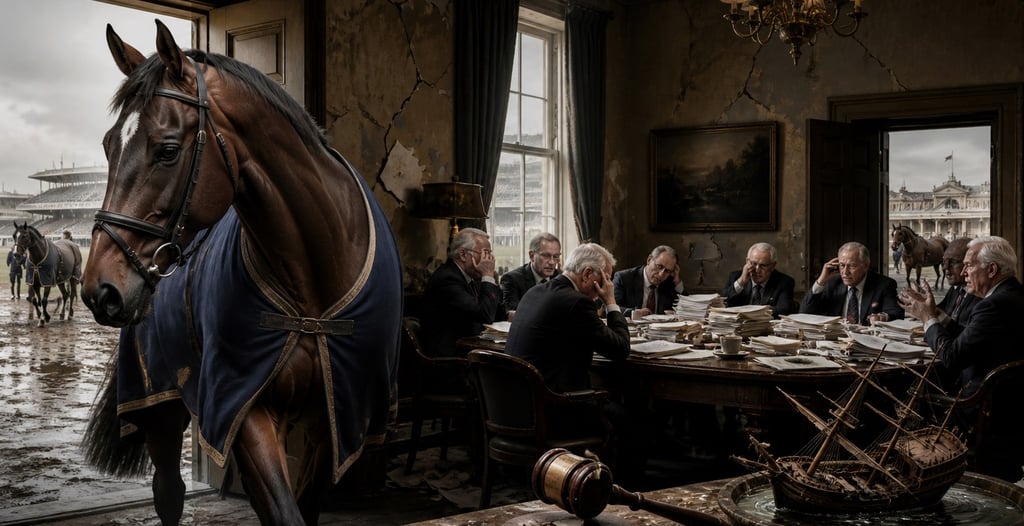
Let us dispense with the diplomatic fiction immediately. Ascot has not "decided to move away" from the Racecourse Association. It has looked at the RCA, concluded that it is a governance cartel dressed up as a trade body, and walked out. The only surprise is that it took this long.
The statement from Ascot chief executive Felicity Barnard — that the decision "was not taken lightly" — is the kind of thing people say when they have actually been thinking about it for years, have exhausted every alternative, and have finally accepted that the building is on fire and the occupants are arguing about the seating plan. British racing's governing class specialises in this particular form of rearranged deckchairs. Ascot has just pointed at the iceberg.
What follows is not a governance dispute. It is the structural collapse, in slow motion, of an organisation that has spent years confusing its own survival with the interests of the sport it claims to represent. The consequences will determine whether British racing has a coherent commercial future — or whether it accelerates, board meeting by board meeting, towards a managed irrelevance that no amount of Royal Ascot glamour can indefinitely disguise.
Sixty Racecourses. One Argument. Zero Strategic Direction.
Britain has 59 licensed racecourses. This sounds like strength. It is, under current governance arrangements, closer to a liability — a fractious coalition of competing interests that has never been successfully organised around a coherent commercial strategy, because the organisation nominally responsible for doing so has been structurally incapable of upsetting anyone sufficiently powerful to block it.
The Jockey Club operates 15 of those 59 courses — Cheltenham, Newmarket, Epsom, Sandown among them. Ascot stands alone as the single most commercially significant independent venue in world racing. Between them, 16 courses generate a wholly disproportionate share of the sport's media value, Levy contribution, and international profile. Then there is Arena Racing Company, operating 21 venues from Chepstow to Wolverhampton — the volume merchants, the fixture-fillers, the all-weather industrial complex that ensures British racing is always on somewhere, for someone, at odds that suggest the participants have never previously been introduced.
That leaves roughly two dozen smaller independents — Cartmel, Kelso, Perth, Fakenham, the genuinely charming outposts of the sport's participatory base — who have the most to lose from a collapsing governance structure and the least power to prevent it. The RCA has somehow managed to represent all of these simultaneously and none of them effectively. That is quite an achievement. Most organisations fail their members in more straightforward ways.
ARC: The Elephant in Every Room It Has Ever Entered
No analysis of this crisis is honest without confronting Arena Racing Company directly, so here we go.
ARC's business model is built on volume. More fixtures, more all-weather racing, more cards squeezed into the schedule until the fixture list resembles the terms and conditions of a mobile phone contract — technically available in its entirety but engaged with, in practice, by almost nobody. This is not racing as spectacle. It is racing as data infrastructure for bookmakers, a relentless content feed that generates Levy income per fixture and media rights fees per broadcast while systematically diluting the product that makes people care about racing in the first place.
The strategic conflict at the heart of British racing is not complicated. Premium venues want a smaller number of higher-quality fixtures that drive genuine public engagement, command premium media rights, attract international competition, and sustain a betting product that people choose rather than stumble across. ARC wants as many fixtures as possible, because ARC's revenues are correlated with volume in a way that Ascot's are not. Royal Ascot does not need a Tuesday all-weather card to pay its bills. Wolverhampton's entire business model is the Tuesday all-weather card.
Both positions are commercially rational from the perspective of their proponents. The problem is that they are strategically incompatible, and the RCA's governance structure — in which ARC's 21 courses provide substantial collective bloc weight — has consistently prevented the sport from making the choice. Instead, British racing has done what it always does when confronted with an irreconcilable conflict: it has split the difference, satisfied nobody, and called it consensus.
The result is a sport that is simultaneously over-supplied with mediocre racing and under-supplied with the kind of racing that anyone outside the industry's data ecosystem actually wants to watch. Field sizes have contracted to the point where some cards resemble a conversation rather than a competition. International prize money comparisons have become a source of national embarrassment. And the Levy — the bookmakers' compulsory contribution to the sport — is being extracted from a product of declining quality and distributed by an organisation of declining credibility. Everybody is getting poorer, more slowly, while arguing about voting rights.
Media Rights: About to Get Extremely Awkward
Here is something the sport's more optimistic administrators are quietly hoping nobody notices: the media rights negotiation that will shape British racing's broadcast income for the next cycle is going to be conducted against the backdrop of this governance implosion.
ITV, Sky, and international broadcasters are not charitable institutions. They are commercial operations that will assess the value of British racing's product with considerable precision and minimal sentiment. What they are currently watching is a sport whose governing trade body is losing its most prestigious member, facing the potential exit of its largest racecourse operator by commercial prestige, paralysed by the absence of a BHA chair, and apparently unable to decide whether it wants to be a premium spectacle or a 24-hour data service.
The negotiating position this creates is, to use the technical term, terrible. A fragmented racing industry — Ascot potentially outside the collective, the Jockey Club with one foot out of the door, no unified voice on what the product actually is — will receive fragmented media rights terms. The broadcasters will smile, express their deep admiration for the sport's heritage, and offer considerably less money than a united industry with a coherent commercial identity would command. Then they will blame streaming.
The Levy compounds this. Declining field sizes reduce betting handle. Lower betting handle reduces Levy yield. Lower Levy yield reduces prize money. Lower prize money reduces the quality of fields. The circle feeds itself, grinding downward, while the governing bodies debate their internal democracy. British racing has been in this spiral for years and has responded by accelerating the fixture count — the institutional equivalent of treating blood loss by running faster.
What the Wreckage Leaves Standing
If Ascot and the Jockey Club complete their exits, the rump RCA becomes, in commercial reality, a trade body primarily representing ARC and the small independents. Thirty-odd courses, the majority of which are either structural volume-providers or charming but financially marginal rural venues. In headcount terms, it can claim to represent most licensed tracks. In commercial terms, it would represent a fraction of the sport's economic weight while retaining, under the BHA's articles, the formal designation of "most representative body" for British racecourse owners.
This is where the constitutional absurdity becomes genuinely dangerous. The BHA's articles require the RCA to hold that designation to retain its two board seats and its Levy Board representation. Whether a body that no longer includes Ascot or the Jockey Club satisfies that definition is a question that a sufficiently motivated lawyer — or a BHA board that has run out of patience — could render extremely uncomfortable. The RCA cannot be removed as a member unless an alternative representative body can be recommended. In practice, this means the sport could be left governing itself through a body that no longer represents it, embedded in the architecture because nobody can agree on what replaces it.
British racing: always one constitutional loophole from complete institutional paralysis.
The Small Independents: Nominally Protected, Actually Exposed
The small independent courses occupy the most precarious position in all of this, which is grimly ironic given that the RCA's democratic structure was nominally designed to protect them. Peter Savill said it plainly: Plumpton's interests were not represented at board level either. The democracy that appeared to give small courses power delivered them neither adequate prize money nor meaningful strategic influence. It gave them votes in an organisation that couldn't use votes effectively. This is the governance equivalent of being given the right to choose the music on the Titanic.
In a reformed structure that properly weights commercial contribution, small independents would have less formal influence. The honest case — which the sport's politer voices have consistently refused to make — is that small venues need the premium venues to be commercially powerful far more than they need an equal vote in a body incapable of converting that vote into outcomes. A sport in which Ascot, Cheltenham, and Goodwood have genuine strategic authority and deliver premium Levy yields and media rights income distributes more resource to Cartmel and Fakenham than a sport in which everyone has an equal voice and nobody has effective power. Formal democracy has been spectacularly bad for the sport's least commercially powerful participants. This is not an accident.
Will This Be Better? Probably. But Only If Everyone Stops Pretending.
The brutal optimistic case for this fracture is that it forces a reckoning that the sport has been postponing for a decade. A reformed representative architecture — in which commercial weight shapes strategic authority, in which the volume-versus-quality debate is conducted openly rather than fudged into paralysis, in which small independents are protected by explicit commitments rather than the fiction of equal voting — could deliver better commercial outcomes for the entire sport.
The BHA chair appointment is now, without exaggeration, the most consequential hiring decision in British racing in a generation. That individual inherits a governing body without a credible representative structure, a media rights negotiation requiring unified authority nobody currently has, a Levy framework in structural decline, and an industry that must choose between two incompatible strategic identities. They will require an independent board, genuine authority, and the courage to tell people things they do not want to hear.
Ralph Beckett said doing the same thing and expecting different results is the definition of madness. He is right. In British racing's governance, it has also been the definition of Tuesday.
The question now is not whether the RCA survives this. The question is whether, in the wreckage of its current form, the sport finally builds something capable of representing what British racing actually is — rather than the comfortable illusion of what everyone at the table wished it were.
Ascot has fired the starting gun. The field has broken unevenly. And somewhere in a committee room, someone is still arguing about the going description.