EXCLUSIVE: Kempton Park Betrayal – Jockey Club’s 7-Year Silence Ends as Bulldozers Lurk
While fans fought to save racing’s soul, secret land deals simmered in the shadows. Now the truth slips out—and something big is coming.
HORSE RACINGSPORT
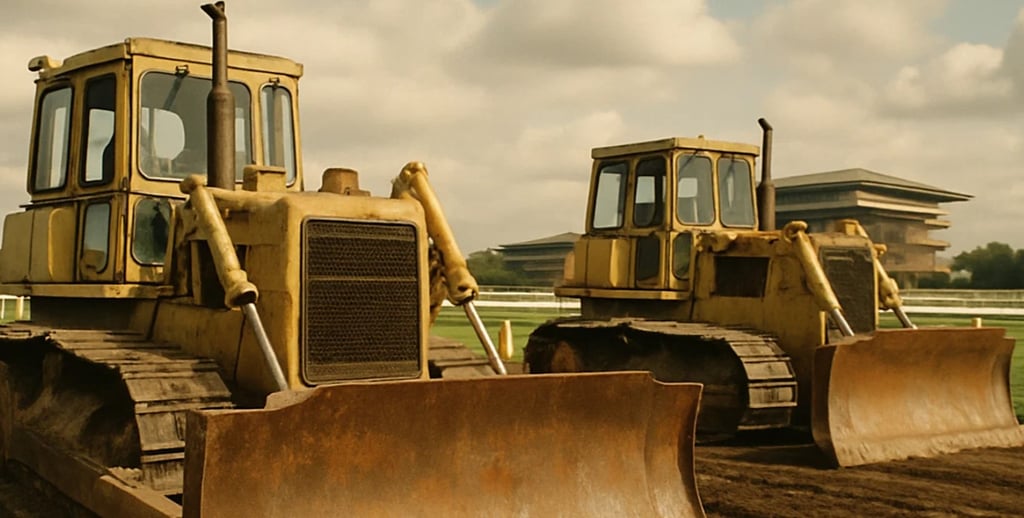
The Great Kempton Con: Seven Years of Silence, and Now This?
For seven years—longer than two World Cups, three Prime Ministers, and the average shelf life of a tabloid scandal—the Jockey Club has maintained a monk-like silence over Kempton Park’s fate. Not a whisper. Not a peep. Just quiet indifference while racegoers, trainers, and locals carried on under the naive delusion that Kempton was still, you know, part of the plan. Turns out, the plan was to hand the keys to Redrow and hope no one noticed until the diggers arrived.
The 2018 option agreement—granting Redrow first dibs on transforming 230 acres of racing heritage into a glorified Barratt brochure—was negotiated in lawyerly silence and then tucked away like a guilty secret. And now, after seven years of shoulder-shrugging opacity, Jockey Club CEO Jim Mullen steps out from behind the mahogany curtain to inform us, casually, that Kempton’s fate is “out of his hands.” Out of his hands? That's not strategy. That's the administrative equivalent of dropping the baby and blaming gravity.
Why now? Why break cover after seven years of treating Kempton like a minor embarrassment on the family tree? The timing stinks like a stable that’s stopped mucking out. The sudden burst of PR around “tens of millions” being spent on Cheltenham and Aintree—the chosen twins of British racing’s future—has all the hallmarks of a distraction campaign. You don't announce huge capital investment and conveniently rediscover a dormant land deal in the same week by accident. This isn’t transparency. It’s narrative management with a side of asset stripping.
The truth? Something is about to happen. Redrow didn’t hold that option like a collector’s item—they’re developers, not sentimentalists. And the political winds have shifted. With Labour now in government and planning laws loosened like a suburban waistband, the barriers that once protected Kempton have crumbled. Green belt? Not anymore. It’s green-light belt now.
So the Jockey Club is getting its excuses in early. Mullen’s “nothing concrete” line is less a reassurance than a legal fig leaf, allowing them to claim they warned us while doing precisely nothing to prevent it. It’s the old trick: delay, deny, then declare it’s too late to stop. The developers call it "due diligence." The rest of us call it a stitch-up.
And what of the racing folk—the little people? The grassroots trainers, the punters with season tickets, the volunteers who assumed Kempton would still be hosting the King George into the next decade? They’ve been making plans. Long-term ones. Investing in horses, staff, futures. All while the Jockey Club knew the rug could be pulled at any moment and chose, quite deliberately, to say nothing. That’s not governance. That’s sabotage by omission.
Racing as a whole now resembles a dysfunctional family business. The golden child (Cheltenham) gets all the cash and compliments. The aging parent (Kempton) is quietly signed into care. And the rest of the siblings squabble over crumbs, wondering why the inheritance keeps shrinking. Meanwhile, the family accountant (Redrow) waits patiently by the door, ready to "help with the paperwork." If Kempton does fall—and make no mistake, the gears are turning—don’t let anyone tell you it was unavoidable. It was perfectly avoidable. It just wasn’t as profitable.
And when the bulldozers arrive, the Jockey Club will likely tweet something about "legacy," slap up a commemorative bench, and carry on as if they hadn’t just sold another piece of British sport to the gods of grey render and Persimmon porches.So yes, ask the question: why now? Because the silence isn’t breaking. It’s being managed. And if we don’t shout back, the next silence will be over Sandown. Or Newmarket. Or racing itself.
And this, ultimately, is where it leaves racing: not in crisis, but in managed decline. The sport is being quietly hollowed out, its mid-tier venues and regional strongholds left to wither while a narrow elite of showcase festivals hoover up the remaining investment. It’s the Premier League playbook, applied to a tradition-bound sport with no global TV rights to save it. The long-term trajectory isn’t growth—it’s gentrification. A racing calendar reduced to six champagne weekends a year, bookended by whitewashed townhouses where paddocks used to be.
The Jockey Club’s silence wasn’t apathy. It was strategy. And the sound you hear now isn’t the sport fighting for its life—it’s the quiet professionalism of an industry being shrunk to fit a spreadsheet.