Collaboration Has Failed. Who Has the Guts to Lead?"
Kempton under threat. Trainers walking away. Owners haemorrhaging money. 2025 laid bare the crisis. 2026 must be the year of action—or there won't be a 2035.
POLITICSSPORTHORSE RACINGCULTURE
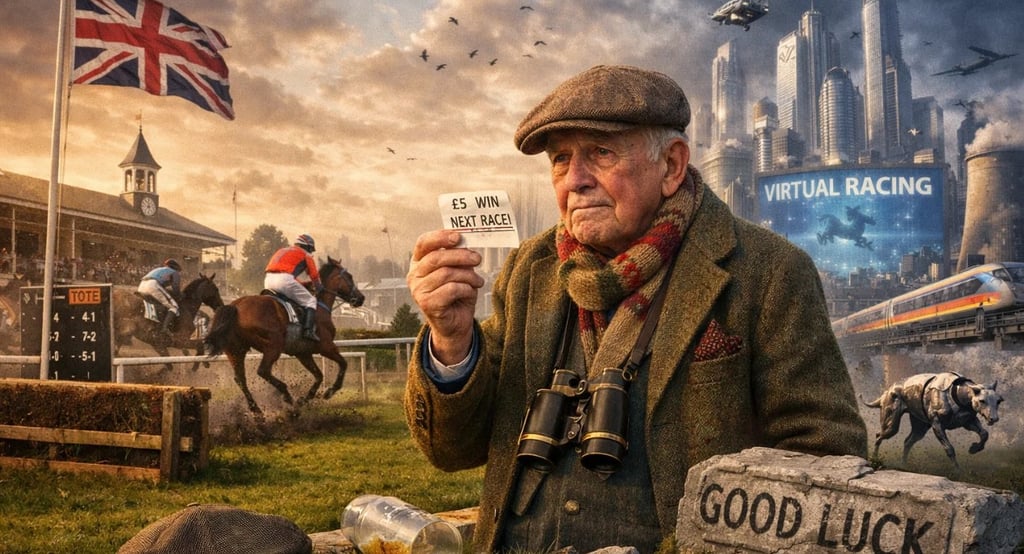
On 4th December 2025, trainer Alice Haynes saddled her final runners at Chelmsford. Thirty-four years old. A Group 3 winner. A Royal Ascot place. And finished—because, as she put it, "racing's current financial model does not make it viable to continue."
Ten days later, as the sport prepared for the King George, the Jockey Club confirmed that Kempton's future remains "out of my hands"—that developer Redrow retains an option to bulldoze the 147-year-old home of jump racing's Christmas crown jewel and build houses. Nicky Henderson said the thought "scares me to death." This is where we are at the end of 2025. Trainers walking away. Iconic racecourses under threat. Owners haemorrhaging money. An audience ageing into extinction. A foal crop in freefall. And an industry that responds to existential crisis with consultation documents, stakeholder forums, and collaborative working groups.
It is not enough. It is nowhere near enough. And the reason it is not enough is that collaboration—the industry's preferred mode of operation—has failed. It has been failing for years. And it will continue to fail, because the structures that make collaboration necessary are the same structures that make decisive action impossible.
The Numbers That Should Terrify Us
The statistics are familiar to anyone paying attention, but let us state them plainly because they describe a sport in mortal danger. Betting turnover has collapsed by £3 billion in two years—a 25% decline that has devastated levy income and media rights revenue. Less than a fifth of the audience is under 35; compare that to 45% for other major sports. The foal crop is forecast to contract by 25% by 2026—a demographic collapse in the horse population that will savage field sizes within three years. Already, 40% of races this year featured seven or fewer runners, approaching the threshold below which betting liquidity evaporates and the entire product becomes unviable.
And ownership? The median return on investment is eight pence in the pound. Eight pence. On training fees approaching £30,000 annually. The overwhelming majority of owners are guaranteed to lose the vast majority of their money, year after year, with no realistic prospect of improvement. They stay because they love the horses, love the sport, love the mornings on the gallops and the rare electric thrill of winning. But love has limits. Even the most devoted eventually tire of subsidising an industry that cannot organise itself to act in its own interest.
The BHA's own analysis suggests that 40% of training yards, studs, and racecourses are at risk within five years. This is not pessimism; it is arithmetic. When the money drains out of the system, everything connected to it withers.
The Leadership Vacuum
Let us say plainly what everyone in racing knows but few will articulate: there is a vacuum at the heart of this sport where leadership should be. Not because the individuals are inadequate—many are talented, experienced, and genuinely committed to racing's future. But because the structures they operate within make leadership functionally impossible.
Power in racing is diffused across more than twenty organisations with divergent interests, competing priorities, and mutual veto rights. The BHA regulates but does not control. Racecourses own the fixtures and much of the prize money but have no collective strategy. Bookmakers provide the funding but view racing as a legacy cost centre. Owners subsidise everything while receiving eight pence in the pound. Trainers bear the operational risk while watching their margins evaporate. And everyone collaborates—endlessly, exhaustingly, fruitlessly.
Collaboration has not worked. It will not work. The evidence is overwhelming. Seventy-five percent of major industry initiatives over the past decade have been delayed, diluted, or defeated by stakeholder vetoes. The pattern is always the same: a problem is identified, a solution proposed, consultation undertaken, objections raised, compromise sought, ambition lowered, implementation delayed, and eventually a watered-down version emerges years later—by which point the original problem has metastasised into something worse. This is not a failure of goodwill. It is a structural impossibility. When everyone must agree, no one can lead. When every stakeholder has a veto, radical change becomes definitionally impossible. The collaborative model was designed for steady-state management of a stable industry. It is catastrophically unsuited to crisis response.
What racing needs now is not more collaboration. It needs leadership. It needs individuals with the strength of character to make difficult decisions, absorb criticism, and drive change over the objections of those who prefer comfortable decline to uncomfortable transformation. It needs people willing to be blamed for the disruption that salvation requires.
What Racing Must Stop Doing
Stop pretending the collaborative model can deliver radical change. It cannot. It has not. It will not. The BHA's Industry Strategy Framework contains sensible initiatives, but they are calibrated for modest headwinds, not existential threat. Enhanced stakeholder forums, improved communication channels, process reviews, awareness programmes—these are displacement activities, not crisis response. We have been collaborating our way toward oblivion for a decade. It is time to try something else.
Stop waiting for consensus. Universal agreement among twenty-plus organisations with divergent interests is a fantasy. The pursuit of consensus has become the alibi for inaction—democratic paralysis dressed up as due process. The Premier League did not wait for every Football League club to agree before transforming English football. Racing must accept that some stakeholders will resist, some will be left behind, and progress requires moving anyway. Those who cannot lead must step aside for those who can.
Stop protecting fixtures that no longer justify existence. The fixture list expanded to absorb whatever the horse population could supply. Now that population is contracting, the mismatch is brutal. Monday cards at minor tracks with fields of five runners serve no one. Racecourse closures are coming whether we plan for them or not—Kempton's predicament makes that brutally plain. The Jockey Club itself is contemplating selling one of jump racing's cathedrals because the numbers do not work. The choice is between managed rationalisation that preserves what matters and chaotic contraction that destroys value indiscriminately.
Stop treating trainers as infinitely squeezable. The industry has systematically compressed trainers' margins while expecting them to maintain standards, welfare, and professionalism on economics that barely function. When young, talented trainers with Group winners and corporate sponsorship cannot make it work, the model is broken. We are losing people we cannot afford to lose, and we are losing them because the system has made their survival nearly impossible.
Stop ignoring the black market. Visits to unlicensed betting operators have increased by over 500% since 2021. An estimated £3 billion flows through platforms that contribute nothing to racing. This migration reflects rational self-interest: offshore operators offer better odds, accept larger stakes, and do not restrict winners. Licensed bookmakers have made their product progressively hostile to serious punters. Racing has watched this exodus with astonishing passivity, as though it were weather rather than a competitive response to policy failure.
What Racing Must Start Doing
Find leaders with the strength to act—and back them. Racing needs individuals willing to make decisions that will be criticised, to absorb blame for necessary disruption, to prioritise the sport's survival over stakeholder comfort. Lord Allen's governance reforms provide a foundation, but governance structures are only as effective as the people who operate them. The sport must identify, empower, and protect leaders with the character to do what the moment demands—and stop punishing boldness while rewarding timidity.
Build a coalition of the willing—and move without the unwilling. If consensus is impossible, circumvent it. Identify the racecourses, owners' groups, trainers, and breeders willing to commit to radical change. Create independent task forces with genuine authority. Reward participation; accept that non-participants will watch from the sidelines. This is not about exclusion; it is about refusing to let those who prefer decline exercise a veto over those fighting for survival.
Rationalise the fixture list—and mean it. Premier fixtures should offer prize money exceeding £1 million, guaranteed field sizes, and production values befitting major sport. Regional festivals should harness heritage and community. Volume racing should continue with minimum standards but without pretence it constitutes compelling entertainment. Some courses will not survive. That is the price of decades of expansion the horse population can no longer support. Better to choose which courses matter than let the market make that choice destructively.
Take control of racing's betting destiny. An industry-owned betting platform—through joint venture with established technology providers—could capture 100% of profits for the sport, offer guaranteed bet acceptance, and compete directly with offshore operators. The objections are real: regulatory complexity, capital requirements, operator resistance. But continued dependence on an industry that views racing as a cost centre, while turnover haemorrhages offshore, offers only managed decline. Sometimes the bold path is the only path.
Learn from sports that have transformed themselves. The ECB secured £1.1 billion for The Hundred, achieving 25% new audience and 42% female viewership. FIFA generates over £1 billion annually from gaming. Racing has no quality gaming presence, minimal digital strategy, and a demographic profile threatening generational extinction. Survival requires questioning every assumption about what the product is and who it serves.
The Human Reality
Behind every statistic is a person whose life is being reshaped by this crisis. The trainer who has watched his string shrink from forty to twenty-five, who has lost owners this autumn, who lies awake calculating whether he can make January's wages. The stable lass who loves the horses but cannot afford rent on racing wages. The breeder who sold yearlings at Tattersalls for prices that barely covered transport. The racecourse manager modelling which fixtures to abandon and how many staff to let go.
These are not abstractions. They are the fabric of communities across Britain—Newmarket and Middleham and Malton, Lambourn and the Curragh, the villages where the gallops are part of the landscape and the yard is the heartbeat of local life. When yards close and courses shut, those communities lose something that defined them.
The Choice Before Us
The Chancellor's exemption from the 25% Remote Betting Rate bought time—perhaps two or three years. That time must be used for structural transformation, not complacent relief. The response to the reprieve will determine whether it was a turning point or a stay of execution.
The path of least resistance is continued incrementalism: modest adjustments, gradual tweaks, enhanced communication. More collaboration. More consultation. More of what has already failed. This path leads somewhere predictable—a residual sport sustained by heritage appeal, having lost the scale and vitality that once made it matter. The alternative requires something racing has been unable to produce: genuine leadership. Individuals with the strength of character to make hard decisions and defend them. To tell stakeholders uncomfortable truths. To accept that transformation creates losers as well as winners. To prioritise the sport's survival over institutional comfort.
What We Stand to Lose
Let us be absolutely clear about what is at stake. This is not merely an industry facing commercial headwinds. This is part of who we are. Part of what makes Britain, Britain.
Racing is woven into our national life in ways that defy quantification. The roar of fifty thousand as the field turns into the straight at Cheltenham. Three generations making their annual pilgrimage to York. The lad who left school at sixteen and found purpose in the yard. The breeder who has devoted forty years to producing something beautiful and fast. The villager who sees the string on the gallops each morning and knows this landscape has continuity with something ancient and enduring.
If Kempton falls, what message does that send? That even our greatest courses are just real estate waiting to be liquidated? That nothing in racing is permanent, nothing worth fighting for? We are not talking about saving an industry. We are talking about preserving a living connection to our past—a thread linking us to generations who stood on these same courses, watched these same colours, felt this same quickening of the pulse. To lose this would be to lose something irreplaceable.
So this is a call to arms. To every owner who has stayed loyal despite the economics. To every trainer fighting to keep their yard alive. To every stable lad and lass who gets up in the dark. To every breeder nurturing each foal with hope. To every racecourse team battling to stay open. To everyone who has ever felt their heart lift watching a thoroughbred in full flight.
The time for collaboration is over. It has been tried. It has failed. We need leadership now—real leadership, with strength and character and the courage to act. We need people willing to be unpopular in the service of survival. We need boldness. We need urgency. We need someone to step forward and lead. Racing has been central to British culture for three hundred years. Our grandchildren deserve the chance to experience what we have experienced. Whether they get that chance depends on what we do now—and on whether we can find leaders equal to the moment.
The tipping point is here. 2025 has shown us where the current path leads. The question is no longer whether racing faces an existential crisis. The question is whether anyone has the strength of character to do what survival requires.
Who will lead?
Ed Grimshaw writes on horseracing, betting markets, and data analysis