Cheltenham: Before the Tape Lifts
Geometry, game theory, and the annual farce at the Festival start
HORSE RACINGSPORTGENERAL
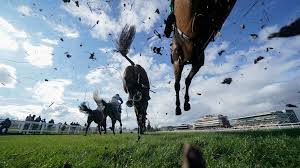
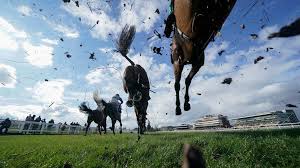
There is a ritual at the Cheltenham Festival as reliable as the rain and the annual revelation that a Nicholls favourite has been pointing at this race since October. The ritual is the chaotic start. The 2026 edition managed to make 2025 look like a masterclass in procedure — no small feat, given that 2025 was already regarded as embarrassing. This year we graduated to jockeys Nico de Boinville and Declan Queally verbally grappling, Tyson Fury's dad style, at the tapes of a Grade 1 hurdle, a horse reportedly kicked, a 21-runner field starting nearly four minutes late, Paul Nicholls's 5/2 favourite No Drama This End left structurally stranded and eventually pulled up, Danny Gilligan suspended, and Queally lodging a formal complaint with the BHA. Ruby Walsh delivered the line of the meeting from the ITV box: "We can launch missiles at fighter jets in the Gulf, yet no one can create a rolling fly-away tape." Ed Chamberlain called it "shambolic." John Francome called it "embarrassing." The trajectory is not encouraging. Year on year, it is getting worse not better.
The Punter's Particular Misery
It is worth pausing to consider the experience of the ordinary punter, because the governance literature tends to treat them as an abstractive afterthought whilst it is their money that constitutes racing's economic foundation. The punter who backed No Drama This End at 5/2 did not lose their money because the horse was outjumped, outpaced, or outthought. They lost it — or at least had their chances materially diminished — because the starting procedure delivered their selection into a standing start on the wrong side of a 21-runner field. That is not a betting loss. That is a governance failure charged to their account.
The problem is structural and worsening. Field sizes at the Festival have increased. Prize money has increased. The number of runners crammed into start configurations designed for a different era has increased. The elastic tape has not evolved. The result is that the Cheltenham Festival — the event that generates more betting turnover in four days than almost any other fixture in the British calendar — has become, at its starts, an unpredictable lottery layered on top of a horse race. Serious punters have begun pricing in start chaos as a variable. That is not hyperbole. It is risk management in the face of institutional failure.
"We can launch missiles at fighter jets in the Gulf, yet no one can create a rolling fly-away tape."
The Physics of Disadvantage
The problem is concentrated, as Sam Twiston-Davies confirmed, not at the straight two-mile or three-mile starts — which were broadly manageable — but at starts positioned immediately after tight bends. Ben Jones was direct: one two-and-a-half-mile start was "a shocker." The geometry is straightforward. In a 24-runner field, the horse on the widest outside travels a materially longer arc than the horse on the rail. It must accelerate while still turning, fighting for balance in a compressed and agitated space. The draw — already an underweighted variable in jump racing — is compounded by course layout into a structural allocation of disadvantage before a stride has been taken in competition. As Jones put it: you cannot win a race at the start, but you can definitively lose one. The BHA's own data makes the specificity of the problem bracing: across jump racing generally, only around 3 in every 100 starts result in a false start. This is not a systemic failure of the elastic tape. It is a Cheltenham-specific failure — which makes it simultaneously more diagnosable and more inexcusable.
Not Game Theory. Just Gaming.
One could dress this up in the language of Nash equilibria (Beautiful Mind film) and collective action problems — and this column has been known to do exactly that. But let us be honest about what was actually observed at the 2026 Festival. It was not sophisticated strategic behaviour emerging from complex incentive structures. It was jockeys blatantly trying to steal a march, starters being ignored, and the whole charade held together by an official waving a flag with the authority of a man directing traffic at a particularly unsuccessful roundabout.
The starter's flag deserves its own moment of recognition. At the world's most prestigious jump meeting, with fields of 24 runners, prize money in the hundreds of thousands, and a global television audience, the primary instrument of starting control was a hand-held flag — deployed with all the commanding presence of semaphore in a naval battle, circa 1805. One almost expected to see a midshipman relaying signals to the back of the field. The horses, it should be noted, were not significantly more responsive to this technology than Nelson's fleet was to the French cannon. The difference is that Nelson won.
What was on display was not game theory. It was jockeys gaming — each one rationally calculating that if they nudged forward six inches whilst the starter's attention was elsewhere, they gained a length on the field and a one-in-twenty chance of a suspension that would cost them a day's riding at a meeting already largely done. The maths was obvious. The deterrence was not. Kielan Woods put it plainly: if horses were not required to be in position before the off, riders would be "camping down at the starts two weeks before." The starting rule exists to prevent exactly that. At the 2026 Festival, it largely failed. Johnny Burke was closest to the structural diagnosis when he noted the rules are "too rigid" — producing binary outcomes without the graduated discretion needed to manage a field of 20-plus animals, each ridden by someone who has been planning this particular race since September.
The BHA Speaks
By Day 3, the BHA had seen enough — or, more precisely, had calculated that being seen to have seen enough was now operationally necessary. Their statement deserves to be read in full, and savoured:
"Following events this year it is clear that more needs to be done. As such the BHA has committed to launch a full review of the starts at the Cheltenham Festival. The review will be specific to the Cheltenham Festival. Away from the Festival the evidence is clear that starting procedures are working well, with approximately three in every 100 jump starts resulting in a false start."
Let us translate. "Following events this year" — meaning two days of nationally televised chaos, a fistfight at the tapes, a horse being kicked, another apparently attending to personal hygiene matters, and a commentary team running out of diplomatic vocabulary — "it is clear that more needs to be done." One is relieved the BHA reached this conclusion before the Festival ended, though the margin was not comfortable. "As such the BHA has committed to launch a full review" — note the careful grammar. Not "has launched." Has committed to launch. The review is, at time of writing, a future intention expressed in the passive voice. It will, one imagines, report in due course, at which point its findings will be considered.
The second paragraph is the masterpiece. Having acknowledged that things at Cheltenham are not working, the BHA pivots immediately to reassure us that everywhere else they are working splendidly. Three in every hundred starts result in a false start across jump racing generally. Tremendous. The elastic tape is, away from this one small detail of the sport's most important meeting, performing admirably. One almost feels sorry for having raised the matter at all. The statement does not quite say "apart from Cheltenham, starting is fine" — but it is in the vicinity.
"The BHA has committed to launch a full review. Not launched. Committed to launch. The review is a future intention expressed in the passive voice."
What a Serious Review Would Actually Do
The BHA's instinct will be procedural: more starter discretion, modified walk-in rules, trotting rule adjustments. Low-cost, quick to announce, satisfying to present as action. The evidence points somewhere considerably more inconvenient. On geometry, every Festival start configuration should be assessed against a minimum standard — a minimum straight-running distance between the last bend and the tape, calibrated to maximum field size. Where existing configurations fail that standard, they should be moved. This is engineering logic applied to a problem misclassified as behavioural for a decade. On incentives, a one-day suspension for causing a false start in a Grade 1 race is not a deterrent; it is a rounding error. Graduated penalties, escalating within a meeting, with post-race inquiry available where positional interference is material, would change the calculation. On technology, the elastic tape is, as one Irish commentator put it, "something from the stone age." The BHA's own statistics confirm it works perfectly well at the other 97% of the sport. At Cheltenham it conspicuously does not. The distinction is not mysterious. It is field size, geometry, and stakes — all of which are known, measurable, and within the BHA's power to address. If it chooses to.
The Contract Being Broken — and Who Pays
Step back from the procedural arguments for a moment and consider what the Cheltenham Festival actually is. It is the sport's annual promise to its most committed participants — punters, owners, breeders, trainers — that four days in March will be the closest approximation to a meritocracy that jump racing can deliver. The best horses, prepared by the best trainers, ridden by the best jockeys, over the best course, in the biggest fields. The implicit contract is simple: what happens between the first obstacle and the winning post will determine the outcome. Not the draw. Not the starting configuration. Not the semaphore skills of an official with a flag.
That contract is now visibly fraying. And the people who notice first — and whose behaviour changes as a result — are serious punters. Not the casual festival-goer nursing a glass of Guinness in the Arkle Bar, who will forgive a messy start as part of the spectacle. The people who matter economically are those who study form for weeks, construct considered each-way positions in 24-runner handicaps, and make rational pricing decisions on the assumption that the race will be decided on ability. Those people watched No Drama This End, assessed at 5/2 by a market that processes millions of pounds of information, reduced to an irrelevance by a starting procedure that had nothing to do with the horse's merit. They will not have forgotten it. Some will have noted, with the cold precision of those who track edge for a living, that starting position at Cheltenham is now a material variable — one that the form book does not record and the market cannot efficiently price.
The damage compounds in ways that are not immediately visible. When a punter loses money because a horse was beaten on merit, they come back. Racing retains them. When a punter loses money because the race was distorted before it began, they do not simply come back — they recalibrate their model of what the sport is. Some conclude that Festival handicaps are structurally noisy in ways that make them unplayable with confidence. Others — and this is the long-run threat — quietly redirect their attention to sports where the start is not a lottery. The erosion is gradual, invisible in any single year, and almost impossible to reverse once established as expectation.
Owners and trainers are not immune. Paul Nicholls is not a man given to public complaint without cause. When he says starts are becoming "ludicrous," he is expressing something that will inform future decisions at the margin — which horses to target at the Festival, whether the risk of an investment being nullified by a starting procedure is one that owners can be reasonably asked to accept. These decisions aggregate across the ownership and training community into something that affects the quality and depth of Festival fields.
"When a punter loses because a horse was beaten on merit, they come back. When they lose because the race was distorted before it began, they recalibrate what the sport is."
A Final Word on What Needs to Happen
The BHA's review will come. It will contain recommendations. Some will be implemented. The question worth asking now — before the process disappears into the institutional machinery — is what success actually looks like. It is not a revised rulebook or a new starter training programme. It is not a statement confirming that starting procedures work well elsewhere. Success looks like this: a punter who has backed a 5/2 Festival favourite can watch the start and know, with confidence, that whatever happens in the next three minutes will be determined by the horses and their riders. Not by geometry. Not by a flag. Not by who got to the rail first in the circle.
That is not an impossible standard. Point-to-point racing, with amateur riders and minimal infrastructure, manages orderly starts routinely. Flat racing, with fields of similar size, has long since moved to starting stalls. Greyhound racing — a sport that operates on a fraction of jump racing's budget — starts its fields reliably and fairly every time. The Cheltenham Festival, with its revenues, its prestige, and its governance apparatus, is the only major sporting event in Britain where the start of the main event is a genuine source of competitive uncertainty unrelated to the competition itself.
The elastic tape is not just a stone age technology. It is a symbol of an institution that has tolerated a known problem for longer than it should, reviewed it periodically without structural consequence, and then retreated to the reassurance that things work fine everywhere else. The BHA has committed to launch a review. Good. The sport should commit to something harder: insisting that the review ends with a Festival where the race, and only the race, decides the result. The tape lifting should be the beginning of the story. At Cheltenham in 2026, it was, far too often, the whole of it.