British Racing Is Being Cooked Alive and the People Holding the Thermometer Say the Water Is Lovely
One horse in seven has vanished from the breeding pipeline. Half of all Jump races now fail to reach eight runners. Cut ten per cent of the fixture list now — or watch the sport schedule itself into extinction.
HORSE RACINGBUSINESS
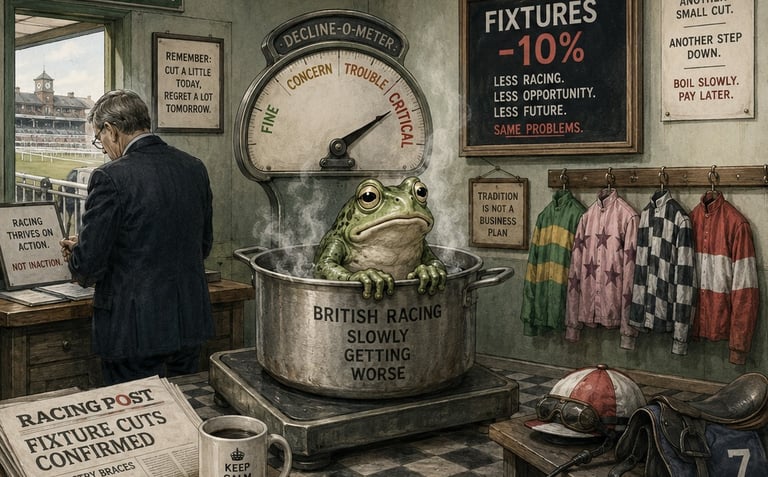
You will know the parable. Place a frog in boiling water and it leaps out immediately — the shock is too great, the signal too loud. But place the same frog in cold water and raise the temperature with sufficient patience and gradualism, and the creature will remain perfectly still, adjusting to each incremental degree of warmth, until it is cooked. Scientists have since questioned the literal truth of this experiment, which is rather fitting, because the people running British horseracing appear to have questioned it too — and concluded it sounds like a workable management strategy.
The water has been heating for years. We have all been in the pot together: bettors, owners, trainers, racegoers, broadcasters, bookmakers, and the increasingly baroque administrative apparatus of the BHA. Each year the field sizes have shrunk a little. Each year the foal crop has fallen a little. Each year the fixture list has stayed roughly where it was, give or take a fixture or two — a rounding error dressed up as a policy decision. Each year someone has published the data showing the product is weakening, and each year the BHA has published a fixture list that is, in the words of its own press releases, "largely unchanged."
Largely unchanged. There, in two words, is the institutional philosophy of British racing governance summarised with an accidental precision that no satirist could improve upon.
Let us examine the thermometer, since the frog will not. The 2026 fixture list runs to 1,458 scheduled fixtures — two fewer than 2025. Two. The BHA has found two fixtures it was willing to sacrifice for the cause of sustainable racing. One suspects the deliberation this required was extensive. The institution has not merely failed to read the room. It has failed to read its own publications.
Because the BHA's own modelling — not an independent critic's, not a disgruntled punter's, the BHA's — tells us that the number of runs in Britain in 2027 is expected to be six to seven per cent lower than in 2024. Six to seven per cent fewer horses running, in a fixture list that is essentially unchanged. The consequential arithmetic is not complicated: you get thinner fields. You get worse races. You get a worse betting product. You get lower turnover. You get less levy income. You get lower prize money. You get fewer owners. You get fewer horses. Round and round we go. This is not a prediction; it is a description of what is already happening.
The foal-crop data is where intellectual honesty becomes genuinely uncomfortable, and the BHA should sit with that discomfort rather than schedule its way past it.
Weatherbys' 2025 Return of Mares recorded 11,374 live foals across GB and Ireland — down from 12,578 in 2024, itself down from 13,438 in 2023. British foals specifically fell to 3,872. Recorded coverings were down a further 3.3%. This is a three-year sequential decline of material magnitude: the GB and Irish foal crop has contracted by more than 15% in two years. Let that register. In the time it takes a foal to become a racehorse, British racing has lost approximately one horse in seven from the breeding pipeline.
Irish-bred horses are not peripheral to the British racing supply chain. They are central to it, particularly over Jumps. When Ireland breeds fewer horses, Britain runs fewer competitive races — and it runs them whether it has enough horses to fill them properly or not, which is precisely the policy error that needs correcting. The BHA's own April 2026 horse population data confirms the pipeline is cracking: total horses in training at 30 April 2026 stood at 14,015, down 1.8% year on year. Jump horses specifically were down 8.4%. Eight point four per cent. Not a blip. A haemorrhage. The field-size data makes the consequences visible to anyone willing to look.
In 2025, average field sizes fell to 8.90 on the Flat and 7.84 over Jumps. By April 2026, Flat fields had slipped further to 8.69. Only 66.8% of Flat races reached eight runners. Fewer than half — 49.9% — of Jump races managed it. Consider what that means in practice. More than half of all Jump races run in the first four months of 2026 failed to reach eight runners. More than half. These are not fields. They are processions with prize money attached — the racing equivalent of a restaurant serving a forty-seven-page menu from which, on any given evening, fewer than half the dishes are actually available.
The betting industry has noticed what the fixture architects apparently cannot. Turnover per race at Core fixtures fell 8.1% in 2025. Meanwhile, Premier fixture turnover per race rose 1.1%. The market is speaking with exemplary clarity: quality retains its audience; mediocrity drives it away. A thin race is not a betting race. A six-runner novice hurdle on a wet Wednesday is not a product; it is an argument for doing something else with your afternoon. And once the punter finds something else to do with his afternoon, the evidence suggests he is not reliably persuaded to return.
The demand, then, is specific: a ten per cent reduction in the fixture list for 2027, bringing it from 1,458 fixtures to approximately 1,310. Not nine per cent. Not eight. Ten — because ten is the number that matches the structural reality of the horse population and the foal-crop trajectory, and because anything materially below it is a rounding error with a press release attached.
In race terms, that means removing approximately 1,000 races from the programme. This will cause discomfort. Racecourses will object. Executives will invoke regional racing, the grassroots, the working jockey, the rural economy, and whatever else presents itself as a shield. These concerns deserve a hearing and some deserve genuine accommodation. But they do not deserve a veto. The BHA exists precisely to make decisions that individual racecourses, pursuing rational self-interest, will not make for themselves. A fixture means revenue to a racecourse whether it produces seven runners or fourteen. The quality of the racing is not the racecourse's primary commercial problem; it is the sport's primary commercial problem. That distinction matters enormously, and the BHA must hold it.
The cuts should fall with surgical intent, not institutional cowardice. Do not touch Royal Ascot, Cheltenham, the York festivals, Goodwood, Newmarket's classics programme, or the premium Saturday cards that command ITV airtime and genuine betting volumes. These are the product working as intended. The cuts should fall on weak midweek Jump fixtures in summer and early autumn — a programme that exists largely because it has always existed. On duplicated all-weather Flat cards running the same low-grade handicap formula four evenings a week. On low-field, low-grade novice hurdles and bumpers that exist to give horses a run rather than to stage racing worth watching or betting on. The Jump programme in particular requires a reduction of at least fourteen per cent, given that Jump horses in training have already contracted by 8.4% and the Irish foal crop that sustains it has fallen off a cliff.
A ten per cent overall cut is not radical. It is arithmetically conservative. If the foal-crop decline does not reverse — and nothing in the breeding data suggests it will without structural intervention on prize money and ownership economics — a further move towards fifteen per cent by 2028–30 will not be a strategic choice but an unavoidable necessity. Better to manage that trajectory deliberately than to be dragged along it by attrition. There is a deeper absurdity at work, and it deserves naming plainly.
The BHA knows all of this. Every data point cited above is drawn from its own publications — the 2025 Racing Report, the April 2026 data pack, the fixture list press release. The information is not hidden. It is published with commendable regularity by an organisation that then appears to file it carefully in a room that has no connection to the room where the fixture list is decided. This is the administrative equivalent of hiring an excellent diagnostician, reading his report attentively, and then ordering the same meal that caused the illness because the kitchen is already staffed and the menu has been printed.
Anything under five per cent fixture reduction is tokenism — a performance of seriousness without its substance, a gesture towards the thermometer while the water keeps heating. The frog, for its part, appears quite comfortable. It always does, right until the end. Someone should mention that this is not necessarily a good sign.
The BHA should mention it. To itself. Loudly. Before 2027.