British Racing Has Been Running on Three Flattering Statistics for Twenty Years. Here Are the Other Thirty-Nine.
While the BHA celebrates Cheltenham attendance and growing social media reach, the sport's breeding population has collapsed by 29%, Saturday TV audiences have fallen 77%, and the governance trust score sits at 38 out of 100. For the first time, all forty-two metrics are in the same room — and none of them have been briefed by the communications team.
HORSE RACINGBUSINESS
There is a particular form of institutional self-deception that thrives in organisations where no independent measure of performance exists. British racing has practised it for decades with considerable flair. Annual reports arrive dressed in the language of progress. Press releases celebrate record prize money without mentioning inflation. Governance reviews conclude — with the reliable inevitability of a short-priced favourite — that governance is broadly sound. Leadership changes but the narrative does not. The sport, we are perpetually reassured by those running it, is fundamentally healthy, strategically positioned, and on a journey.
It is a very long journey. The destination appears to be somewhere nobody originally intended to go. And nobody in charge seems entirely sure how the map works.
This is the animating purpose behind the UK Racing Health Dashboard: not to embarrass, not to score political points, and certainly not to provide ammunition for those who would abolish the sport entirely. The purpose is considerably more radical than any of those. It is to establish, for the first time in British racing's modern governance era, a number. Possibly several numbers. Forty-two, to be precise.
Why a number matters
Numbers are uncomfortable things for organisations that have grown accustomed to narrative. A story can be shaped, nuanced, contextualised, and if necessary quietly buried on a Friday afternoon. A statistic cannot be wished away with similar elegance. When the BHA publishes its annual summary of the sport's condition, it selects the metrics it wishes to discuss — the ones that are improving, or at least not visibly deteriorating — and frames them within a context it controls entirely. The CEO, whoever happens to be occupying the chair at the time, delivers a presentation of selective optimism that would make a FTSE communications director reach for the smelling salts: the Cheltenham attendance was excellent, international trainers are recognising our prize money, social media reach is growing. These things may all be true simultaneously with the sport being in serious structural difficulty. What is carefully not discussed is the other thirty-seven metrics.
Because the UK Racing Vital Signs Dashboard tracks forty-two feeder metrics across seven domains. Forty-two. Not three hand-picked to support a preferred narrative, not a general sense of things, but forty-two specific, source-attributed, trend-tracked data points covering every dimension of the sport's health — from the inbreeding coefficient of the UK thoroughbred population to the BHA governance trust score; from the number of active registered breeders to the average prize money per race in real terms. Running a sport on three cherry-picked metrics is the equivalent of a doctor assessing a patient's health solely by checking whether their hair looks nice and their shoes are polished. The patient may still be expiring quietly in the chair.
The concept is not novel. Robert Kaplan and David Norton introduced the Balanced Scorecard to management theory in the early 1990s precisely because organisations had discovered — predictably, painfully — that optimising for one or two financial metrics while ignoring leading indicators, customer experience, internal processes, and organisational capacity produced institutions that looked healthy on the day of their collapse. British racing has been running its own version of this experiment for twenty years. The results are instructive. Leadership informed by selective data makes selective decisions. It invests in the things that are already working and defers the structural problems that require numbers it does not wish to look at. A genuine balanced scorecard forces the uncomfortable metrics into the same room as the flattering ones, and requires everyone present to account for all of them.
Five stakeholders, one managed truth
The sport has five primary stakeholder groups, each of whom experiences British racing very differently from one another, and none of whom currently has access to a common, objective baseline for that experience.
Owners are subsidising the sport to the tune of tens of thousands of pounds per annum with the reward structure of a philanthropist and the contractual protections of a tourist. Their numbers have declined steadily — from 11,200 registered in 2005 to 8,640 today — a fact that tends not to feature prominently in leadership speeches about the sport's bright future. Trainers are running businesses on margins that would not survive scrutiny in any other sector, with stable staff turnover running at approximately 34% per annum; it is an industry that eats its own workforce and then wonders why recruitment is difficult. Breeders — perhaps the most structurally important group of all, since their investment decisions today determine the competitive quality of the sport in three to four years' time — number approximately 2,710 active operations in the UK, down 29% from 3,840 twenty years ago. They are voting with their exit, one stud book at a time.
Racegoers come to enjoy themselves and broadly do. They are the most forgiving stakeholder group and the one leadership most enjoys surveying, since their responses reliably produce the kind of positive sentiment data useful for press releases. And punters — the people who actually fund the Levy that funds the prize money that theoretically retains the owners, completing the circular economy that keeps the whole enterprise airborne — have been migrating to better-served, more competitively priced products for a decade, taking the betting turnover on UK racing from £10.4 billion at its 2015 peak to £8.4 billion today.
These five groups do not share a boardroom. They do not share a publication. They do not, in any meaningful sense, share a conversation. What they share is a sport whose long-run health concerns all of them, and about which each receives a carefully managed version of the truth from the body nominally responsible for all of them. A health scorecard with independent custodianship is the closest thing to a common language these groups currently lack.
What the dashboard reveals
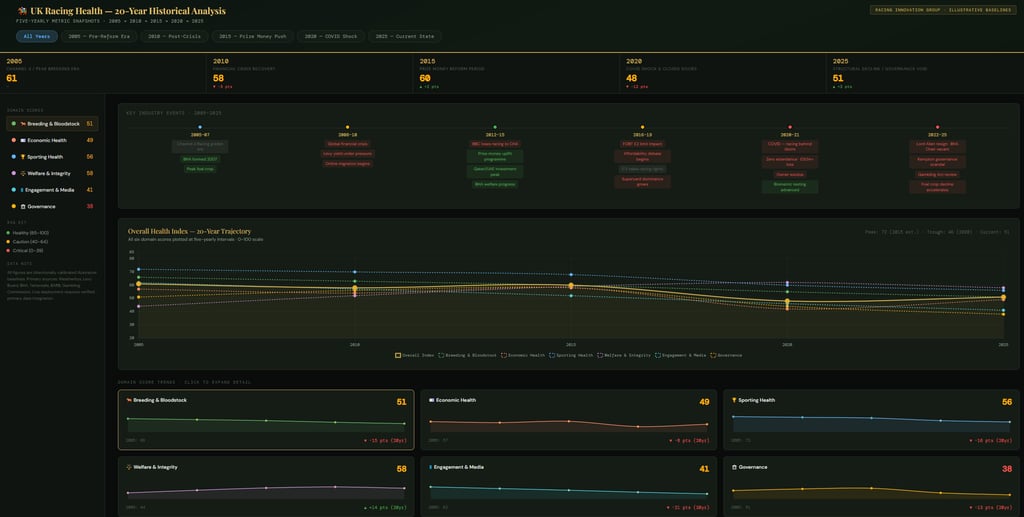
The twenty-year trend data embedded in the Vital Signs Dashboard is not comfortable reading, and it was not designed to be. The breeding domain — the sport's primary leading indicator, the canary in the coal mine, the metric that tells you where racing will be in 2028 more accurately than anything the current leadership will say at Cheltenham — scores 51 out of 100 in 2025, down from 66 in 2005. Governance sits at 38 — the lowest domain in the framework — with the BHA governance trust sub-score estimated at 31 out of 100. Anyone who has attended an industry conference, read the trade press with genuine critical engagement, or simply spoken candidly with owners and trainers in the past three years will find that figure not merely credible but arguably generous.
The engagement domain scores 41, with the standard Saturday feature race television audience having collapsed from 1.84 million in 2005 to approximately 420,000 in 2025. That is a 77% decline in a generation. The Grand National's 9.2 million viewers is the number leadership will instinctively reach for, like a man checking his best suit before acknowledging the roof is on fire. The 420,000 on a typical Saturday is the number that tells you something true about the sport's structural relationship with the broader British public.
Why the dashboard is imperfect — and why that is entirely beside the point
The objections to a health scorecard are predictable, and some of them are technically legitimate. The data is not always directly available; some metrics rely on estimates, proxies, and illustrative baselines rather than verified primary sources. The domain weightings are arguable. The RAG thresholds are somewhat arbitrary. Different analysts would construct the composite score differently.
All of this is true. A health scorecard for British racing is an imperfect instrument.
But imperfect in comparison to what? The alternative is not a perfect instrument. The alternative is no instrument at all — or worse, the collection of instruments that racing's leadership selects for itself, calibrated to produce the outcomes that sustain institutional confidence and the CEO's continued visibility at major meetings. The perfect is not merely the enemy of the good here; it is the enemy of the honest.
The epistemological point is straightforward: an objective measure with acknowledged limitations is analytically superior to a subjective account with none acknowledged, because at least the former can be challenged, refined, and improved. Selective optimism from racing's leadership cannot be improved. It can only be replaced by more selective optimism, ideally delivered by someone who has recently arrived and not yet had time to look at the breeding statistics.
What comes next
A health scorecard achieves its full value only when it is institutionally embedded — when governing bodies are required to respond publicly to it, when trend movements trigger formal reviews, when leadership is genuinely accountable to all forty-two metrics rather than the three that make the annual report sing. The data should be owned by an independent function with clear methodological accountability: an academic partnership, a cross-stakeholder analytical body with representation from owners, trainers, breeders, racegoers, and the media — any credible arrangement that excludes as custodian any organisation whose own score appears in the results.
British racing does not lack talent, heritage, or genuine quality at its summit. What it has lacked, for longer than is comfortable to admit, is data-informed leadership — the kind that Kaplan and Norton were advocating for thirty years ago, the kind that measures what matters rather than what flatters, the kind that treats a composite health score of 51 out of 100 as a management emergency rather than a communications challenge.
The sport should look into the mirror. Whatever it sees there will be considerably more useful than what it has been telling itself. And considerably more interesting than the alternative, which is another decade of the same journey to the same unintended destination, announced with the same confidence, and explained afterwards with the same straight face.