“BREAKING: Man Accepts BHA Job, Immediately Discovers It’s a Trap”
The BHA’s part-time chair discovers the full-time tyranny of “collaboration” — and the ARC machine doesn’t do mercy.
The One-Day-a-Week Waterloo
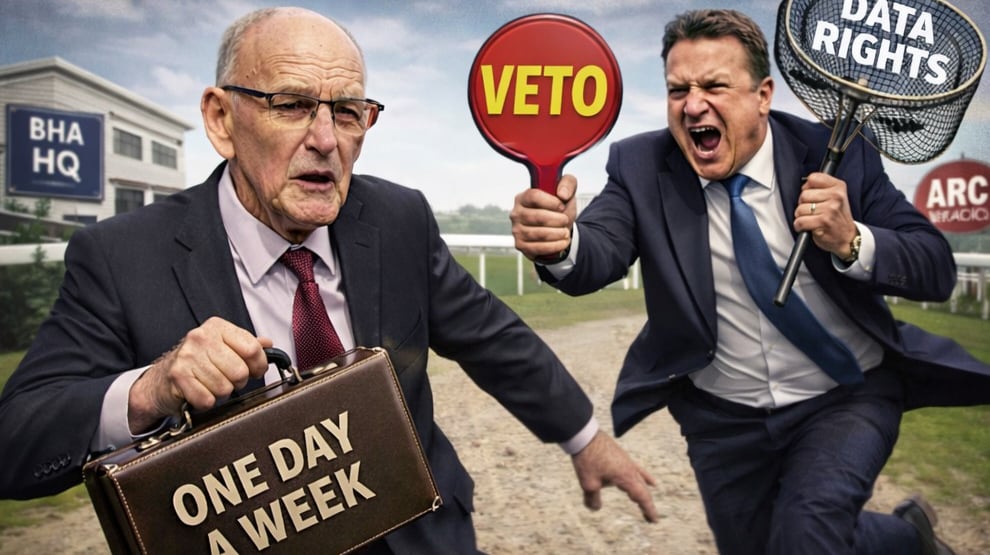
Lord (Charles) Allen has resigned as Chair of the British Horseracing Authority after six months, which sounds dramatic until you do the arithmetic and realise it’s effectively 26 days of work. Because it was a one-day-a-week gig—the modern leadership model where you parachute into a smouldering crater, nod gravely, ask for “alignment”, and then depart with the serene air of a man announcing early retirement after a long stint in a disaster zone… despite having done, at most, the equivalent of a month of Mondays.
Twenty-six days. That’s not a tenure. That’s a Costco free sample. It’s barely enough time to learn everyone’s first name, let alone reconcile a decade of trench warfare over money, power, data, fixtures, and the eternal British question: who gets to be in charge without ever being held responsible? And yet we must all pretend to be shocked. British racing does shocked beautifully. It’s practically a bloodline.
It Was Always Doomed (Because the Building Is Designed to Collapse)
This was doomed not because Allen is uniquely inept, or uniquely heroic, or uniquely anything. It was doomed because the sport has built itself a constitutional trap: unanimity. The dream was an independent board and a more commercial remit. The mechanism required to achieve it was “everyone agrees to reduce their own leverage, forever, with a smile.” This is like asking seagulls to vote unanimously for a ban on chips.
British racing keeps appointing chairs the way medieval villages used to appoint plague doctors: good costume, confident mask, brief appearance, inevitable exit. The chair is asked to “lead” while the system politely removes leadership from the architecture. You can’t steer if every passenger has a steering wheel and the car’s bylaws require unanimous agreement before turning left.
The Tyranny of Collaboration
The sport’s favourite religion is “collaboration”, which sounds wholesome until you notice it functions as a veto in a cardigan. The tyranny of collaboration is where everyone must be consulted, everyone must be included, everyone must be comfortable—and therefore nothing can ever be decided. It produces endless process and zero outcome, like a book club that meets weekly to agree which book might someday be considered for reading.
This is the strategic vacuum: there are plenty of people with titles and lanyards and urgent facial expressions, but no authoritative centre with a mandate strong enough to choose a direction and enforce it. Everyone can slow the car. Nobody can drive it. It’s coalition politics without the bother of elections, or accountability, or even the courtesy of an honest argument.
And into that vacuum falls the perfect British substitution for action: another working group. Another “framework.” Another “roadmap.” Another email beginning “Following productive discussions…” and ending with absolutely nothing that could be described as productive.
Cathedral Racing vs Factory Racing
Here’s the problem racing won’t state plainly because it would require choosing sides: British racing is now two sports trying to inhabit the same skin.
One is cathedral racing: prestige, narrative, the big days that still feel like a country can produce beauty without a focus group. The other is factory racing: fixtures as inventory, pictures as product, data as the bloodstream, and the week-to-week schedule humming like an industrial belt grinder.
Cathedral racing needs clarity, scarcity, meaning, spectators, stories. Factory racing needs throughput, reliability, monetisable volume, and terms. You can run both, but only if someone is empowered to decide what happens when they conflict. British racing’s current answer to conflict is to form a committee and wait until the conflict dies of boredom.
This is why fan engagement feels like trying to follow a soap opera where half the episodes are broadcast on different channels at random times, and the writers keep insisting the confusion is “part of the experience.”
The ARC Gravity Well
Now we come to the bit everyone circles politely, like diplomats avoiding the pudding fork: ARC’s gravitational pull. Call it a stranglehold if you like the blunt language of the pub, or “structural leverage” if you prefer the soothing narcotic of corporate phrasing. Either way, when one operator supplies a huge portion of the weekly product—fixtures, pictures, volume—it becomes a force of nature in negotiations about anything commercial.
That’s not a moral accusation. It’s physics. If you control a large share of the supply, you influence the shape of the market. And if the sport’s governance is paralysed by unanimity and a terror of decisive authority, then scale becomes the default steering wheel—because there isn’t another one.
The Cruddace / Reubens empire—the modern, industrial, commercially literate machine associated with that scale—stands as the emblem of racing’s new reality: a sport increasingly optimised for screens and revenue flows, not necessarily for atmosphere. Critics see a conveyor belt that turns living, breathing sport into programmable content. Defenders see the only model robust enough to survive in a world where romanticism doesn’t pay the bills. Both camps are correct enough to keep the war going indefinitely, which is precisely why the current system—built to prevent decisive settlement—guarantees permanent war.
And permanent war, dressed up as “collaboration,” is what killed Allen’s project before it ever left the paddock.
Meanwhile, the Sport Polices Whips Like a Calvinist Seminary
British racing can measure the angle of a jockey’s wrist with the forensic zeal of a Victorian headmaster. It can prosecute whip infringements with the solemn intensity of a morality play. It can issue punishments with a precision that suggests the sport is run by watchmakers.
But when it comes to power, money, and governance—the things that actually determine whether the sport survives—it becomes a woolly-minded Quaker meeting, gently murmuring until the roof caves in. The weak are disciplined. The strong are “consulted.” It’s not hypocrisy so much as a national tradition: strict rules for the small, soft rituals for the big.
The Press Release Sunset
So Allen goes off into the sunset on the soothing surf of his own farewell language—passionate people, great potential, tribute to hard work—while everyone else nods as if this wasn’t the most predictable outcome since a novice chaser at Cheltenham meets a fence.
The funniest part is the performative solemnity: as though the resignation of a part-time chair after 26 working days is a tragedy, rather than an obvious reaction to discovering you’ve been hired to build a bridge in a country that has outlawed wood, stone, and agreement.
Where We Go From Here
There are two routes. British racing will choose one while insisting it has chosen the other.
Route One: Keep Collaborating Until Extinction
Appoint another chair. Preferably one day a week again, because why not hand the nuclear codes to a weekend volunteer. Announce unity. Form groups. Commission reviews. Produce a vision document with photos of empty grandstands shot at flattering angles. Celebrate “progress” measured in meetings. Repeat until the sport becomes two glittering festivals and a long tail of low-grade inventory that nobody loves but everyone invoices.
Route Two: The Boring, Necessary Revolution
Not guillotines—just wiring.
Stop worshipping unanimity. Use supermajorities. Build real conflict-of-interest rules. Protect minority voices without allowing any faction to freeze the sport indefinitely.
Separate the referee from the shopkeeper. Regulation should regulate. Commercial strategy should be handled transparently elsewhere, with published principles and proper accountability.
Create an actual strategic centre. Not another stakeholder circle. A small, empowered body with a mandate, metrics, and consequences—so leadership means something other than “chairing discussions.”
Face concentration honestly. If ARC’s scale is essential to the sport’s economic plumbing, then that influence must come with obligations, transparency, and constraints. If it’s not acceptable, then design competition and limits like adults, not like people hoping the problem will fade quietly out of politeness.
Because the truth is brutal and simple: British racing cannot continue pretending it can reform without upsetting anyone powerful. That isn’t leadership. It’s etiquette. And etiquette does not pay prize money, does not grow audiences, does not settle commercial wars, and does not keep a sport alive when the rest of the world has moved on.
Lord Allen’s 26-day cameo is not an anomaly. It is a diagnostic. The sport didn’t lose a chair. It lost another illusion—the illusion that you can fix a leadership vacuum with a part-time title, while leaving the veto culture and the strategic emptiness untouched. If racing wants to survive, it must choose what it is, decide who can decide, and accept that someone will leave the room unhappy. Otherwise it can keep “collaborating” forever—warmly, inclusively, unanimously—right up to the moment the lights go out.