BHA Chair : Read the Brief. Then Worry.
The application closes tomorrow. Eight pages from Elevate Talent are the most instructive document in British racing right now — not for what they contain, but for what they confess by omission.
HORSE RACINGPOLITICS
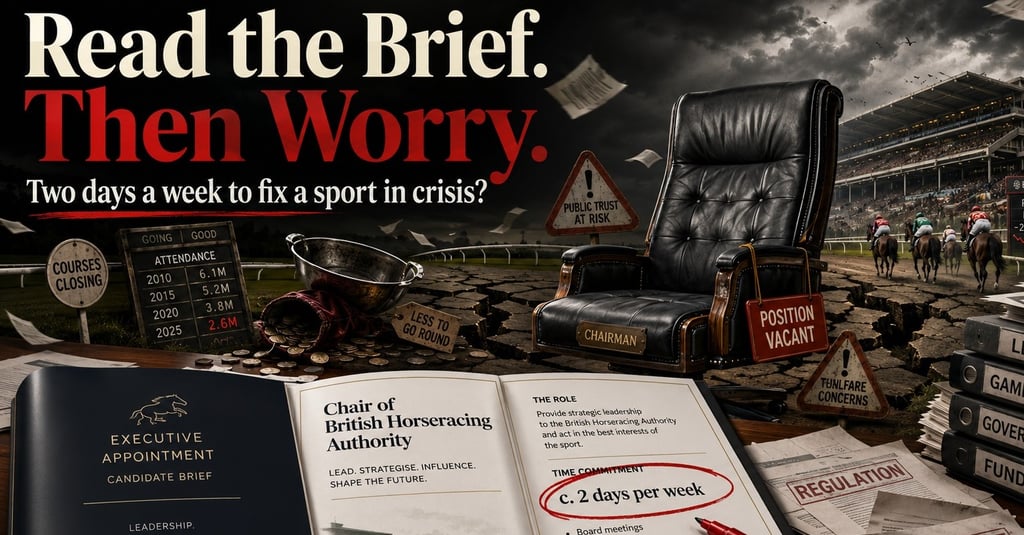
The application deadline for Chair of the British Horseracing Authority is Friday 19th June 2026. Tomorrow. Which makes this a particularly useful moment to examine eight pages that purport to describe what one of the most demanding and consequential appointments in British sport actually requires. They do describe it. Just not in the way the authors intended.
Read the brief once and you see a competent, professional candidate document: sensible layout, BHA branding, a few racing photographs and the kind of language that executive search firms have been packaging since the invention of the “people-first culture.” Read it twice — knowing what you know about British racing in the summer of 2026 — and you see something else entirely. You see the institutional self-portrait of a sport that has not yet grasped the scale of what has gone wrong.
Who Is Elevate Talent, and What Does That Tell You?
The firm conducting this search describes itself as operating at “the intersection of sports, media, entertainment, and lifestyle brands.” Their approach is “defined by an obsession with attitude, bravery, and collaboration.” At Elevate Talent, they do not just find leaders. They elevate them. This is the firm hired to find a Chair capable of navigating the Levy, the Gambling Commission, DCMS, DEFRA, a fractured racecourse landscape, the Ascot-RCA schism, affordability checks, black-market drift, prize money atrophy and an executive team that has just watched its governance reform programme collapse in six months. The firm chosen for this task sources talent for lifestyle brands.
The mismatch is not cosmetic. It is diagnostic. When you choose a recruiter, you reveal your mental model of the role. British racing has chosen a firm that specialises in commercial sport and entertainment. It has therefore signalled, probably without fully intending to, that it considers this a commercial sport and entertainment appointment. It is not. It is a governance and regulatory emergency with some excellent prize money attached.
Two Days. The Number That Defines the Brief.
Tucked into the Overview section, between a reference to diversity and inclusion and a note about product optimisation, is the commitment that will be remembered when the next Chair resigns: “A time commitment of c. 2 days per week.”
Two days. Two days per week to chair the governing and regulatory body of an industry with over £4 billion in annual betting turnover, sixty racecourses, approximately sixty thousand licensed personnel, a structural funding crisis, an active governance rupture and a regulatory environment simultaneously under pressure from the Gambling Act, the Gambling Commission’s consumer protection agenda and the looming question of whether the Levy framework is any longer fit for purpose. Two days is the time commitment of a prestige appointment. It is the schedule of someone who will attend meetings, read papers, pose thoughtful questions and add institutional legitimacy. Two days is not the schedule of someone who will fix anything.
Lord Allen lasted six months. His attempt to secure governance reform failed because the sport’s member bodies could not agree on a more commercially independent board. The sport is not between chairs; it is between fires. And the extinguisher is available Tuesday and Thursday, subject to diary.
The Responsibilities: A Close Reading
The key responsibilities section rewards careful attention. The Chair is asked to “support the executive to develop the strategy for the sustainable future of horse racing.” Support the executive. This is the governing syntax of the brief. The Chair’s relationship to the executive is framed throughout as supportive, facilitative, mentoring. The Board Responsibilities section makes this explicit: establish a “strong working relationship with the Chief Executive, providing mentoring as required and clearly respecting executive authority and responsibility.”
Mentoring. British racing’s new Chair is being hired to mentor Brant Dunshea, appointed permanent BHA CEO in March 2026 after a period in an acting capacity. A sport that has just watched governance reform collapse, a chair resign within six months and its flagship race won by a foreign-trained raider for the twelfth time might reasonably want the incoming Chair to arrive not as a mentor but as an interrogator. Where is the commercial plan? What precisely failed during Lord Allen’s tenure? Who blocked what, and why? What does the BHA exist to do that nobody else is doing?
Mentoring is a word for when things are broadly working and the executive needs development. It is not a word for when the dam is cracking.
The responsibilities continue: “Keep focus on important relationship between racing and betting.”
Keep focus. The relationship between racing and betting is not a relationship that requires focus to be kept. It is the oxygen supply. Without the Levy, without the commercial return from the gambling industry, there is no prize money, no fixture list, no viable breeding model and no credible claim to elite international status. France extracts materially more from its gambling industry than Britain does. Ireland does likewise. The BHA has itself noted that British racing receives under three per cent from the industry it generates. That is not a talking point. That is structural subordination dressed as a stakeholder relationship.
And the word that appears nowhere in all eight pages? Levy. Not once. The word at the centre of British racing’s commercial survival does not appear in the brief for the person who will be expected to fight for it. Product optimisation appears. Diversity and inclusion appears. Consumer growth appears. Levy does not appear.
The responsibilities also ask the Chair to “engage internationally as requested across the global racing industry to ensure British industry interests are understood and considered.”
As requested. The global racing picture — in which Ballydoyle has colonised the British Classic programme, in which the World Pool raises questions about betting product integrity, in which Hong Kong, Dubai, France and Japan are running competing elite product offers — does not call for reactive international engagement. It calls for an active commercial strategy. “As requested” is the language of a diplomatic attaché. It is not the language of a turnaround.
The Experience Specification: What It Asks and What It Omits
The candidate must have “active knowledge of horse racing and some level of profile within the industry.” Some level of profile. This is the experience standard for the Chair of the institution responsible for regulating and governing a sport that employs tens of thousands, generates billions in betting activity and sits at the intersection of agricultural policy, gambling law, animal welfare regulation and international bloodstock commerce. Some level of profile.
The spec asks for “a track record of developing and implementing consumer growth strategies encompassing diverse stakeholder and consumer groups.” This is a competency for a streaming service or a leisure group. It is not wrong to want it. But it is revealing that consumer growth strategy is specified in detail whilst Levy negotiation capability, regulatory independence, financial turnaround experience and crisis governance are absent entirely.
What should be present and is not:
A track record of negotiating commercial frameworks against powerful vested interests. Evidence of successful structural reform in a complex multi-stakeholder system. Demonstrated willingness to make powerful people uncomfortable in the service of an institution’s long-term health. Experience of managing the boundary between regulatory and promotional functions in a single governance body. Understanding of the dynamics of a sport whose primary commercial partner — the gambling industry — has spent thirty years working to reduce rather than increase its payment obligations.
None of this is there. In its place: “negotiating skills” (mentioned once), “curious mind” (mentioned), “open and transparent working style” (mentioned). These are qualities for the Chair of a thriving mid-market business. They are necessary conditions for the BHA Chair role. They are not sufficient ones.
The Structural Problem the Brief Cannot Name
Somewhere beneath all the governance language is a problem the brief cannot name because naming it would require the sport to decide what it actually wants. The BHA is simultaneously the governing body and the regulatory body for racing in Great Britain. A regulator must be feared by powerful people. A promoter must keep them at the table. A regulator says no. A promoter says come in. A regulator’s authority depends, in part, on a willingness to impose consequences that powerful interests would rather avoid. A promoter’s credibility depends on relationships, trust and the perception of common purpose.
These functions have been combined in the same institution since the BHA’s formation. They generate a structural tension that no Chair, however gifted, can resolve by personality or governance housekeeping. The brief does not acknowledge this. It asks the incoming Chair to perform both roles simultaneously whilst mentoring the executive team and keeping focus on the betting relationship. On two days a week. The Ascot-RCA split did not happen because of a failure of interpersonal manner. The governance crisis that ended Lord Allen’s tenure did not occur because the Board needed better agendas. These are symptoms of a sport that has not resolved its fundamental constitutional question: who has the authority to make British racing do things it would rather not do?
The Brief That Should Have Been Written
It would have read differently. Not longer. Just honest.
Wanted: Chair for a governing body in structural crisis. The sport generates an elite product that is being systematically extracted by better-resourced international competitors. Its commercial relationship with the gambling industry is under-remunerated and under-negotiated. Its governance has just failed, publicly, in an attempt at basic reform. Its flagship racecourse has left the main representative body. Its incoming permanent Chief Executive is newly appointed. Its Levy framework faces challenge. Its regulatory credibility with Whitehall is uncertain.
The Chair will be required to do more than two days per week. They will need to understand the Levy, not merely “the relationship between racing and betting.” They will need to be willing to impose consequences on powerful interests within the sport. They will need to interrogate the executive, not mentor it. They will need genuine views about the structural conflict between regulation and promotion — and the courage to propose resolving it.
The sport offers: historic courses, magnificent horses, genuine cultural and economic significance and a funding model with room for serious improvement. It does not offer an easy chairmanship. Anyone who thinks it does should apply elsewhere.
The deadline is tomorrow. The brief closed as written. The question is whether the appointments panel reads the sport better than the people who wrote the spec.
If they do, British racing might yet find the animal it needs. If they do not, it will get a presentable chair-shaped object with a gift for stakeholder communication and a twice-weekly diary commitment.
The horses will still run. The Ballydoyle colours will still appear on the Epsom hill. And the brief for the next Chair will still not contain the word Levy.
Ed Grimshaw writes for Cutting Comment and International Thoroughbred. He is a founding member of the Racing Innovation Group and a Committee Member of the Horserace Bettors Forum.