Barrier Trials: The Mornings British Racing Forgot to Monetise
A modest proposal to switch the lights on, open the gates, and admit the public to the rehearsal.
HORSE RACINGBUSINESS
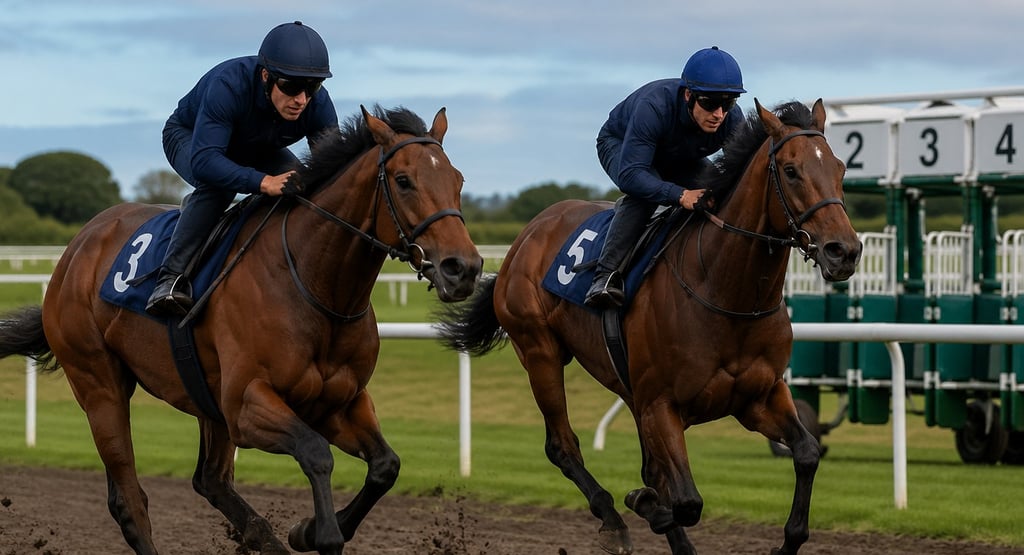
There is a peculiar British conviction, deeply held and seldom examined, that any innovation in racing must have been invented here, ignored for forty years, and reintroduced with a sponsor attached. Barrier trials, that quietly successful Australasian institution, sit awkwardly outside the tradition. They were not invented here by Gary Witherford or anyone else. We do not pretend they were. We simply pretend we already do them, which is worse.
Walk onto a British racecourse on the wrong morning and you can see the covert version. A small string at Lingfield jumping out of the stalls in the home straight, the lads in body protectors and old fleeces, the surface cold enough to throw mist where the hooves cut in. A returning chaser at a jumps track being asked four questions over schooling fences, audibly puffing. An unraced two-year-old at Newbury having a "racecourse gallop" in front of three pensioners, a vet, and a man with a stopwatch who knows things you do not. We have something that closely resembles barrier trials. We schedule them inconsistently, publish almost nothing about them, and treat the whole exercise as a private rehearsal to which the paying public is not invited. The British insider has always preferred a closed loop to an open record, and the morning gallop is the latest place that preference shows itself.
This matters more than it sounds.
The problem already in the programme book
Field sizes in the lower handicap grades are slipping, and slipping for understandable reasons. Trainers complain, accurately, that there is nowhere appropriate to run a horse who is unraced, returning from injury, learning the trade, or simply not yet ready to be tested at race intensity. The default escape route is to enter the animal in a Class 6 four-runner on a wet Tuesday at Southwell, where it will either win unimpressively or finish a respectable fourth, and either way contribute nothing useful to the form book and very little to spectator value. The handicapper assigns a mark on evidence the handicapper does not really believe; the punter prices it on evidence the punter knows is not really evidence; and the form book proceeds politely with the fiction.
Meanwhile, the same racecourses sit dark for substantial portions of the week. Catering staff are stood down, stewards' rooms locked, cameras and timing infrastructure that were expensive to install gathering dust. By any reasonable estimate, the industrial plant of British racing is being run at well under its operational capacity for output that, on the racecard side, is becoming visibly thinner. A formal trial programme, properly designed, is one of the few genuinely additive ideas left on the table that does not require an act of Parliament, a levy review, or another consultancy report whose third recommendation is a further consultancy report. It uses existing capital, borrows existing staff, and pulls a problem out of the racecard and puts it where it has always belonged.
What the southern hemisphere worked out
In Sydney, the trials at Randwick and Rosehill are televised, sectionally timed, written into the form book, and watched by a small but serious constituency of punters who treat them as the qualifying laps of a Grand Prix grid. In Hong Kong they run them at Sha Tin and Conghua with such precision that the trial sectionals are themselves a respected analytical product. New Zealand operates a similar system. Conventions vary; the principle is consistent. Trials are scheduled, filmed and published, and the form book is the better for it.
The British informal equivalents are excellent in intent and erratic in execution. Newbury runs a respected racecourse gallops scheme. Lambourn and Newmarket open mornings draw thousands of paying customers into the cold dawn for the simple pleasure of watching horses work. Schooling sessions at jumps yards are staged routinely. Stalls tests happen quietly at training centres. None of this is secret. Very little of it is systematic. Footage is sometimes available, sectionals sometimes published, horse identities sometimes confirmed. Sometimes is the operative word, and it is the wrong one for an industry whose primary product is information.
The honest diagnosis
The most useful thing one can say about British barrier trials is that they exist. The second is that almost no one outside the relevant yard reliably knows they have happened. The third is that information leaks unevenly, to whichever insider holds the better address book. This is not an integrity scandal so much as something duller and slower-acting: an information asymmetry built into the architecture of the sport.
Owners pay for racecourse gallops. Trainers schedule them around the right surface and the right operator. Reports filter through the closed loops of the yard, the agent, the betting friend and the well-briefed correspondent. By the time the horse appears on a racecard six weeks later, the people who matter, in the narrow sense of those who bet large, broadly know what to expect. The people who do not matter, in the broader sense of those who buy the sport, are still trying to work out why the unraced filly is 4/1 favourite on her debut when her pedigree page suggests 16/1 would be a generous offer.
This is not how a regulated sport with a public form book is supposed to function. It is how a private members' club functions. One suspects British racing has historically been more comfortable with that framing than it has been willing to admit.
Trials as raceday supplement, not raceday substitute
The proposition here is deliberately not the one that would frighten the BHA most, which would be replacing fixtures with trials. Britain has too many fixtures already, and fixture rationalisation is its own argument, the successful prosecution of which requires negotiating sense out of the ARC–Jockey Club–RCA triangle, an exercise of comparable yield to herding Schrödinger's cats.
Instead, this is the modest version. Adopt a formal trial framework. Run it on existing infrastructure on mornings already dormant. Treat it as a supplement to the raceday programme — a low-cost evidence product that turns empty mornings into useful information.
The two codes need slightly different things from such a system. On the Flat, the trial answers the questions of the unraced two-year-old, the returning older horse, and the candidate for a step up in trip — questions currently answered badly in thinly-attended Class 5 and Class 6 races. Over jumps, it answers the questions of the novice's jumping, the returning chaser's wind, and the bumper graduate's rideability — questions currently answered half-honestly in weak novice events. In both codes the benefit is the same: less guesswork in the racecard proper, less waste in the lower grades, less pretence that everything which happened at 14:25 was real.
A pilot, in concrete terms
A workable British pilot need not be complicated.
Four venues, one for each requirement. Newbury, whose existing racecourse gallops scheme and Flat heritage make it the obvious lead.Newcastle and Lingfield, whose all-weather surface offers year-round running irrespective of the British February. A jumps venue — Wincanton, Plumpton or Kempton — to ensure both codes are represented from the outset.
Four classifications, declared in advance and printed on the published programme: educational, for inexperienced or quirky horses learning the trade; fitness, for those returning from layoff; qualification, demonstrating minimum competence for race entry; and public, effectively a prep run that may carry form weight. The classification is not a marketing choice but the basis on which form is read, the market priced, and the trial audited against its declared purpose. A short, fixed list of published outputs. Full video. Sectional times. Going and distance. Stewards' notes. Veterinary observations where appropriate. Jockey, trainer, owner. Nothing more is needed; nothing less is enough.
A funded twelve-month pilot, underwritten by the Racing Foundation, the levy, or both, with a costed budget that, given the use of existing infrastructure, ought to be measurable in the low six figures rather than anything frightening. Streamed on Racing TV's existing pipe. Reviewed at twelve months against four measures: effect on field sizes in adjacent races, form-book improvement, market behaviour, and welfare flags. Expanded if it works. Refined if it does not.
The objections, briefly
The objections deserve serious answers, briefly given.
Cost is marginal. Cameras and timing infrastructure exist at the major venues, staffing is a half-day, and the racecourses gain morning revenue from catering, hospitality, and owner experience, however modest. A pilot ought to cost less than a single Group race purse.
Weather is real. The all-weather venues exist precisely for this reason. Jumps trials are weather-vulnerable but no more so than current schooling, which already adapts.
Audience demand is disputed but not honestly absent. The Newmarket and Lambourn open mornings already prove that British racegoers will watch horses work in the cold dark for the price of a bacon roll. Sky Sports Racing's morning gallop coverage during Royal Ascot week pulls viewers it is not supposed to pull. Framing matters more than proposition.
Integrity is improved, not undermined. Trials place evidence on the public record. The current opacity is the integrity problem.Trainer resistance is predictable and partly legitimate. The biggest yards prefer the existing asymmetry. The honest answer is to make participation voluntary at the pilot stage, classify trials clearly so bad work is not over-interpreted, and let the form-book benefit do the slow work of persuasion.
Welfare, carefully framed, is improved. A horse that does not need to win a Class 6 to demonstrate fitness is a horse less likely to be asked an unreasonable question on the racecard. Data rights are the genuinely thorny one. Ownership of trial sectionals — racecourse, BHA, broadcaster, or some shared model — must be settled before the first stalls open, or the pilot will founder on the same dispute that has stalled half the industry's modernising efforts.
The likely fate
A modest prediction. The proposal will be received politely. It will be referred to a working group chaired by someone who has not been on a racecourse before noon since 1997. A consultation will be launched. The consultation will recommend a pilot. The pilot will be approved subject to funding. The funding will become a dispute between the BHA, the RCA and the racecourse groups about who pays for the cameras. Eight years from now a single trial morning will be staged at Lingfield, attended by four people, broadcast nowhere, and quietly absorbed into the existing racecourse gallops scheme without any of the data publication that gave the idea its point.
I would prefer to be wrong, and occasionally I am.
The cleaner alternative is to do what the other jurisdictions did. Pick three racecourses. Pick a morning. Run a programme of properly classified, properly declared, properly measured, properly published trials. Stream them on infrastructure already paid for. Integrate the data into the form book within a season. Review at twelve months. The mornings are already there. The horses are already there. The cameras are already there. The audience, properly addressed, is almost certainly there. What is missing is the institutional decision to stop treating morning work as a private rehearsal and to start treating it as the useful, transparent, supplementary product it has plainly always been.
Or we can carry on running four-runner Class 6s on Tuesdays at Southwell, and calling the result form. Mornings tend to reward those who turn up. We have the mornings, the horses and the cameras. What we lack is the modest courage to switch the lights on, open the gates, and admit the public to a rehearsal we have been quietly conducting, with reasonable competence, for the better part of a century.