All Bets Covered — Except the Tax One
Michael Dugher quits the gambling lobby at the exact moment the Treasury cashes in.
HORSE RACINGPOLITICS
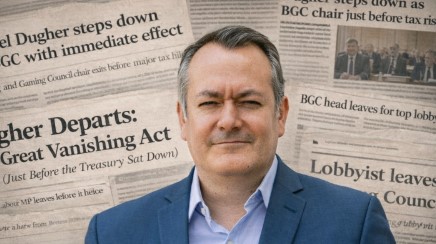
Michael Dugher has slipped away from the chairmanship of the Betting and Gaming Council with immediate effect—that Westminster phrase meaning “nothing to see here, please stop asking questions”—and re-emerged at Brunswick, where he will run UK public affairs. This is the sort of job where one doesn’t so much do politics as interpret it, like a UN translator for rich people who dislike surprises. Officially, this is a tale of service, standards, and a man “immensely proud” of bringing the gambling industry together. Unofficially, it has the unmistakable aroma of someone pushing back from the table just as the waiter arrives with the bill, smiling apologetically and asking, “Shall we split this?”
Because the curious thing is not that Dugher has gone. It is when he has gone. The gambling industry has just been walloped with serious tax rises, the sort that make accountants go very quiet and trade bodies go very loud. Yet when the Treasury Select Committee convened to grill the sector ahead of Budget 2025, the BGC’s witnesses were Grainne Hurst and Stephen Hodgson. Dugher was nowhere to be seen. Not hiding under the desk. Not stuck on a delayed train. Simply… absent.
This is not a crime. But it is odd. If your industry is facing what it calls an existential threat, you generally want the chair in the witness chair, not watching on Parliament TV with the sound down. In politics, presence is half the argument. If you want to stop a train, you don’t send the station announcer. You stand on the tracks and wave your arms about.
Instead, what we had was the chief executive doing the trench warfare while the chair prepared for a dignified lateral move into corporate public affairs. The timing is immaculate in the way only Westminster timing ever is. One could almost admire it.
Dugher’s farewell comments, meanwhile, were vintage. He blamed “ignorance and snobbery about betting,” linked this to the decline of working-class MPs, and warned darkly about the rise of the unregulated black market. This is classic Westminster judo: take a dispute about harm, tax, and regulation, and flip it into a cultural grievance about who’s allowed to tut at whom. It’s an old move, but still effective—rather like shouting “class war” when someone suggests fewer slot machines.
The difficulty is that the industry’s three core claims now sit awkwardly together:
– We’re responsible.
– We’re essential.
– We’re too fragile to pay this much tax.
Pick any two. All three at once and the maths starts to wobble.
Tributes poured in, as they always do. Grainne Hurst praised Dugher’s clarity and standing. Flutter’s Ian Proctor thanked him for “constructive engagement”. Everyone wished everyone else the very best. It reads like a leaving card passed round the office, with the only missing detail being whether the cake was shaped like a roulette wheel or a Treasury red box. The industry’s great fallback argument—the black market—was dusted off once more. And yes, it exists. Yes, it is a problem. But it has also become the regulatory equivalent of “if you make me tidy my room, I’ll go and live with pirates.” Sometimes it’s a warning. Sometimes it’s a threat in a sensible cardigan.
Which is why Dugher’s move to Brunswick feels so perfectly judged. This is not really a departure. It is a promotion: from trade body general to elite persuasion consultant. If you can’t stop the tax rise, you shape how it lands. You soften the language, manage the fallout, and make ministers feel that any alternative would have been worse. That is public affairs in its natural habitat.
The representation problem (or: who’s actually holding the megaphone?)
The BGC will continue to speak, of course. But unity becomes harder when money gets tight. Online firms, retail bookmakers, casinos—all have different pain thresholds. The CEO becomes the lightning rod, which works until the lightning gets serious. The big firms will increasingly go direct, armed with their own studies, their own briefings, and their own quiet lunches.And the more the industry leans into narrative management—jobs, sport, choice, black markets—the more brittle its credibility becomes. People can smell theatre. They always can.
If the sector wanted a genuinely durable argument, it would try something radical: candour. Admit that some products are riskier. Admit that riskier products attract heavier regulation and tax. Admit that “keeping customers safe” occasionally means making less money. That would land better in Parliament than permanent crisis-mode outrage.
So is this a reckoning? No. A reckoning involves consequences. This is choreography.
The bill has landed. Michael Dugher has decided he’d rather be advising on how to argue about it than explaining, under oath, why the industry shouldn’t have to pay it. And if you want the final joke, it is this: At the precise moment the gambling sector needs representation more than ever, its most prominent representative has left the building to become a professional representative of representatives.
Farcical? Perhaps. Efficient? Undeniably. Curtain.